Yannick Nézet-Séguin speaks out about the Vienna Philharmonic’s controversial New Year’s concert
The conductor chose Florence Price's "Rainbow Waltz" for the "personal meaning the rainbow holds for me as the first openly gay man to conduct this concert." The piece plays in the city next year.
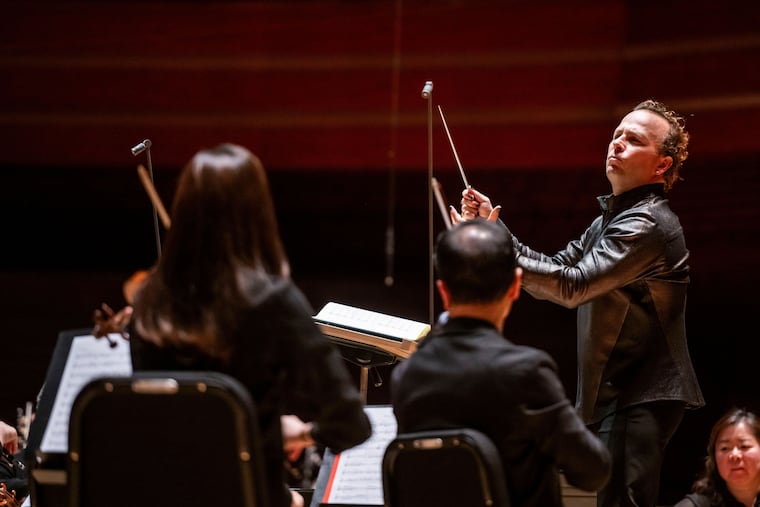
The newsiest element of the Philadelphia Orchestra’s lineup next season isn’t a Wagner opera or the return of conductor Simon Rattle, but a short waltz with a Philadelphia backstory that has drawn international scrutiny.
Florence Price’s Rainbow Waltz from 1939 was hardly well-known until Yannick Nézet-Séguin led what was purportedly a newly arranged and orchestrated version of the piece for classical music’s most popular annual event, the Vienna Philharmonic’s New Year’s Day Concert.
But after the performance — which was broadcast internationally and recorded — critics noticed that the music performed bore little resemblance to Price’s original for piano, and controversy ensued.
For sure, arrangements and orchestrations take liberties. But the character of Price’s music, the distinctly American sound, was nowhere to be found. What made Price Price was erased.
And now another wrinkle in the story has emerged. Nézet-Séguin confirms that the orchestration/arrangement/reinterpretation of Rainbow Waltz played at the New Year’s concert was not the one originally planned. At his behest, the Philharmonic first commissioned an orchestration from Philadelphia favorite composer Valerie Coleman, and, upon receiving her version, rejected it.
And so it turns out the Vienna Philharmonic slighted not just one, but two, Black female composers.
The question now is, why was Coleman’s orchestration set aside? Philadelphians know from Coleman’s long association here that there is zero chance that what she produced was anything other than a substantive, beautiful homage to Price.
Instead of spotlighting Coleman, the Philharmonic performed an orchestration by Wolfgang Dörner, a white male Viennese conductor and musicologist. The piece played on New Year’s Day billed as Price’s Rainbow Waltz was uber-Viennese.
Was Coleman’s orchestration not Viennese enough? Too American-sounding? Too Black?
The Vienna Philharmonic declined repeated requests for comment. A copy of the musical score of Coleman’s orchestration would answer some questions, but the Philadelphia Orchestra, which routinely grants requests to review scores, has declined to make this one available.
The dénouement of this story may have to wait until June 2027, when the Philadelphia Orchestra performs the work here and in Carnegie Hall and listeners can judge for themselves.
Coleman declined to speak about the matter, which may be smart. It would be difficult to overstate the prestige and visibility it means to have a piece played by this orchestra for this event. No composer would want to risk saying anything that would close off the possibility of future work.
Nézet-Séguin also declined to be interviewed about the matter. But in his first extended written explanation since the controversy emerged several months ago, the Philadelphia Orchestra’s music and artistic director said quite a bit:
“When I was invited to conduct the Vienna Philharmonic’s New Year’s Concert for the first time, I immediately wanted to include a work by Florence Price,” he wrote in a recent 400-plus-word note to this reporter. “I was aware that she had written waltzes for piano that could be arranged for this concert, and I suggested her music in my very first conversations with the Vienna Philharmonic. My suggestion was met with great enthusiasm by orchestra leadership, who were already familiar with her music and equally recognized the significance of programming her work.
“I should also note that I specifically chose the Rainbow Waltz because of the personal meaning the rainbow holds for me as the first openly gay man to conduct this concert.”
The inclusion of Price had other significance. It was a testament to what the composer’s music has meant to the conductor’s career and the stature of the Philadelphia Orchestra. A recording of Price symphonies brought both their first-ever Grammy awards, and, even if the orchestra was not the first ensemble to rediscover Price’s symphonic music, having an orchestra of Philadelphia’s prominence and polish advocate for it in the concert hall and on recordings over the past few years has no doubt boosted the composer’s profile.
This concert could have been an image-changing moment for the Vienna Philharmonic, which long resisted allowing women as members. When Price’s music was announced as part of the program, it promised to be perhaps the first time the Vienna Philharmonic has played the work of a Black composer at the New Year’s event.
It’s not clear now that the claim can survive; some are saying that the work played at that concert is so different from Price’s original that it is a “forgery.”
Pianist, composer, and arranger Kevin Wayne Bumpers, whose YouTube video of Rainbow Waltz shot from a few hundred views to more than 10,000 after the Vienna controversy, said he was “dumbfounded” by the Philharmonic’s Vienna-ization of Price. He said he could not detect any of her music in the orchestration that was played.
“She is an American composer of African descent, and that’s the way she writes. She is not Viennese,” said Bumpers, who is on the piano faculty of Miami Dade College. “I would think the Vienna orchestra would have honored that more than anything. Why are you trying to colonize her?”
The historical echoes are exasperating. As a Black woman pursuing a life in classical music in mid-20th-century America, Price encountered exclusion from the establishment, even after becoming the first Black woman to have a work played by a major American orchestra (the Chicago Symphony, in 1933). The appearance of her name at the Vienna Philharmonic’s New Year’s Concert in 2026 was an attempt to give worldwide visibility to an important historical Black voice silenced in her time, and yet it ended up silencing two — hers and Coleman’s — in ours.
Nézet-Séguin wrote in his note that “after reviewing Valerie’s arrangement, the Philharmonic felt the writing for brass and percussion was too prominent, and that it wouldn’t fit the style of the New Year’s Concert program.”
“During the preparation process, the orchestra ultimately chose to proceed with a different arrangement by their regular arranger, Wolfgang Dörner. As a guest conductor — not their music director — I accepted that decision, as it’s their production and they are the experts in that style.”
In any case, Coleman’s impressive body of work over several decades, starting with her role as both flutist and composer for Imani Winds, speaks for itself. She has not served as the Philadelphia Orchestra’s composer in residence, but for all that she’s done here, she might as well have had the title. It was Coleman who captured the spirit of a tricky, vulnerable time with Seven O’Clock Shout, an anthem written in 2020, just weeks into the pandemic, which stirringly evoked the ritual of cheering frontline workers on their way to their shifts.
Her Umoja: Anthem of Unity is so fresh, it is the sound of life itself. Astonishingly, when the piece premiered, it was the first time the Philadelphia Orchestra had ever performed a classical work by a living female African American composer. It was 2019.
In This Is Not a Small Voice for soprano and orchestra, Coleman matched words by Philadelphia poet Sonia Sanchez to sensitive, powerful orchestrations in a way that magnified the meaning of both. This is what great composers do, from Bach to Schubert to Mahler.
There was a moment available to Vienna of great historical resonance, pairing Price and Coleman, two rarities — Black women composers — speaking to each other nearly a century apart. Nézet-Séguin’s instincts were absolutely correct that Coleman was the right person for the job. Her orchestration, the conductor says, “reflects the American sonority.”
I’m eager to hear how Coleman handles this deceptively sophisticated piece — simple and easygoing, yet glowing with complex harmonies and a main melody as elusive as, say, a rainbow.
Come June 2027, when Coleman’s version of Rainbow Waltz finally gets its debut, it’s a pretty sure bet that it will land as a gift to Philadelphia so generous we will only be able to say:
Thanks, Vienna.