The Philadelphia Orchestra next season premieres a ‘new’ piece by Leonard Bernstein. Plus, Simon Rattle is coming back.
The orchestra will perform Bach's 'Christmas Oratorio' for the first time, and much-loved pianist Emanuel Ax has a special role in the 2026-27 season.
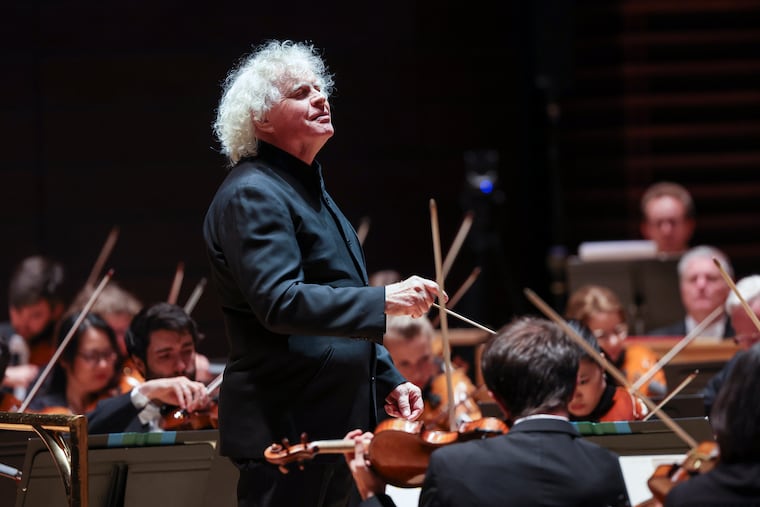
Simon Rattle is returning to the Philadelphia Orchestra after a decade. New works are being unveiled by Spirited Away composer Joe Hisaishi. And a major orchestral piece by Leonard Bernstein is receiving its world premiere — sort of.
The Philadelphia Orchestra’s 127th season will be a mix of standard repertoire, newly minted scores, film music, family concerts, and guest artists new and familiar.
Emanuel Ax has been dubbed “artist of distinction” for the season, the orchestra said in its announcement of 2026-27 artists and repertoire unveiled Thursday. The much-loved pianist makes both recital and concerto appearances to celebrate his half-century-plus history with the orchestra.
Several big, ambitious pieces anchor the season in Marian Anderson Hall.
The Philadelphians will perform their first-ever complete Bach Christmas Oratorio. Following on the heels of last season’s Tristan und Isolde, the orchestra takes on Wagner’s Lohengrin for the first time. Beethoven’s Symphony No. 9 is on the roster, as are four Mahler symphonies — Nos. 1, 3, 5, and 7.
Lohengrin, like the Tristan, will be led by music and artistic director Yannick Nézet-Séguin.
“He’s always able to attract the people that are known for these roles,” Jeremy Rothman, chief programming officer for the Philadelphia Orchestra and Ensemble Arts, said of the cast of singers. Tenor Stanislas de Barbeyrac takes the role of Lohengrin, with soprano Elza van den Heever as Elsa.
“It’s the kind of thing that really only the Philadelphia Orchestra can do — attracting this talent with Yannick conducting with this level orchestra,” said Rothman.
Nézet-Séguin will lead 12 weeks of programs in 2026-27 (plus special concerts), with podium appearances by Esa-Pekka Salonen, Anthony Parnther, Dima Slobodeniouk (his debut here), Jane Glover, Fabio Luisi and others.
Marin Alsop, the orchestra’s principal guest conductor, leads three weeks of programs plus special concerts.
Guest soloists include pianists Yunchan Lim and Seong-Jin Cho in Rachmaninoff, Nikolaj Szeps-Znaider as both violinist and conductor, violinist Arabella Steinbacher in Beethoven, Yefim Bronfman in Schnitke and Liszt, Daniil Trifonov performing Prokofiev, and Yuja Wang in Beethoven.
The Spotlight recital series continues with artists like Yo-Yo Ma, Yuja Wang, and Itzhak Perlman.
Among the premieres, or first performances by the Philadelphia Orchestra, are works by Reena Esmail, Julia Wolfe, Unsuk Chin, Anna Meredith, Erkki-Sven Tüür, Gabriela Ortiz, and Caroline Shaw.
Film music once again threads throughout the season, with live orchestra-to-screen presentations of Star Wars: A New Hope and Harry Potter and the Prisoner of Azkaban. Film concerts are often a sell-out for the orchestra, but they are also a lure for new audiences who later buy tickets to regular orchestra concerts, said Ryan Fleur, president and CEO of the Philadelphia Orchestra and Ensemble Arts.
If past statistics are a reliable guide, the orchestra will sell 6,000 tickets to next season’s Star Wars program. About 4,000 of those listeners will be people who had not bought an orchestra ticket previously. Of those, 20% will come back for a straight orchestra concert in the following year and a half.
“It’s pretty consistent data now that we’ve seen over the last few years,” said Fleur.
“Gateway” is the word the orchestra uses to describe concerts like those with film, or the shorter, informal Orchestra After 5 concerts, which also continue next season.
“It’s programs that are accessible as a first date,” said Fleur.
The season-wide average ticket price next season is increasing about 2.5% due to a higher share of premium, or special, programs, a spokesperson said.
Another film-adjacent presence next year is Joe Hisaishi, the orchestra’s composer in residence best known for his work on the animated films of Hayao Miyazaki (My Neighbor Totoro, Castle in the Sky). Hisaishi’s Orbis is the very first work heard next season, prefacing Beethoven’s Symphony No. 9 on opening night, Sept. 24. In the spring, Hisaishi leads the world premiere of his own Piano Concerto with Alice Sara Ott as soloist on a program with his Concerto for Orchestra.
Rattle’s concerts, in January 2027, feature familiar territory: John Adams’ propulsive and emotional landmark work from 1985, Harmonielehre; Debussy’s La Mer; and the Ravel Daphnis et Chloé Suite No. 2.
Why these particular pieces?
“We didn’t have an in-depth discussion about it,” said Rothman. “When Simon wants to bring a program here, we trust him with what he knows [is] going to work really well with this ensemble.”
More novel for both performers and audience is a Marin Alsop program that includes the world premiere of The Party, a collaboration between composer Austin Fisher and conceptual artist Alex Da Corte. The artistic forces include the orchestra, a cast of singers, and life-size sculptures inspired by 1960s artist Marisol Escobar in a stop-motion film.
Rothman calls the work, which was commissioned by the orchestra, “a really novel way to present opera, where you have the singers and the orchestra live on stage, but all the action is taking place up on the screen.”
The Party is on a program with Pacific 231, Arthur Honegger’s classic 1923 depiction of a train accelerating, then grinding to a halt; and Haydn’s Symphony No. 101, “the Clock.”
“It’s a way of exploring the depiction of time,” said Rothman of the three pieces.
Rothman was responsible for the creation of one of the season’s most intriguing creations: a “new” work by Leonard Bernstein.
“I was thinking about how Mass has some of his most beautiful music in it,” said Rothman, “but just the scope of that work means that music is rarely ever heard live because of the forces that are required to mount it.”
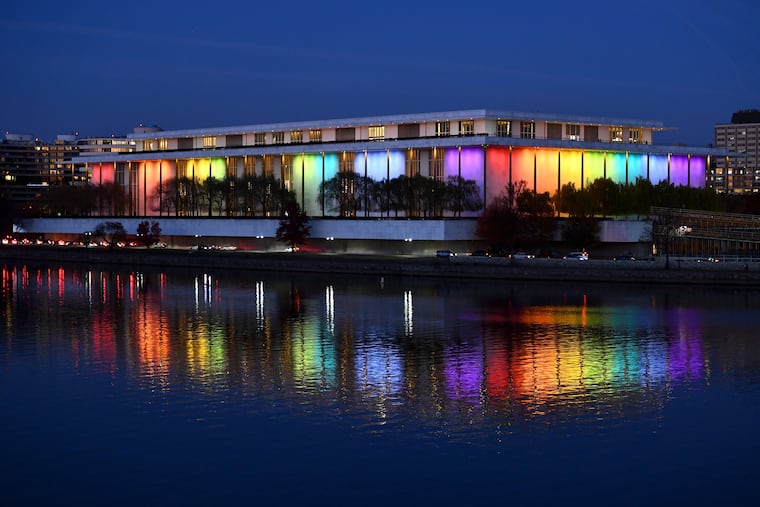
He conceived of a symphonic suite made of material from Mass, the musical-theatrical piece commissioned by Jacqueline Kennedy that premiered in 1971 at the opening of the John F. Kennedy Center for the Performing Arts.
“So I reached out to the kids,” said Rothman, referring to Bernstein’s three children, “and I said, ‘What do you think of this idea?’ And I got back like an immediate, ‘Oh my God, we love it. Let’s do it.’”
Garth Edwin Sunderland, a composer and vice president of creative projects at the Leonard Bernstein Office, was engaged to create Symphonic Rituals from Mass, which contains about 40 minutes of music — a “new” work drawn from Bernstein’s original colorful, groovy score.
“It’s still paying homage to the sacred nature and the ritual of the piece, but bringing all that fantastic musical material into the orchestra, so no vocalists, no choirs,” said Rothman. “There will be a little bit of a rock band because that’s so essential to the core essence of the piece.”
Nézet-Séguin was, of course, the perfect choice to conduct. He’s been an enthusiastic champion of Bernstein’s music and was involved in the Bradley Cooper movie about Bernstein, Maestro.
“I texted Yannick,” said Rothman, “and I said, ‘Yannick, how would you like to give the world premiere of a piece by Leonard Bernstein?’ And he goes, ‘What? What are you talking about?’"
Philadelphia Orchestra 2026-26 subscriptions go on sale at noon Thursday, with single tickets available July 30. ensembleartsphilly.org, 215-893-1955.