The U.S. Postal Service is among the many things we can thank Ben Franklin for
As Philadelphia's postmaster and then postmaster general of the colonies, Franklin turned mail delivery into a 24-hour operation and used it as a means to spread the word of the American Revolution.
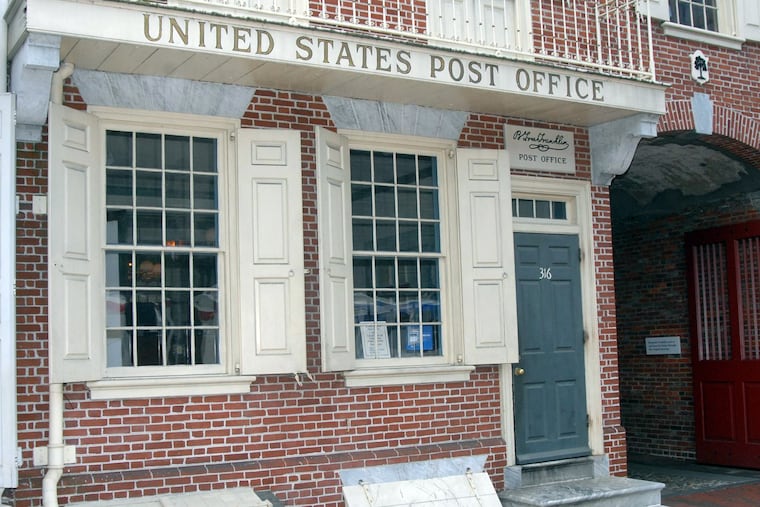
In 1728, Andrew Bradford was appointed Philadelphia’s postmaster. He stayed in that position until 1737, when British authorities fired him for poor mail service and cooking the books.
In his place, the monarchy hired Ben Franklin, a model American and British loyalist, whose work in Philadelphia laid the groundwork for him to become the postmaster general of the United States, in 1775.
The Philadelphia Historic District will celebrate Ben Franklin becoming Philadelphia’s postmaster general on Saturday at Franklin Court at its weekly “Firstival” day party. Firstivals, a part of the city’s 52 Weeks of Firsts celebrations, are fetes honoring American — and world — firsts that happened in Philadelphia.
As Philadelphia’s postmaster, Ben Franklin, also the founder of the Pennsylvania Gazette, mailed his newspapers to readers at no cost, said Nicholas Guarino, an interpretation park ranger at Independence National Historical Park. In awarding himself free postage, he was able to build a wide circulation, making his newspaper one of the most popular in the country.
Franklin did such a good job for the Crown that in 1753, it appointed him postmaster general of all 13 colonies.
In his role, he established mail routes along the Eastern Seaboard, set a schedule for quick mail delivery, and authorized couriers to deliver mail during the day and night.
Franklin instituted the practice of delivering mail to people’s homes and created a space for dead letters, mail that could not be delivered but could be recovered.
He also set up a flat rate so that newspapermen could send out papers and pamphlets. Quick and accurate delivery of information in an emerging democracy would prove crucial in the formation of the Continental Army and building the new republic.
“Franklin had an egalitarian approach to mail,” Guarino said. “[He] believed that it was important that a just society flourish from its foundation. His work as postmaster aligns with his other civic work, like starting the lending library, the Pennsylvania Hospital, and the volunteer fire department.”
» READ MORE: Yes, John Bartram founded America’s first botanical garden. He also created the first subscription box for gardeners.
By the mid-1700s, the British government was intercepting colonial mail because they heard whispers of rebellion. Colonists soon got disillusioned with British rule and the monarchy and Franklin switched his allegiance. The mail then became a vehicle through which he spread his message of revolution.
Franklin’s sympathies for American freedom led Britain to dismiss him in 1774.
The following year, on July 26, 1775 — three months after the first shots of the Revolutionary War were fired — Ben Franklin became the first postmaster general of the nascent United States Post Office, established by the Second Continental Congress.
“He began stamping the mail with ‘B. Free Franklin,’” Guarino said, ”spreading his message of revolution in a subtle way."
Franklin served as the newly forming country’s first postmaster general for a little over a year before the Continental Congress sent him to France to solicit the country’s support in the Revolutionary War. Franklin’s son-in-law, Richard Bache, took the job.
In 1787, the Founding Fathers wrote the Constitution, granting the government the power to create a postal system. Five years later, President George Washington signed the bill creating the United States Post Office Department, the foundation for the modern postal system.
“They felt a postal service was important for new ideas and economic prosperity to flourish in the new nation,” Guarino said.
The post office was part of the presidential cabinet until July 1, 1971, when then-President Richard Nixon signed the Postal Reorganization Act, transforming the United States Mail into an independent for-profit entity we now know as the U.S. Postal Service.
This week’s Firstival is Saturday, April 25, 11 a.m.-1 p.m., at Franklin Court, 322 Market St. Each week, The Inquirer is highlighting a “first” from the Philadelphia Historic District’s 52 Weeks of Firsts program. A “52 Weeks of Firsts” podcast, produced by All That’s Good Productions, drops every Tuesday.