Choreographer Rennie Harris grew up wanting to be a priest. Now he is questioning beliefs in a world premiere piece.
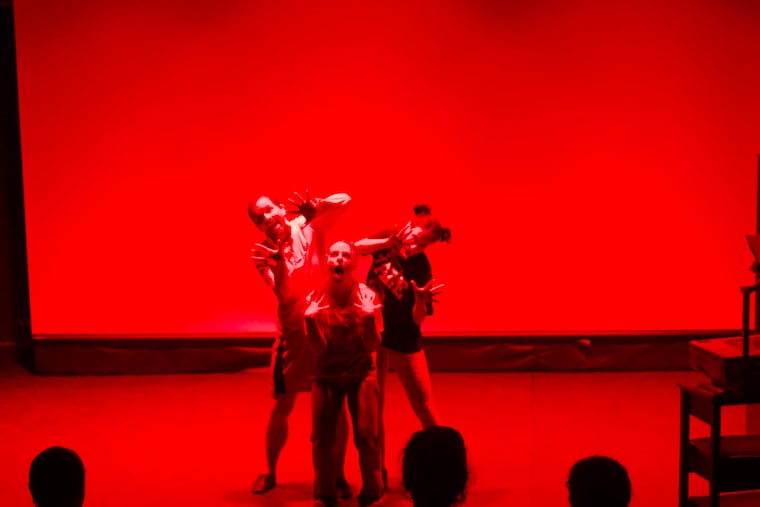
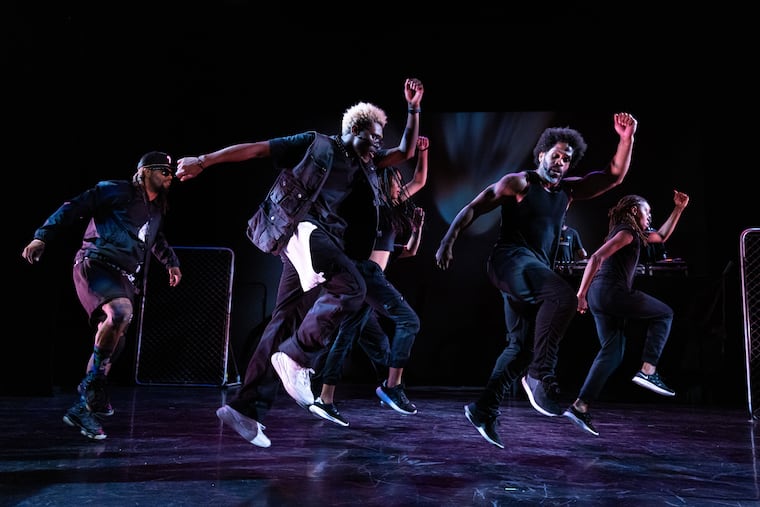
Harris' "Losing My Religion" uses breaking, hip-hop, house, and other street dance styles to interpret the many fragile belief systems people hold. Be it religion or sports fandom.
As children, we adopt many things we are taught as truth, choreographer Rennie Harris said. We say the Pledge of Allegiance in school, sing the national anthem, maybe go to religious services on weekends.
“When I say all those things had been ingrained in me as a child, it had been to a whole other level of, I think, patriotism,” he said. “This generation — even the ones a little bit behind me — wouldn’t understand how we were raised in that way.”
But over time, “you realize that there’s some things that are not exact — and that’s putting it lightly.”
The choreographer, who specializes in street dance with his company, Rennie Harris Puremovement, is highlighting these concepts in his world premiere of Losing My Religion. It will be presented this week as part of the America Unfinished series, which is marking the country’s Semiquincentennial, at the Annenberg Center for the Performing Arts.
The piece is also part of the third and final year of Harris’ residency at Penn Live Arts, which presents artists at the Annenberg.
Harris knows the title of the piece, Losing My Religion, may raise some eyebrows. He’s OK with that. His definition of “religion” includes any beliefs we hold dear.
An example was when he, as a Black American man, was thrown off when he visited Gambia in 1996.
“I remember feeling odd there when I was there,” Harris said, “It felt like people treated me a little different. I couldn’t put my finger on it.”
It dawned on him as he sat drinking in a speakeasy.
“I was talking to this cat. I think he was from Ghana,” said Harris.
“You think I’m white, don’t you?” Harris asked him.
“He said, ‘Yes, you are white. If you’re American, you’re white. You’re not African.’”
“Here I was going back, as many of us do — we glorified and romanticized going back. That has been squashed and I have no place in the world. There’s a major sense of not belonging anywhere.”
Another example of “religion” is prevalent in Philly, said Harris, who was wearing a Phillies ball cap during the interview.
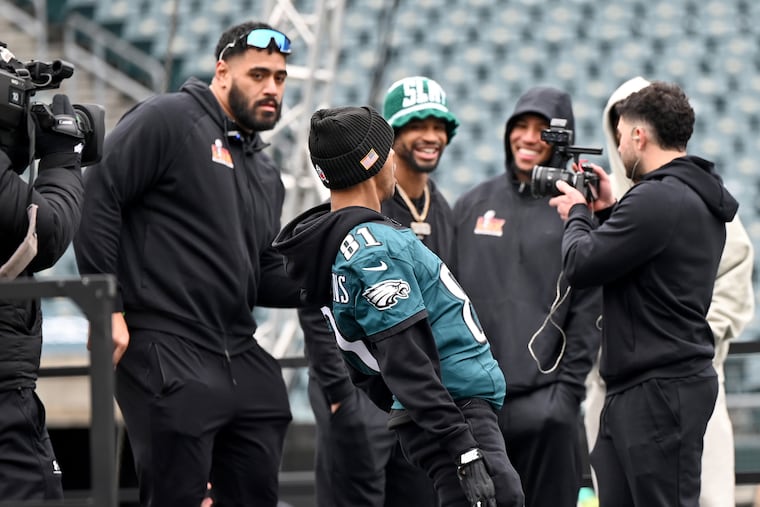
“It’s like the Eagles in Philadelphia,” he said. “It’s a religion all day. The Eagles, Phillies, whatever, it is a religion.”
But all these concepts can be fragile.
“It’s like finding out it was all a sham after you worship so long. And I don’t want to say, ‘worship’ like, blindly, but just being taught a particular culture, and then to find out there is none.”
Religion, of course, can also have a more straightforward meaning. Harris grew up Catholic and attended Gesu School in North Philadelphia and then Center City’s Roman Catholic and University City’s West Catholic high schools.
Growing up, he wanted to become a priest. On weekends and in the summer, he’d study toward achieving that goal at Divine Word Seminary, then located in Bordentown.
But Harris was interested in history, and he wanted answers. He wanted to know about things like the Inquisition, and there were no satisfying answers. In the end, he found his calling in dance.
“I wouldn’t call it, ‘I denounce the church [or] anything,’” he said. “I studied Rastafarians for a minute, and considered myself Rastafarian for a second. I thought about Buddhism. I roamed around in that department for a second.
“And then, as I got older, realizing, ‘It’s all the same.’ There’s some spiritualism within it. There’s some stuff ... that’s controlling in each. It’s like, ‘be good to people.’ It’s very simple. And I realized I didn’t really fully need a religion to back that.”
All of that inspires Losing My Religion, as does the eponymous R.E.M. song. It’s one of Harris’ favorites, though it is not in the piece.
» READ MORE: There’s a bit of Philly everywhere, even in Milan’s La Scala
The movement in the piece uses a combination of breaking, hip-hop, house, and other street dance styles.
This work, like most of his others, leans into the Black experience. But it’s not meant for kids, Harris said. After last year’s American Street Dancer, which he called “completely entertaining,” he wants to return to making a statement.
In the early days of his company, he said, “I was doing political work: religion, sex, or all kinds of crazy activism. I used to purposely put all the harder pieces in for the first half.”
Rows of audience members walked out.
“I felt like we were weeding,” he said. “We called it ‘the walkout half,’ because ... if you couldn’t go through the culture and what the people are going through ... you didn’t deserve to see the acrobatic, flipping, spinning, all the dynamics.
“If I wanted to just do entertainment, I would have focused on having an agent and just doing Broadway.”
Rennie Harris Puremovement in “Losing My Religion.” March 19-21. Zellerbach Theatre, Annenberg Center for the Performing Arts. $45-$93. 215-898-3900 or pennlivearts.org.