Market East’s Lits Building is taking us back to the Centennial with America’s first typewriter, telephone, popcorn, and seltzer
A new initiative makes sure 1876 isn’t forgotten in the 250th hoopla. Frederick Douglass, Elizabeth Duane Gillespie, and Susan B. Anthony all played a major role in the celebrations.
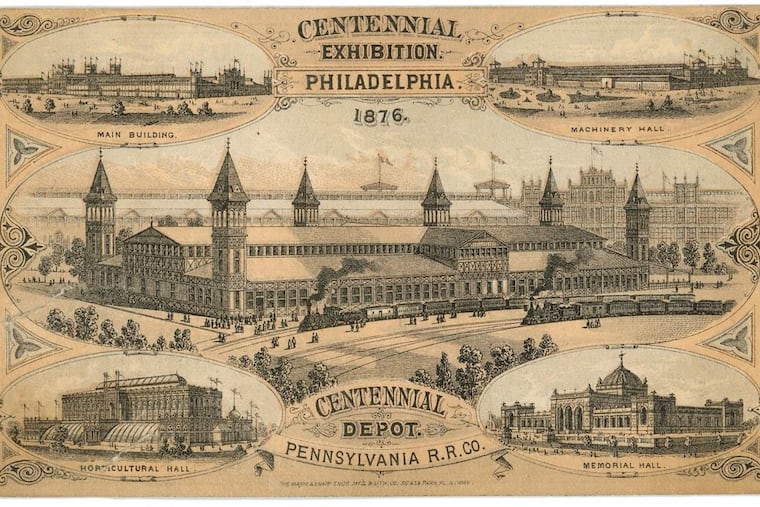
This summer, Market East’s Lits Building — the former home of Ross Dress for Less — will house replicas of technological products that debuted 150 years ago at Philadelphia’s 1876 Centennial Exhibition, North America’s very first World’s Fair.
In time for the Semiquincentennial, "Revisit 1876" will connect our world today to all the ways in which it draws from that seminal event. A facsimile of Alexander Graham Bell’s telephone — introduced in Philadelphia at the 1876 fair — will be on display next to wall graphics linking its story to the evolution of smartphones.
A Remington typewriter — the first apparatus with the QWERTY keyboard that 19th-century fairgoers used to type postcards for their loved ones — will be presented as a precursor to the laptop and all our social media apps, especially Instagram.
Those postcards of yesteryear are like the images we capture on our phones today and post on social media seconds later, said Paul Levy, executive director of the Center City District Foundation, the nonprofit arm of the Center City District that is producing Revisit 1876.
“In celebrating America’s 250th, we wanted to look back at the things that got us here, Levy said. “The ‘then’ and ‘now’ will connect Philadelphia to its past and recapture history that has been forgotten,” Levy said.
Like this year’s Semiquincentennial, America’s Centennial celebrations were also years in the making. Planning started in 1866 when John L. Campbell, an Indiana math professor approached Philadelphia city officials with the grand idea to celebrate America’s 100th birthday through the lens of America’s advances in science and technology.
Philadelphia was not only America’s birthplace, it was by many accounts, the center of the world’s second industrial revolution as shiny new factories were being built throughout the city, making everything from clothing to car parts.
The Centennial Exhibition opened May 10, 1876, with a welcome address from President Ulysses S. Grant. Ten million visitors from 37 countries descended upon Philadelphia for 172 days, many of whom lined up along Market Street in front of John Wanamaker’s spanking new Wanamaker’s Department Store. Wanamaker’s opened just two months before the Centennial Exhibition began.
Philadelphians took shuttles from the then-pristine East Market Street to West Philly’s Centennial Campus, where 200 new buildings sat on 450 acres of fairgrounds, including Memorial Hall, now home to the Please Touch Museum.
Not only did fairgoers get to experiment with the telephone and the Remington typewriter, they also climbed the right hand of the not-quite-finished Statue of Liberty. Earlier that year, French artisans had started building the massive statue and sent the finished arm holding the torch to the Centennial Exhibition.
“Part of the Statue of Liberty stopped in Philly before making its way to Liberty Island,” Levy said, in a very “Isn’t this cool?” kind of way. “The French wanted to both generate publicity and raise funds.”
Fairgoers calculated sums on mechanical calculators, rode the monorail — the single-track train that, today, transports people around amusement parks — and celebrated the Baldwin locomotive, by a Philly-based train manufacturer that helped revolutionize how Americans traveled.
And they were treated to their first tastes of popcorn, ketchup, and seltzer.
“There is so much relevance between yesterday and today,” Levy said. “We are paying homage to science, technology, and industrial prowess of our nation at a pivotal time.”
America was at the dawn of major social change in the 1870s, much like today, Levy said. “Revisit 1876″ will address that, too.
In the year after former President Rutherford B. Hayes ended Reconstruction, America was creating an industrial landscape without the slave economy while actively resisting Black people’s pleas to treat them with humanity.
The formerly enslaved abolitionist Frederick Douglass was invited to speak at the opening day celebrations and share a platform with President Grant. “But he was stopped by the Philadelphia police from entering. When they realized who he was, he was invited up on stage, but was not allowed to speak,” said Levy.
Ben Franklin’s great-granddaughter Elizabeth Duane Gillespie raised over $30,000 — almost $1 million today — for a Woman’s Pavilion at the fair after male organizers refused to pay for one. After she was denied a speaking spot during the July 4, 1876, festivities, early suffragist Susan B. Anthony crashed the ceremony at Independence Hall and read the Declaration of Rights for Women of the United States.
Those stories will be told in panels at “Revisit 1876.”
“It’s not an either or,” Levy said. “It’s telling both stories.”
“Revisit 1876″ will be situated near several pop-ups along Market Street owned by Comcast and Harris Blitzer Sports & Entertainment and implemented by Center City District and Interface Studio Architects to spruce up Market Street East for the Semiquincentennial.
The idea for “Revisit 1876″ bubbled up last summer during a conversation between Levy and Paul Steinke, executive director of the Preservation Alliance of Greater Philadelphia. The two men wanted to make sure the Centennial wasn’t forgotten in the 250th hoopla.
Levy met with Mark Merlini, managing partner of Brickstone Realty, the firm that owns, operates, and manages the Lits Building. Merlini agreed to donate the space, the home of Lits Bros. Department Store from 1891 to 1977. The building has been on the National Register of Historic Places since 1979.
From there, Levy connected with Tim Durkin, a vice president at the nonprofit Connelly Foundation, to fund the planning and design of “Revisit 1876.″ Durkin presented the idea to the Philadelphia Funder Collaborative for the Semiquincentennial, which granted $250,000 to the effort. Levy collaborated with Drexel University’s Lenfest Center for Cultural Partnerships to gather the images, text, and history that will be showcased in “Revisit.”
Art Guild in West Deptford will do the build-out, and starting in early June, will transform the Lits Building’s lobby into a gleaming 8,000- square-foot exhibit space.
Elements from the 1876 World Fair’s marquee buildings — Memorial Hall, Main Building, Machinery Hall, Agricultural Hall, Horticultural Hall, and the Woman’s Pavilion — will be recreated on the walls and display tables.
Replicas of Bell’s telephone will be housed at the welcome desk, a converted sales counter that will greet visitors as soon as they walk in. “Revisit” is slated to open at the end of June and remain open through the end of 2026.
“Philadelphia in 1876 marks the beginning of the Philadelphia we know and love today,” said Levy, who coincidentally moved to Philadelphia in 1976, the year of the Bicentennial.
“The goal of ‘Revisit 1876’ is to see the role Philadelphia and the Centennial played in so many things we take for granted today, whether it’s eating popcorn in movie theaters or talking on the phone.”
For more information on “Revisit 1876,” visit centercityphila.org.
An earlier version of the article misstated the location of the Statue of Liberty. It stands on Liberty Island.