‘Dream Girl’ at IRC: A dull, lifeless trudge
Maybe the play is dated, or the acting overdone, or maybe the venue just swallows up all the dialogue, but whatever the reason, this comedy doesn't have a dream of a chance.
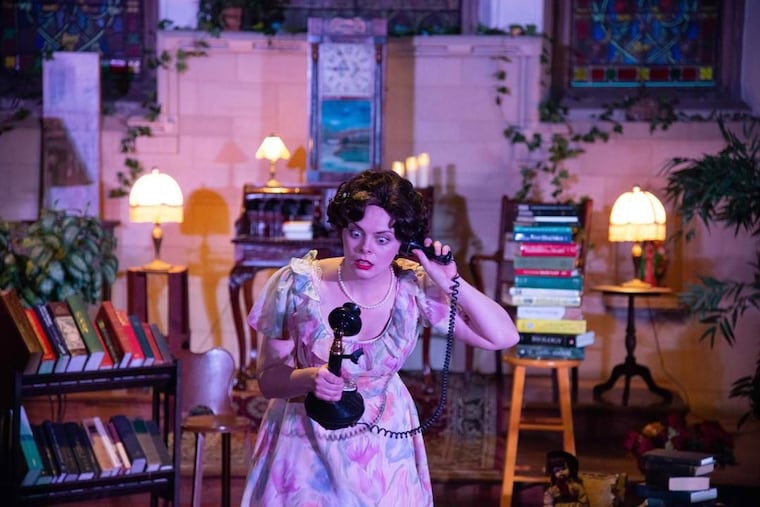
Leave it to Tina Brock to unearth Elmer Rice’s Dream Girl. The comedy opened on Broadway in 1945, and the copy from my town library was last checked out in 1963. Perhaps this is one of those leave-well-enough-alone moments. Idiopathic Ridiculopathy Consortium (a.k.a. IRC) is Brock’s eccentric company, specializing in rediscoveries and reinvigorations since 2006. Lately, the company has moved from the European absurdists to the American nostalgists: IRC’s recent brilliant production of Tennessee Williams’ Eccentricities of a Nightingale turned out to be the perfect vehicle for its talents and sensibilities.
Unfortunately, Dream Girl is an uphill trudge, mainly because the venue’s acoustics made the dialogue largely unintelligible, so that even the simple plot was hard to follow. Not to mention the hardness of the pews and the hopeless sightlines. Not to mention the weakness of Rice’s script.
The plot depends on a gimmick: Georgiana (Brittany Holdahl) is a daydreamer (thus the title); she runs an unprofitable bookshop, has written an unpublishable novel, and is, sadly, secretly in love with her sister’s husband, Jim (Dexter Anderson). So what’s a girl to do if not daydream about a romantic, adventurous, glamorous life where rich seductive men whisk her off to Mexico and she substitutes for a famous actress as Shakespeare’s Portia? The dramatic device works this way: As reality crowds in on her, she will raise a hand to her cheek, gaze off in the upper distance, run offstage to change costume, and return to transform the scene into her fantasy.
These dream sequences should be both funny and pathetic, since daydreaming is a way of hiding from reality, taking no risks, playing it safe. In the event, these scenes are neither funny nor pathetic. It is only when Clark Redfield (Kyle Fennie), a newspaperman, asserts his male, realistic views, that there is some hope for Georgiana. If the play tries to make her into an independent woman who wants to order her own food in a restaurant and objects to the word obey as part of the wedding ceremony, its feminism lands with a thud.
Another thud comes from the basic theme of daydreaming, which can work only if the real-life scenes are dull and the dream scenes are lively. It’s often hard to tell which is which, because everybody seems pretty silly all the time, with extreme eye-widening, constant running to and fro, and much exaggerated gesturing.
The large cast — Anna Pysher, Brian McManus, Paul McElwee, and Anderson, as well as Brock, who also directed — play many roles and try valiantly, but this is not a show that will provide an evening’s entertainment.