James Ijames rewrote the script to ‘Good Bones’ after seeing the pushback to the Sixers arena. Is the play any good?
Our arts reporter and residential real estate reporter share their thoughts on the Pulitzer winning playwright's gentrification drama, now playing at Arden Theatre.
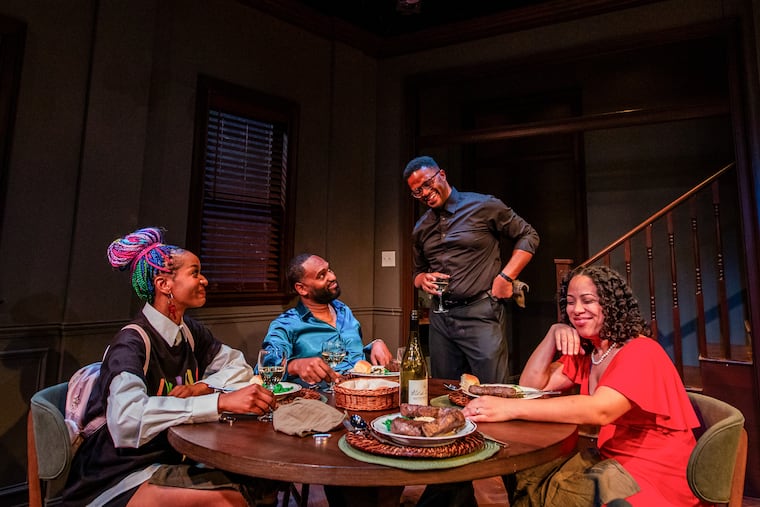
Gentrification is perhaps not the flashiest subject for a play. But in a city like Philadelphia — which has seen years of rapid development and community backlash, particularly surrounding the contested Sixers arena effort — it serves as a ripe starting point for dramatic exploration in Good Bones, running at the Arden Theatre through March 22.
Directed by Akeem Davis and written by Pulitzer Prize-winning playwright James Ijames, the play centers on Aisha (Taysha Marie Canales), a businesswoman tasked with community outreach for sports complex developers, and Earl (Walter DeShields), the contractor she hires for home renovations who vehemently opposes the arena. They both grew up in the same (fictional) neighborhood but hold vastly different visions for its future.
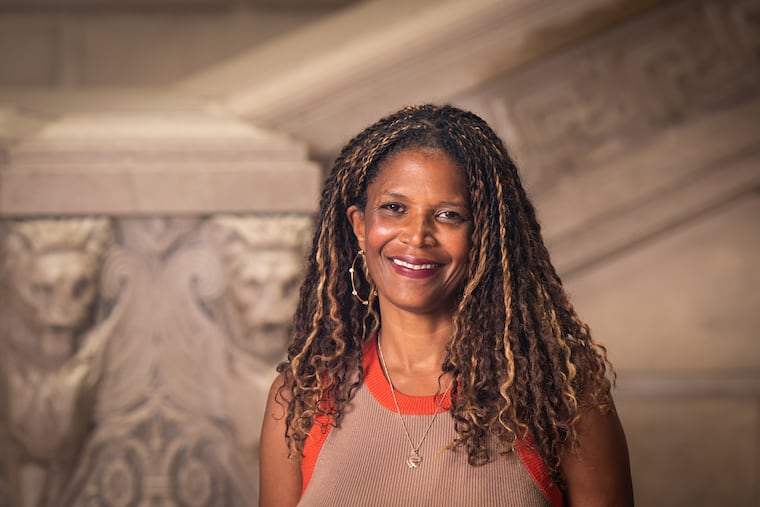
Arts reporter Rosa Cartagena and residential real estate reporter Michaelle Bond discuss the production’s funny, emotional, and complex portrayal of a very Philly reality.
Old neighborhoods, new names
Rosa Cartagena: You’ve been covering real estate extensively here in Philadelphia. I’m wondering what’s your first impression of the way this play addressed gentrification?
Michaelle Bond: I saw a lot of themes that I hear about all the time covering housing. The feelings of longtime residents vs. newer ones, revitalization vs. displacement, what new construction looks like and how it fits (or doesn’t) in a neighborhood, even what a neighborhood should be called.
RC: Right, there was a funny moment on opening night when Earl criticized the newcomers for calling their neighborhood the new name “Finbrook” instead of “the Heat” and an audience member clapped. We’ve seen that kind of rebranding all across this city, too.
MB: I think the Heat is the cooler of the two names, by the way. There’s more passion behind it. But yes, developers and real estate agents have rebranded or tried to rebrand lots of neighborhoods. The Gayborhood, for example, is also called Midtown Village now. Almost 10 years ago, a small developer in North Philly’s Norris Square tried to rename the neighborhood Stonewall Heights and was promptly shut down. In an extreme example, the Black Bottom neighborhood in West Philly was bulldozed and renamed University City.
The Sixers arena influence
RC: This story is set in an American city that could stand in for Philadelphia, or the sites of previous performances in Washington, D.C., and New York. The playwright James Ijames was living in South Philly when he wrote Good Bones, and he’s previously discussed his own growing pains of moving to a new community. This production delivers a specifically Philly version but with a universal resonance.
MB: Right, because in the other productions, the new development coming in wasn’t a sports complex, was it?
RC: Ijames rewrote the script after seeing the local pushback to the Sixers arena proposed in Chinatown. There are a few Philly callouts, like Earl’s sister Carmen (Kishia Nixon) attending the University of Pennsylvania and a joke about the Sixers sucking (which killed).
Revitalization vs. destruction
MB: One thing I’ve heard a lot about across Philly is that residents raise their kids in their neighborhoods, but when the kids grow up, they can’t afford to buy a home in that same neighborhood. Earl says that the public housing complex where he and Aisha grew up will be torn down and probably replaced with condos that no one can afford. The production does a good job highlighting the displacement and the class dynamics that are often at play.
RC: Absolutely. In this case Aisha grew up, moved away, married a guy from a rich family, and returned to purchase a home with “character and charm.” But her view of the neighborhood’s drastic transformation isn’t a negative one — she sees her efforts as “healing” her once neglected and sometimes violent home. Aisha and Earl bond over their memories of the Heat but fiercely disagree about what is revitalization vs. destruction.
MB: That’s the thing. They’re both passionate about the neighborhood and want to help the residents there, but they have different ways of going about it. Aisha wants to get rid of the public housing complex and “start over,” but Earl wants improvements that don’t erase the history.
RC: We learn that Earl has been handcrafting cabinet knobs that look like the ones originally in the kitchen, because he has memories of playing in the empty house after the previous owner died.
MB: Earl is a big fan of preservation. He calls new construction ugly and says it has no character or charm. And that’s definitely something I’ve heard from Philadelphians. And how that’s particularly irritating in a historic city like Philadelphia. Inquirer architecture critic Inga Saffron said in a recent column that Philly neighborhoods “are now awash in interchangeable blocky structures, all dressed in the same dreary gray clothing, their aluminum panels shrink-wrapped around the exterior like a sheet of graph paper.”
Block parties and traditions
RC: Ew, yeah the millennial gray. New neighbors also bring new problems. When a block party interrupts Aisha’s husband Travis’ (Newton Buchanan) sleep, he decides to lodge a noise complaint using an app called the Hood — a clever Ijames invention that makes “this narc s— so pleasant,” Carmen says — and the cops come in a harrowing scene portrayed through anxiety-inducing lighting design thanks to Shannon Zura. It’s later revealed that the event was an annual community gathering Earl organized.
MB: That’s also something I hear about. The tension between longtime residents who have longstanding traditions and newer residents who don’t have an understanding of that history or what it means to the community.
RC: Or who are scared to even talk to their neighbors. Earl makes the point that Travis could have simply stepped outside and asked them to turn it down. It’s even more damning because Aisha’s whole job is to “help the franchise speak the language of the community.” Earl criticizes her by saying, “I expect more from my people.” As universal as it is, Good Bones isn’t a stereotypical representation of gentrification because these aren’t white newcomers in a historically Black community, which makes this portrayal richer and thornier.
Nuance and personal experience
MB: Speaking of thorny, the play also touches on what can be development’s double-edged sword. Investment boosts existing residents’ property values, but then everything gets more expensive, from property taxes to groceries. Earl mentions at one point that a Whole Foods replaced a neighborhood spot.
RC: That frustration shined through in DeShields’ strong performance, too. The actor has had his own direct experiences with gentrification here after growing up in South Philadelphia and seeing his neighborhood renamed to Point Breeze. I think that personal pain and loss bolstered his take on Earl, who reminds Aisha that transformation to some means elimination for others. Aisha, on the other hand, primarily focuses on her memories of violence and trauma that she experienced, saying that they deserved better. Canales delivers a layered and emotional speech that underscores how these conversations can be conflicting and difficult.
MB: I went into the play thinking there would be a clear resolution, but there really wasn’t one. And that speaks to the complexity of the subject matter.
RC: That’s also a testament to the play’s strengths — it succeeds in getting audiences to think critically about a nuanced topic. Hopefully that means they’ll actually talk to their neighbors, too.
“Good Bones” runs through March 22 at the Arden Theatre, 40 N. Second St., Phila., 215-922-1122 or ardentheatre.org. Runtime: 1 hour and 45 minutes (no intermission).