The Philadelphia theater shaped by late, legendary playwright Tom Stoppard
Blanka Zizka cofounded the Wilma Theater which staged several plays of Stoppard's plays. “He was very much a strong part of what the Wilma was,” she said.
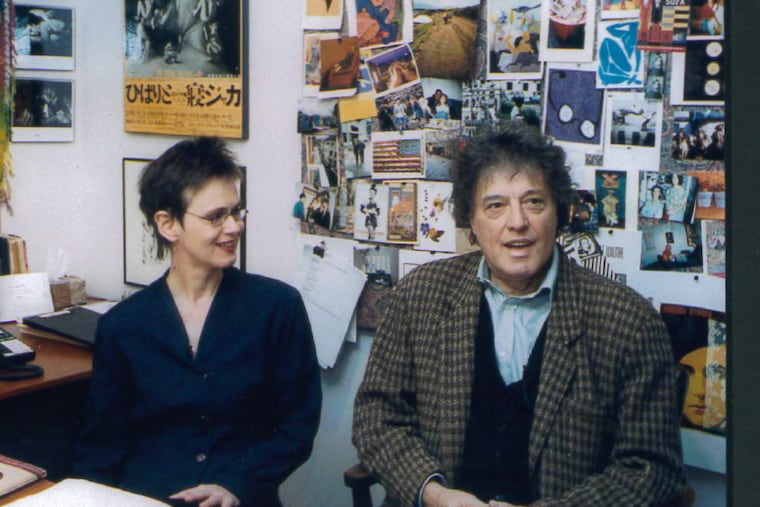
Theater communities across the globe have been mourning Tony Award-winning playwright Tom Stoppard, the beloved Czech writer who died last week at his home in Dorset, England, at 88.
Stoppard’s acclaimed dramas graced countless stages over six decades, but he had a special place in his heart for Philadelphia’s Wilma Theater, where he formed deep, longstanding friendships with founders Blanka Zizka and her late husband, Jiri.
The prolific playwright, known for irreverent, cerebral dramas with dense and rather dizzying rhetoric, was often compared to William Shakespeare and George Bernard Shaw. Some of his most popular works include Rosencrantz and Guildenstern Are Dead (a clever take on Hamlet), The Real Thing, The Coast of Utopia, and the screenplay for the 1998 Oscar-winning rom-com Shakespeare in Love.
He made Tony Award history and broke his own records, winning best play five times between 1968 (Rosencrantz and Guildenstern Are Dead) and 2023 (Leopoldstadt).
The latter beat out Pulitzer Prize-winning Fat Ham — also a clever take on Hamlet, in wildly different ways — from former Wilma co-artistic director James Ijames. (The Wilma coproduced the Broadway production that earned five Tony nominations.) A year later, the Wilma received the 2024 Regional Theatre Tony Award, becoming the first theater in Pennsylvania to earn the recognition.
But beyond his international fame, Stoppard is an integral part of the Wilma’s history and, in turn, Philadelphia theater history.
Blanka Zizka first met Stoppard in 1996, when they both participated in a panel discussion at the University of Pennsylvania. The dramatist was visiting the city for a three-day residency on Penn’s campus following a symposium dedicated to his play Arcadia.
At the time, the Zizkas, political refugees also from the Czech Republic, were in the process of moving the Wilma from a small Sansom Street theater to its current larger venue on Broad Street. The first play of the season at the new location happened to be Arcadia, which they had chosen before meeting Stoppard. (The Wilma had produced his 1974 play Travesties as well.)
“He was very impressed by the fact that Jiri and I were from Prague, and we came all the way to the United States, to Philadelphia, and that we were creating a new theater,” said Zizka, who now lives in New York’s Catskills region. “He’s from Czech Republic, originally. He left when he was 2 years old, and he doesn’t speak too much Czech, but he still had a very strong connection to the country. … So for him, [ours] was just a very impressive story.”
Stoppard came to the Arcadia opening and became a frequent Wilma visitor over the years as the theater went on to produce 12 of his plays; he made his way to town for nearly every show and often attended rehearsals, too. He even helped with fundraising for the Wilma by visiting the homes of board members.
Zizka has happy memories of Stoppard’s visits, as well as the times he invited her to join him in New York for tea parties. Whenever she and her son traveled to England, Stoppard let them stay at his apartment and set them up with tickets to whatever shows they wanted to see. He would send her books to read and ask about not only her theater work but her other passions, like painting.
Stoppard was generous with his time, Zizka said, especially with younger theater artists and organizations like the Belarus Free Theater, which was forced to flee to England after facing political persecution for their work.
His plays provided a thrilling challenge for Zizka as a director and for the Wilma actors. She spent months preparing for brainy Stoppard shows, which the playwright meticulously researched as his characters included historical figures like Oscar Wilde, Vladimir Lenin, James Joyce, and Mikhail Bakunin.
“A lot of people consider him this intellectual playwright, but I think Tom is also full of emotions that are covered by those intellectual ideas. And for me, as a director, I didn’t have to look for the intellect … because it was there, but I had to always look for the world that is underneath the words,” she said.
That effort proved particularly difficult in the 2000 production of The Invention of Love, which centered on poet A.E. Housman. There’s a scene in which Housman meets a younger version of himself and the two engage in a lengthy debate over the placement of a comma — not typically the most entertaining of topics.
“It was two or three pages of dialogue, and it was so intense. … I just could not sleep over it. I felt we were in our heads, and it was boring,” said Zizka.
She had the actors try speaking in their own words to get the idea across but ultimately had a breakthrough when she asked them to perform in gibberish. The result was “an amazing, intense and exciting scene” in one of the most successful productions in Wilma history.
Gibberish helped them crack Stoppard’s code again in 2016, when the Wilma staged the U.S. premiere of The Hard Problem, which Zizka also directed. It followed a psychology student at a neuroscience research center attempting to understand the root of human consciousness.
Lindsay Smiling, now a co-artistic director at the theater, performed in the play and remembers meeting the famous dramatist in rehearsal, when they replaced Stoppard’s dialogue with nonsense words.
“It was nerve-wracking to do that in front of this playwright who is a legend,” said Smiling. “His work is so much about the language and his plays are very talky. … He was like, ‘I don’t know what you all did, but that is the scene with none of my words.’ And he was thrilled.”
As exciting as it was to discuss the work, Smiling marveled even more at Stoppard’s friendliness. After rehearsal, a group, including Zizka, went to Caribou Cafe for burgers and beer.
“We sat outside on the sidewalk on Walnut Street and we talked about beer, we talked about history, we talked about Philadelphia,” said Smiling. “He was interested not just in theater makers and our lives … I remember him just coming back with all these conversations he’s had with random people on the street around Philadelphia.”
Though Stoppard did not spend too much time in the city, his contributions were profoundly meaningful to Philadelphia artists — and of course his work will continue to be produced across the region. Earlier this year, the Pennsylvania Shakespeare Festival staged Rosencrantz and Guildenstern Are Dead alongside Hamlet.
Of course, he’ll always be part of Wilma history.
“He was very much a strong part of what the Wilma was,” said Zizka. “We have not done any other playwright in such a big measure as we did his work.”
This article was updated with the correct release year for ‘Travesties.’
