How Volodymyr Zelensky’s TV truck made it from the war in Ukraine to a Bensalem driveway
Construction firm owner Alfred Hagen has spent years supporting the war effort in Ukraine. Now he has a souvenir with an unusual story.
If you want any old used Chevrolet Silverado, you’re in luck. It’s been among the top two selling vehicles in the United States for decades; you can choose from roughly 1,500 examples within 100 miles of Philadelphia, according to Cars.com.
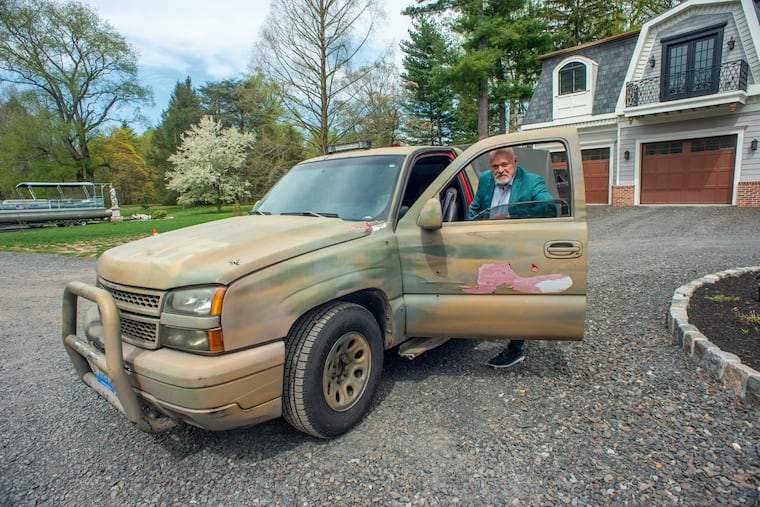
Alfred “Fred” Hagen took delivery of a 2006 Silverado in April, and you might think he got taken, paying about eight times the $5,000 KBB book value. But it has a pedigree.
Television star. War veteran. A few bullet holes.
Hagen — a Bucks County construction firm owner, art historian, movie producer, Ukraine supporter, and front-line volunteer — took delivery in April of the Silverado that ferried now-Ukraine President Volodymyr Zelensky across Kyiv for then-comedian Zelensky’s TV series Servant of the People.
Hagen wanted to support the war effort as the fight against Russia has entered its fifth year. But delivery of the vehicle was a little more difficult than it might be from the neighborhood car lot.
“It’s been about a two-year odyssey between getting it running and getting it out of Ukraine,” Hagen said, estimating costs north of $40,000.
When Russian President Vladimir Putin ordered the invasion of Ukraine on Feb. 24, 2022, the country of almost 40 million people had its work cut out for it, up against arguably one of the strongest military organizations in the world.
One method of Ukraine’s defense was to order all trucks be put to into service. Hence the Silverado of the People followed the Zelensky path into the political realm.
The Zelensky truck received its new uniform — repainted from its signature red from the TV series to a khaki tan to blend in among the military vehicles.
So where does the founder of a commercial construction company based in Bensalem come into this picture? It started in 2014.
“I was disturbed after Putin invaded the Crimea,” Hagen said.
It was then that Hagen started visiting Ukraine. He even had plans to start an agriculture business there. COVID got in the way, and then the mainland invasion happened in 2022.
At that point, Hagen bought a Jeep and trailer and began delivering supplies from nearby Poland to Ukraine. Then Hagen and fellow American volunteers began buying and delivering ambulances to the country to help patch up wounded soldiers and civilians. He’s made six humanitarian missions to Ukraine and helped deliver 50 ambulances for the country’s war effort, as part of a group that has delivered more than 300 used ambulances total.
Hagen doesn’t scare easily, whether it’s delivering supplies to war-ravaged Ukraine, later volunteering on the front lines, taking two trips in the Titan submersible to see the wreckage of the Titanic, or recovering the remains of a B-17 bomber in remote swamps of Papua New Guinea.
“I’m relatively fatalistic and I didn’t waste any energy on fear,” Hagen said. “You know there is an element of danger.”
A patron of the arts and lover of ballet — a visit to his Bensalem riverfront estate known as Chelwood begins with a tour of the statues on the lawn, the paintings on the walls, and one of the original pianos from Kimmel Center — Hagen was executive producer for a film about the Kyiv ballet company, The Sky Was on Fire.
Oleh Tokar, stage director for the National Ballet of Ukraine, got to know Hagen while he was visiting the country for the movie production, which he described as showing the country’s commitment to beauty and art despite the ugly reality of the war.
Hagen was definitely not wary of putting himself in harm’s way, for the movie or to support the war effort, said Max Golubenko, a soldier in Ukraine’s army, who met Hagen in 2024.
In an hourlong video call, Golubenko recounted a five-day trek in 2024 with Hagen through some of the country’s most war-torn areas, specifically Chasiv Yar, just west of Bakhmut, securing footage to tell the ballet’s story.
At one point Hagen wanted to photograph a sign pointing the way to Bakhmut and Kostiantynvika, very close to the front, with bombs falling nearby and an unexploded Russian drone on the road.
“To make this photo, it took like 15 seconds or something, like 20 seconds,” Golubenko said. “I was screaming, ‘Alfred, get back to the car!’”
But Hagen wasn’t satisfied with the shots and asked to come back — on a bicycle.
Golubenko strongly discouraged that, saying, “You will be killed. This is not a question of luck you will 100% be killed.”
“He said, ‘I’m 60-something years old, what I have to lose,’” Golubenko recounted. “I said, ‘OK maybe you can risk, but we don’t need any problems that we brought some foreigner there, not just a foreigner, like a famous person.’”
Golubenko was further surprised how this wealthy American benefactor slept in the barracks with the soldiers and others on the tour, sleeping in a room shared by eight travelers.
You could see how the battered Silverado could mean so much to Hagen. He found out about the truck while delivering ambulances to the battalion that owned the vehicle.
“It defended Kyiv, Kharkiv, and Bakhmut — it got shot up pretty badly,” Hagen said.
He hopes to use the truck to help him raise funds for more ambulances, and eventually display it as a tribute to Zelensky, whom he calls “the Churchill of our age.”
For Ukraine, the fighting continues on. Hagen said the country is turning a corner, with drone strikes into Russian territory, and it’s backed up by recent reporting.
The war is affecting the Russian people as well. Though noting that gauging public opinion is difficult in an authoritarian regime, the Washington Post reported April 26 that polls have Putin’s support among the Russian people at 65.6%, the lowest level since the beginning of the war and down 12.2 points since the beginning of 2026.
The Post referenced Reuters reporting that increasing attacks by Ukrainian drones on Russian ports and refineries forced Russia to slash oil production in April by 300,000 to 400,000 barrels per day.
The war continues with no end in sight. For Hagen, that means more trips delivering ambulances. He plans to bring three more to the country in May with the nonprofit Ukraine Focus. He received messages from Ukraine soldiers and other volunteers that the vehicles have saved countless lives.
“It dawned on me … I can spend $10,000 for an ambulance, and that ambulance has saved hundreds of lives,” Hagen said. “So at a cost per life of dollars, I continue to do it. Because at the end of the day, there’s many types of investments in this world and not all of them are financially rewarding.”
And he has the shot-up truck in his driveway to prove it.