Airco’s new Bucks County factory will build machines that make jet fuel from air and electricity
The facility is in New Britain, where the company will do research, engineering, and assembly, CEO Gregory Constantine says.
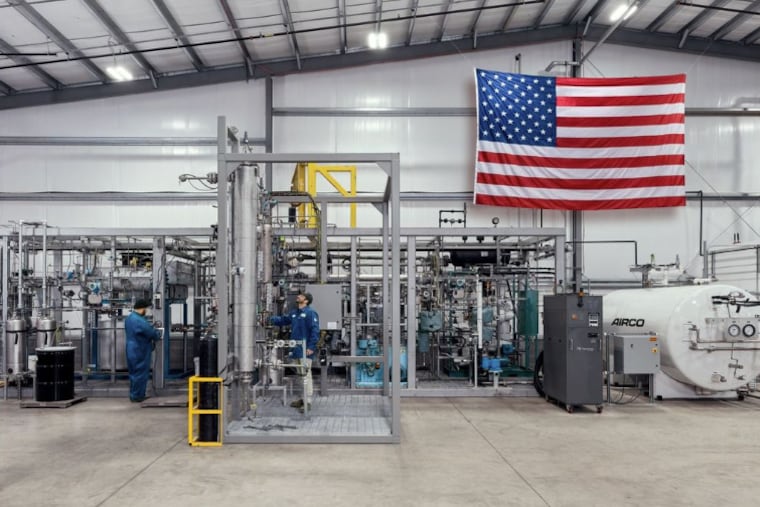
Airco, a company that developed portable systems to make jet fuel from water, carbon dioxide, hydrogen, and lots of electric power at its lab in Brooklyn, announced Tuesday that it has moved manufacturing production and other key work to a new factory in Bucks County.
Airco is backed by private equity, government funding, and contracts with airlines. It is flush with $67 million from the U.S. military’s Defense Innovation Unit; $15 million from the Air Force’s AFWERX innovation group and other military contracts; and more than $150 million in commitments from JetBlue, Alaska Airlines, Toyota Ventures, and private investors.
The new plant in New Britain, west of Doylestown, quadruples Airco’s factory capacity and combines Airco’s research and development, engineering, and assembly at one location, chief executive Gregory Constantine said in a statement.
The 16,000-square-foot plant, which is already operating, is about the size of three Wawa markets. The company won’t say how many workers it will employ there.
In New Britain, Airco is assembling shipping-container-sized MAD (Mobile, Adaptable, and Dynamic) fuel-generation units to send to the Air Force, and it hopes to sell them to commercial airlines. The units can make fuel anywhere they can plug into electric lines or run generators, according to the company. The system attracts users who want to cut fuel transport risks and costs compared with the usual system of making fuel at central refineries and shipping or pipelining it to airports and storage-tank centers.
“This facility enables us to manufacture autonomous systems that produce fuel anywhere, on demand” — a “fundamental shift from fuel as a commodity” for shipping and distribution, said CEO Constantine, who was born in Australia and has a Harvard MBA.
Synthetic fuels derived from simple gases in Earth’s atmosphere split by electric current aren’t new; they were used in World War II. They are generally more expensive than those derived from petroleum because they take more energy. Standardizing facilities into easily shipped units makes the process more convenient and accessible, according to Airco. Mass production could help develop more efficient fuel production processes and parts, cutting costs.
Some parts for MAD will be made off-site for assembly in New Britain.
Constantine called the plant “a significant expansion” and said it would be home to all of Airco’s production capabilities going forward.
Biomanufacturing fuels and other resources from natural materials such as water and carbon dioxide are one of the “Six Critical Technologies” identified by the U.S. military’s research and engineering group for increased funding and development.
Why New Britain? Nearby communities have “a solid technical workforce for growth,” and there’s room to expand, Constantine said.
Bucks County is the only county in Philadelphia’s Pennsylvania suburbs with more than the state average of 10% of private-sector workers in manufacturing plants. The national average is around 9%.