Burpee, the Philly-born seed seller, has proven to be ‘recession resistant’ after 150 years in business
The company that introduced Big Boy tomatoes and Iceberg lettuce once teetered on the brink. Now, it’s once again thriving.
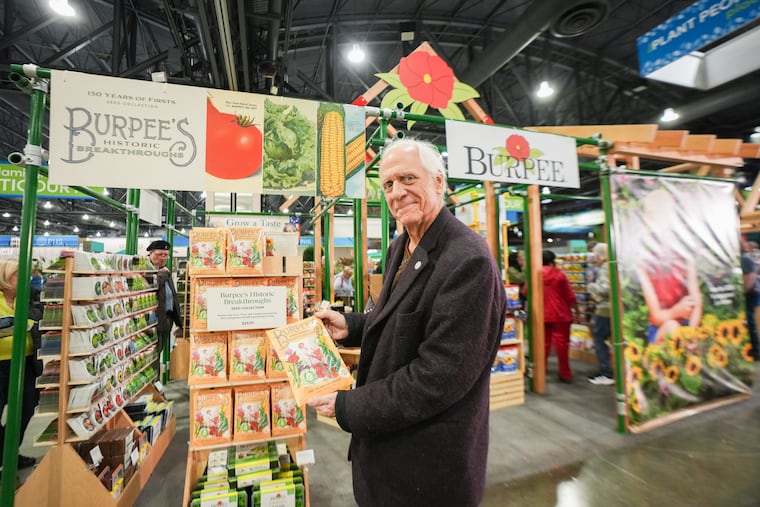
George Ball stood at the W. Atlee Burpee & Co. booth at the Philadelphia Flower show last week and lifted the company’s artfully designed 150th anniversary seed collection from a wooden rack.
Ball, 74, traced a finger down the list of nine packets of “Historic Breakthroughs” and told stories about some of them: Iceberg lettuce (1894). Big Boy tomatoes (1949). Snowbird sugar snap peas (1978).
Golden Bantam sweet corn (1902) wasn’t an instant hit, Ball noted, despite its sweet, buttery flavor. Americans were accustomed to white corn.
“This is the first yellow sweet corn. Before that, yellow corn was hog feed. The kernels were hard,” Ball said. “This yellow corn was a totally new taste. It’s delicious. But for two years, nobody bought it because to them it was hog feed.”
Only when an assistant coined the phrase “Looks like butter, tastes like butter” did the variety take off.
Burpee has been rooted in the Philadelphia area since its founding by W. Atlee Burpee in 1876. Now, more than a century later, having once teetered on the brink, it’s again thriving and positioned for the future with seed, plant, and product sales in big box stores and online.
“We’re celebrating our 150th” and still selling those same seeds, Ball said.
Regrowing Burpee
When Ball came to buy Burpee in the 1980s, the company was in serious financial trouble, and its staying power was anything but certain.
“Burpee was going to be padlocked,” Ball recounted. It had fallen 240 days behind on payments, some of which were owed to his family’s company, Ball Horticultural.
Ball had become president of PanAmerican Seed, a Ball Horticultural company, by the mid-1980s and was breeding plants in Costa Rica. When he returned to the United States, he read a story in the Wall Street Journal that industry giant Burpee was teetering.
Sensing an opportunity, Ball moved to buy the historic brand for a fraction of its value, or as he phrased it, for “kind of a poem.”
More than a century before that, W. Atlee Burpee, scion of a prominent Philadelphia medical family, started his seed company in 1876, the same year he visited the Centennial Exposition in Philadelphia. It featured robust agricultural and horticultural displays. By 1881, a notice for the company’s Old City warehouse appeared in The Inquirer.
Burpee seized on the emerging power of mail-order catalogs — the era’s version of the internet — and the catalog became a rural household staple since most of his customers were originally farmers.
In 1888, Burpee bought a farm on New Britain Road in Doylestown. He named it Fordhook and transformed it into the company’s experimental garden and began conducting thousands of seed trials. The 60-acre property still opens to the public once a year.
Burpee died in 1915, leaving the business to his 22-year-old son, David, who expanded the company’s flower offerings and cemented a reputation for innovation. The company soon found a market for its seeds with home gardeners.
Christopher DeMairo, a former archivist for the Smithsonian Institution and the author of a book on the history of Burpee, calls W. Atlee Burpee, “a really fascinating man, and one of the most prolific businessmen in American history.”
DeMairo credits David Burpee as a visionary who steered the company through the turbulent 20th century when many competitors went bankrupt. Under David’s leadership, Burpee pushed hard on innovation, pioneering hybrid vegetables through controlled pollination experiments.
“Even if you may not know Burpee now, your ancestors certainly did,” DeMairo said. “It is still really important when you think of where agriculture and gardening are today.”
In 1970, David Burpee sold to General Foods, and the corporate headquarters moved from Philadelphia to Warminster, where it remains.
Eventually, ownership passed to a private equity firm, and the company fell into financial trouble.
Then Ball, who views himself as a turnaround specialist, stepped in to save Burpee, officially becoming its sole owner in 1991. He’s run the company ever since and still lives at Fordhook Farm.
“I was very interested in the basic virtues and values of life,” Ball said, and felt that the nursery business fit with that essence.
DeMairo, the archivist, believes the founding Burpee family would be relieved to know the company is privately held by Ball, who has no plans to sell.
“I can almost say for a fact that both David and Atlee would be very happy to know that the company is in the hands of a true gardener,” DeMairo said, “and not a boardroom.”
Burpee today
Under Ball’s leadership, Burpee expanded into retail aisles and into the digital age.
When COVID-19 hit in 2020, Burpee experienced a surge in demand, CEO Jamie Mattikow said, and the company has retained much of that momentum.
He declined to share financial details or an employee count. But, he said, consumers spent $242 million on Burpee products last year, a 120% jump from 2019. Growth, he added, is in the “mid-single digits.”
“Fortunately, seeds have proven to be a recession-resistant type of category,” Mattikow said, “so the growth is pretty steady.”
Burpee has long focused on home gardeners. Its products appear in major chains including Walmart, Target, Home Depot, and Tractor Supply.
Mattikow describes Burpee as a full-service “gardening company” rather than simply a seed supplier, offering live plants and supplies like soil and cages. Online sales through Burpee.com and Amazon continue to expand.
The company also maintains a niche business selling seeds to small growers who supply farmers markets and restaurants.
The company has leveraged social media to reach younger customers. It has about 725,000 followers across Meta’s Facebook and Instagram platforms, and offers advice such as “the easiest tomatoes to grow for beginner gardeners.”
Burpee relies on its own horticulturists and traditional seed breeders to adapt to changing customer preferences.
For example, a seven-year breeding process resulted in the company’s new line of “garden sown” tomatoes and peppers — seeds hardy enough to be planted in ground after the last frost, bypassing indoor tray-starting.

The Smithsonian Institution has released a free book by archivest Christopher DeMairo on the history of Burpee Seed Co. You can access it here.
That painstaking breeding process has been with the company since the beginning. In his history of Burpee, DeMairo cites a Life magazine article describing the painstaking work behind developing seed varieties.
The company, the article noted, “hired 60 girls from Vassar, Smith, Bryn Mawr and other colleges to spend the summer with tweezers and brushes” to control pollination and create new hybrids.
Mattikow said Burpee faces typical challenges such as supply chain issues, tough competition, and tariffs.
“We do a great balance of holding on to a loyal base of customers, and every year we bring in new customers,” Mattikow said.