Comcast owes $240 million to start-up for using its voice-remote tech, jury says
A lawsuit by Promptu Systems Corporation said Comcast expressed interest in their capabilities as early as 2001, and discussed launching a remote in collaboration.
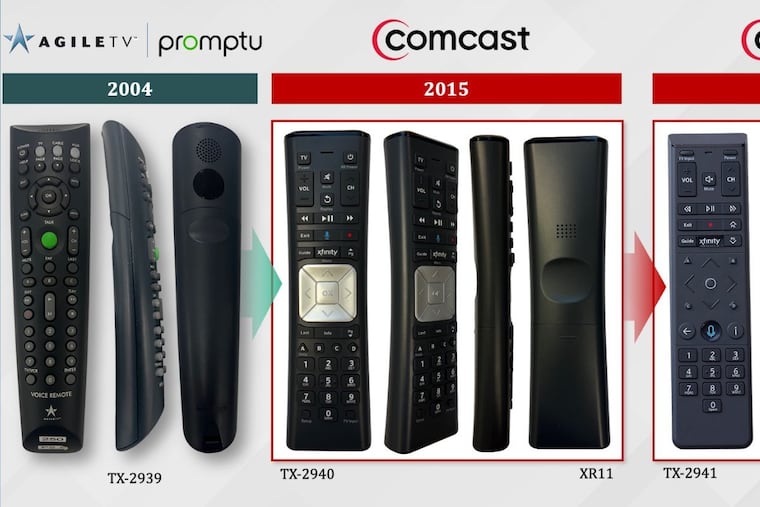
Comcast owes a California company $240 million for infringing on its patent when rolling out a voice-activation feature on television remotes over a decade ago, a Philadelphia federal jury decided.
Promptu Systems Corporation “pioneered” the technology that allows users to control their TVs through voice commands spoken into a remote control in the early 2000s, the company said in legal filings.
After Comcast launched its voice remote in 2015, Promptu sued, accusing the telecommunication giant of utilizing patented technology. Comcast executives were aware of the patents, expressed interest in Promptu’s capabilities as early as 2001, and took steps to launch a remote in collaboration with Promptu, the 2016 lawsuit said.
But Comcast ended up launching a voice-controlled remote on its own, which the suit says was based on technology that Promptu shared with Comcast in demonstrations.
“Promptu technology was exploited without permission over a 10-year period,” said Jerry Ivey, an attorney at the law firm Finnegan who represented the company in the trial.
Propmtu’s attorneys asked the jury to award $346 million, based on a calculation that the company was owed 30 cents per month for each Comcast cable customer over a 10-year period.
At the conclusion of a six-day trial in the Eastern District of Pennsylvania, on Jan. 23, jurors found that Comcast infringed on two patents but that only one of them was valid. The jury deliberated for less than three hours and awarded $240 million.
The verdict will have no impact on Comcast’s customers, a company spokesperson said.
“We will continue to pursue our claim in court against Promptu to show that these expired patents are unenforceable and appeal this decision if necessary,” the spokesperson’s statement said.
During the 10 years of litigation, Comcast attacked the validity of the patents. It is pursuing a separate claim arguing that the patent that led to the verdict is not enforceable.
Promptu technology wasn’t ahead of its time, the attorney representing Comcast told the jurors, and the start-up did not succeed in becoming a big player in the TV remote market.
“Investors from Promptu have come here to ask you to not only bail them out of their investment in Promptu but to give them an enormous windfall in profits that they didn’t earn in the marketplace and for technology that they didn’t invent,” said Douglas Lumish, a Weil Gotshal & Manges attorney representing Comcast, according to court transcripts.
» READ MORE: Comcast agrees to $117.5 million settlement to resolve data breach lawsuits
Around the same time that Comcast launched its voice remote, voice-controlled speakers like the Amazon Echo and Google Home were popping up in homes.
By 2017, Comcast said it had voice-activated remotes in about 12 million homes — roughly half its subscribers at the time — and the company expected to process 4 billion voice commands that year. In a 2024 meeting with investors, Comcast said their remotes were processing about 50 million voice commands daily in five languages, allowing users to quickly access cable and streaming content.
The company also developed a large-button voice remote with accessibility in mind. Both have been provided to their cable subscribers at no additional cost.
Even if they don’t directly bring in revenue, these kinds of tech features can help a company keep customers. (In recent years, Comcast has been losing more cable customers than gaining, but it counts its Peacock streaming service among areas of growth.)
On Thursday, Comcast reported its 2025 financial results, showing flat revenue from the year before. The company touted Peacock’s 22% increase in paid subscribers, the release of Wicked: For Good from its studios division, and growth in its mobile phone business.
Its count of cable customers decreased — again — to 11.2 million.
Also this month, Comcast agreed to a $117.5 million settlement to resolve 24 lawsuits surrounding a 2023 data breach. The settlement received initial approval from a judge, with a final approval hearing scheduled for July.