When Elon Musk targeted Delaware, this law leader made a case for ‘America’s Corporate Capital’
Lisa Schmidt weighed in on how corporate law has changed in Delaware, what she looks for in young lawyers, and how AI has changed the discovery process.
Delaware has twice as many corporations as people, attracted by the state’s business-friendly Chancery courts and laws. Corporate law is big business, with New York, Philadelphia, and Washington firms and the Wilmington hometown bar jostling for clients. Young associates start at over $200,000 a year; senior partners can be multimillionaires.
More than half the Fortune 500 are legally based in Delaware, and more than 80% of newly public companies are incorporated there. Legal spending feeds the local economy — and corporate legal business fuels a third of the state’s budget, enabling Delaware to forgo a retail sales tax.
Other states covet this prosperous niche industry, and company founders who are disappointed by court decisions have threatened to move elsewhere. Tesla’s Elon Musk was especially upset when Delaware Chancellor Kathaleen McCormick ruled against his attempt to back out of buying Twitter and twice against his record-setting pay package.
Musk and a few other big-tech founders last year began moving legal business to Texas, Nevada, and other states that advertised themselves as founder-friendly.
Newly elected Delaware Gov. Matt Meyer, a former corporate lawyer, sought to ease the reaction and prove the state took corporate concerns seriously. He signed Senate Bill 21, a law that will help limit legal inquiries and complaints by small groups of shareholder dissidents. He overcame opposition from a faction of fellow Democrats, allies of labor unions, activist shareholders, and pension plans, and their lawyers who sue companies.
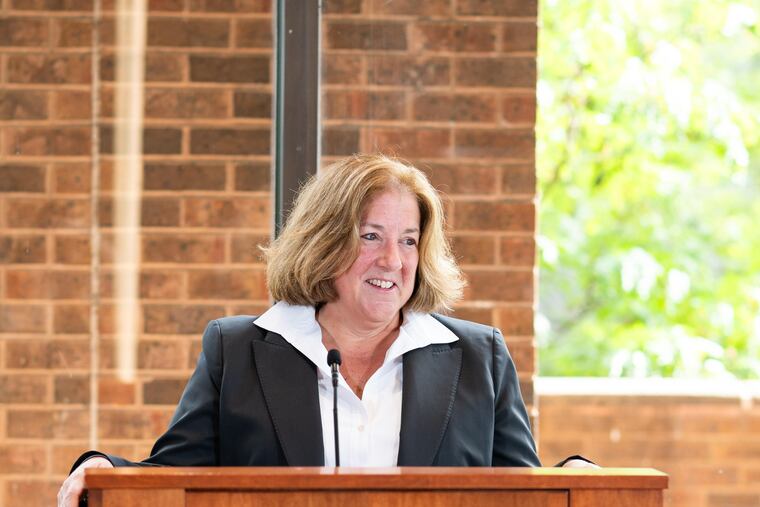
Partners at Richards Layton & Finger, Delaware’s largest corporate-law firm with 180 lawyers, were among those representing Musk, and firm leaders were also prominent in the campaign to change the law. Lisa Schmidt, a 35-year veteran of the firm who recently served a three-year term as its president, talked about the bill and other legal issues at her Wilmington office on Aug. 13.
Questions and answers have been edited for clarity and brevity.
Delaware law usually evolves quietly, with legislators adopting what a committee of defense and plaintiff attorneys recommend. How did this year’s update become a public struggle?
We, as Delaware corporate lawyers, had always taken Delaware’s corporate “franchise” for granted. Our law was the gold standard for corporations. Every 10 years something would bubble up — threats to federalize corporate law, [another state] trying to copy our standards. But it was never very serious. Never any question that venture-funded start-ups would IPO in Delaware. We became very comfortable.
And then, suddenly, a series of cases, a series of loud voices, and then Texas and Nevada came on with marketing campaigns we had never seen. They were in the Wall Street Journal every week, competing aggressively [to attract corporate registrations, legal business, and fees].
So we as a firm had to do something we never did: put ourselves out front. We had to explain SB21 to members of our General Assembly, really reinforcing the importance of the Delaware corporate franchise, and the risks if we didn’t address these real threats.
Despite the pushback and Elon Musk’s efforts to shift legal work to Texas, Delaware incorporations were up again in the past year, even with a national slowdown in business formation. Who did you have to convince?
There are companies that have left, but some of them started the process before SB21 was adopted.
[Decision-makers, advisers, and general counsel] are looking at the balance in our corporate law between management’s discretion to run their companies and shareholders having a voice. If you are out of balance, people won’t want to serve as directors. They won’t want to invest in your companies, and companies will look to other states.
This year, very loud voices raised concerns about Delaware. The governor had been in office 15 days. I give him a lot of credit for stepping up as quickly as he did.
Wouldn’t it be more surprising if he didn’t? Gov. Mayer was elected with backing from corporate donors [such as Michael Bloomberg and Phil Shawe]. He was advised by former Judges William Chandler and Leo Strine, now prominent corporate lawyers.
There was concern this was outside the normal process. The governor said, “Let’s look at what this group has drafted.” The council, which includes plaintiffs’ as well as defense lawyers, approved the revisions.
The opposition to SB21 vocalized this as challenge to our courts, which it’s not. If you are constitutionally opposed to corporations, but you want to provide services to constituents — and the corporate-law franchise funds a third of our budget — there’s a disconnect.
The governor says he acted after hearing at least one big law firm was preparing to advise clients on alternatives to Delaware.
We heard that New York firms were setting up practice groups for reincorporation and domestication. They leaked spreadsheets comparing the jurisdictions and laying out the provisions and the inferences.
But there’s more [at stake] than the corporate franchise. Once you change the state of incorporation, that impacts where you file for bankruptcy and where somebody can sue you for your patents.
Delaware remains the most attractive place for our clients. Texas courts have jury trials — that’s not where a company may want to be. Companies have to look at it all, to get the whole picture.
Delaware law is a well-paid career. Do young lawyers want to move here, as you did after law school?
I don’t think it’s any harder to recruit. We face more competition in retaining our associates. Law firm models are a funnel. You don’t want to lose really good associates in their third and fourth year.
We pay our associates $210,000-$215,000. New York firms pay about $10,000 higher.
We were the first firm to come back [to the office from COVID shutdowns] four days a week. I was not very popular when we did that. But it’s so important to have associates in the office to listen and interact with the clients.
Is artificial intelligence replacing lawyers?
AI-type tools are helping us get through the big burden of discovery, when you have millions of pages to review.
We’ve been told the courts are using AI to scan filings to make sure the precedents are not overstated. It’s to be determined how that impacts us.
You want young people who are critical thinkers. Who write well. I hope AI never replaces that. I always look for people who are student athletes. They can multitask. They can balance their schedules. Work with a team. For litigators those are some of the most important skills.
When Elon Musk was criticizing Chancery, followers on X called Delaware judges corrupt, partisan, and communist. Will threats and abuse make it harder to find judges?
In that job, you have to have a thick skin. There are people who may disagree with your judgment.
People here disagreed with some of my judgments, but they didn’t leave.
I have respect for all of our judges — to take on a job that pays a fraction of what they make in the private sector, to work harder, to be available on holidays, and to constantly train young associates as their clerks. They are up nights and on weekends.
This story has been corrected. Elon Musk tried to back out of buying Twitter. The target company was misidentified in an earlier version.