Wish EV prices were lower? This Drexel engineering lab’s work could help.
Two professors are studying processes to make batteries for electric vehicles without solvents, which require expensive drying equipment. One analyst calls the research “so important.”
If vehicle prices are upsetting to American consumers, electric vehicle prices might be called just short of shocking.
For a variety of manufacturing and supply reasons, buyers have been paying up to $11,000 more on average for solely electron-fed vehicles vs. gasoline-powered since the end of 2023.
But a pair of Drexel University professors are working to mitigate some of the cost of making of EV batteries, potentially lowering the prices of EVs on dealer lots.
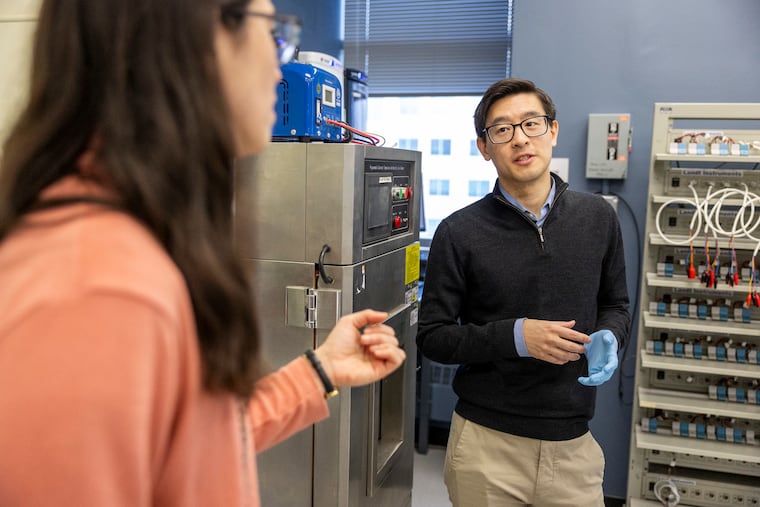
In a lab at Drexel’s Center for Automation Technology, overlooking 30th Street Station, Wesley Chang, an assistant professor in the Department of Mechanical Engineering and Mechanics, directs six researchers as they test new materials for battery electrodes.
He’s also working with colleague Maureen Tang, an associate professor of chemical and biological engineering, as the two aim to develop less expensive methods to test batteries, a critical part of the manufacturing process.
What’s different about the new battery electrodes?
One step of the process for making electric vehicle batteries involves using a solvent to coat the electrodes with materials that can conduct electricity, then using an oven to dry the material. Chang’s work would allow a dry process, eliminating industrial ovens and reducing the electricity cost.
“The use of the toxic organic solvent NMP can take up almost half of the manufacturing cost of a battery because of the large ovens and infrastructure needed for its use,” Chang explains.
The cost of an EV battery is about 70% from materials and 30% from manufacturing, according to a recent article from tech publication IEEE Spectrum, citing data from consultancy Thunder Said Energy.
How would battery testing change if Drexel researchers are successful?
Meanwhile, Chang and Tang are each studying processes that could make battery testing easier.
Chang’s testing process involves contact-free ultrasound while Tang’s is in electrochemical fluorescence microscopy. Both methods allow scientists to measure the electrodes without contact, which is useful because the batteries themselves must be kept inside oxygen-free, moisture-free chambers in the lab. Both have patents pending.
The ultrasound is not unlike that used in prenatal screening — in that process, a water-based gel coats the wand so it can contact the skin with no gaps. But Chang found a way to apply ultrasound without contact, gels, or fluid. The scientists simply shoot sound waves at the electrode to measure density.
Tang’s testing process uses ultraviolet light to show where the electrons can move in and out of the electrodes. They have to move easily for the electrodes to work.
Both innovations streamline the battery testing process, which Tang says can take weeks or months.
“It’s very expensive because it takes a long time, and if you messed up you have to go back and fix your recipe, and you won’t know if it’s a good recipe for a long time,” Tang explained.
“We’re trying to invent new ways of testing that tell you if things are working or failing faster.”
How can electric vehicles become more affordable?
EVs cost more than gasoline vehicles. The upcharge can vary widely month to month, depending on overall transaction prices and sales. It’s actually shrunk to $6,575 in February. Surprisingly, price data doesn’t show a big jump in the price difference since federal rebates ended in October.
But it’s hard to draw conclusions from the most recent pricing data.
“We’ve had an atypical year — because of all the winter storms, the sales have been pretty depressed and I want to say EV sales would be naturally [down] as well,” said Jessica Caldwell, head of insights at the automotive website Edmunds.
Still, lowering the manufacturing costs of batteries could have a real effect on EV prices, and on their attractiveness to potential buyers.
The battery can account for up to 40% of the price of an electric vehicle, according to Stephanie Valdez Streaty, Cox Automotive’s director for industry insights.
“The Drexel research they’re working on, that dry coating, is so important,” Valdez Streaty said. “In order to get those EV prices to go down, we need the battery cost to go down.”
She noted other ways to lower battery costs have been through chemistry. Recently manufacturers have started to use more lithium iron phosphate batteries in EVs, which removes expensive components like cobalt and nickel.
Valdez Streaty noted EV prices could fall further for other reasons, like Ford’s universal EV platform, which reduces manufacturing costs, and the overcapacity of battery and EV factories, which could drive down demand.
Still, the price of EVs has already dropped tremendously since the introduction of the Nissan Leaf over 15 years ago. In 2010, EVs cost about $1,000 per kilowatt-hour. Last year the average was $108 per kWh, Valdez Streaty said. That gives buyers more range and charging speed for their money.
Furthermore, the rising price of gasoline amid the war in Iran could make EVs an even more attractive proposition. The war closed the oil-shipping channel the Strait of Hormuz, clogging up about 34% of the world’s crude oil supply.
Indeed, Edmunds reports that its highest rate of EV searches in 2026 happened the week ending March 15, accounting for 23.8% of searches.
As for dry manufacturing, companies like Anaphite in Bristol, England, and Sakuù in San Jose, Calif., are also working on more efficient processes for making EV batteries, according to IEEE Spectrum.
Tesla has confirmed on various websites that its 4680 battery can be made using a dry manufacturing process, though information surrounding their advances can be difficult to verify.
Back at the Drexel lab, the research carries on. Chang and Tang each have had $70,000 projects sponsored by the Manufacturing PA Innovation Program of the Pennsylvania Department of Community and Economic Development. Both have worked with Arkema, a multinational manufacturer of specialty materials based in Paris, which has a battery research and development center in the Philadelphia area.
“The goal is to complement what industry does, not necessarily to compete with them, because universities and companies, they have different kinds of goals,” Tang said, “We’re trying to build things that give us more information about a battery faster, rather than necessarily making a better battery altogether.”