Pa. and N.J. are getting more electric-vehicle chargers even as EV sales start to dip
Private companies continue to expand stations in Pennsylvania and New Jersey, and federal fund cancellations never happened. On the road, drivers report mixed results.
The electric-vehicle business has been an unpredictable venture. Analysts and automakers have long been forecasting the downturn of the EV market.
The end of EV rebates in September seems to have finally made for a downward trend in U.S. EV sales. But on the other side of the equation, EV charging stations are forging ahead, and EV charging suppliers are not losing their motivation.
Public and private investment have helped take one of the EV’s two biggest snags — range anxiety — out of the equation. And that’s despite the Trump administration’s failed attempt to halt a federal charging station program. (The as-yet unresolved snag: price.)
The U.S. Department of Energy’s Alternative Fuels Data Center’s website shows 16,579 high-speed charging stations across the United States with a total of over 71,000 charging ports. Pennsylvania has 382 stations with nearly 1,700 high-speed charging ports. New Jersey has 389 stations with more than 1,800 ports. The New York Times reported last month that EV fast-charging stations in the U.S. soared from 1,000 in 2015 to 12,000 now.
“Every time I open this map, the number has gone up,” said Ingrid Malmgren, senior policy director for the EV advocacy nonprofit Plug in America.
Private investment
There’s plenty of private investment in charging for EVs, and convenience stores are at the forefront.
Wawa, Sheetz, and Pilot are deep into the EV charging game, and the Transportation Energy Institute — a research arm of the National Association of Convenience Stores — said this month that charging remains a focus of the industry.
“Despite recent news indicating a slowdown in vehicle electrification, the data is clear that electric vehicles will continue to gain ground, although at a slower than anticipated rate,” said a white paper released earlier this month. “This means that the demand for reliable charging infrastructure will also continue to grow.”
Wawa currently has 210 EV charging locations, Sheetz more than 125, and Pilot 218.
“The convenience industry is an industry built on mobility, so, yeah, they will have to figure this out,” said Karl Doenges, executive director of the Transportation Energy Institute’s Charging Analytics Program and liaison to the EV industry for NACS. “They’re going to deal with refined products, and they’re going to deal with electrons.”
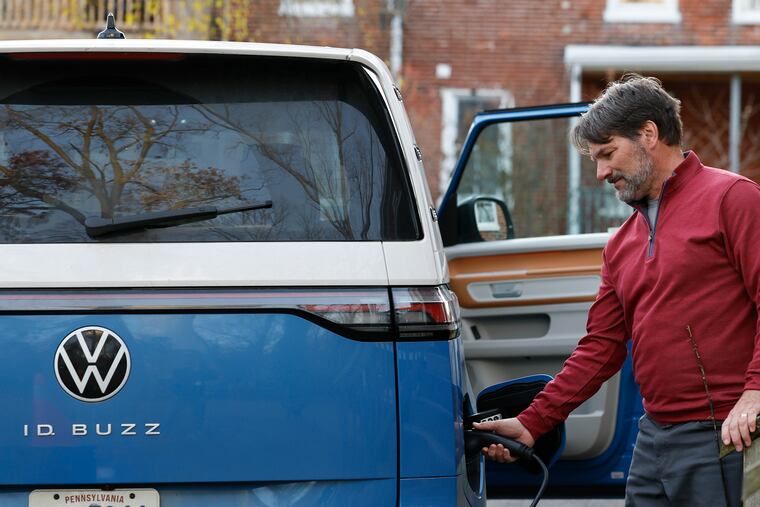
EV owners like Peter Doehring of Kennett Square are noticing the changes. He has owned four EVs in total since 2019 and currently has a Ford Lightning, Tesla Model Y, and a VW ID. Buzz.
“We’ve done a bunch of road trips for each of the vehicles,” Doehring said. “So for the Tesla, that network was not great when we started — like [when] we had a long-distance trip we really had to plan in advance.”
Now, though, “I feel pretty comfortable I can find a charger almost anywhere unless I’m really out of the major areas,” Doehring said.
Outside the Tesla network, though, it’s not so good.
Public investment
The Trump administration in February froze funding for the $7.5 billion National Electric Vehicle Infrastructure (NEVI) program and Charging and Fueling Infrastructure (CFI) grant program, part of the Bipartisan Infrastructure Law passed in 2021. The NEVI program planned a network of charging stations every 50 miles on major highway corridors, and CFI will fill in EV charging gaps.
The end of the NEVI program didn’t survive a court challenge after 14 states sued. A judge in the Western District of Washington ordered funds to be released in late June, according to NPR.
Pennsylvania was among states that forged ahead regardless because it already had its funds obligated for its 86 stations. In March, eight charging stations were in place and operational; 22 are online now, according to PennDot, which expects another dozen stations online shortly. (True to Malmgren’s word, this number rose twice in two days the week before Thanksgiving.)
Still, there’s a question of how effective federal dollars will be.
“Frankly, if you can’t make a charger work without government subsidies, then you need to take a hard look if it’s a good investment regardless, because at some point it has to stand on its own two feet,” Doenges, of the Transportation Energy Institute, said.
But chargers in remote areas become a lifeline for travelers. The more recent NEVI-funded stations arose in remote, highway-adjacent places like Chambersburg, Altoona, and Slippery Rock, and in Clearfield, Clinton, and Lebanon Counties.
The Department of Transportation did announce slightly adjusted rules in August, allowing states more control, specifically easing the rule that stations must be available every 50 miles.
The new Trump administration guidance “has been helpful‚” said Andrew Wishnia, a senior vice president at Boundary Stone Partners, the former deputy assistant secretary for climate policy at the U.S. Department of Transportation, and a principal architect of the Bipartisan Infrastructure Law.
Wishnia said the more flexible rules make it easier for states to address their individual needs, pointing in particular to Wyoming’s approved NEVI plan as one example. That sparsely populated state popular with tourists was able to count privately funded charging stations already in place along some corridors in its plan and instead build more public chargers near national parks and other sites. “It’s totally consistent with the design and architecture of a national EV charging network,” he said.
A PennDot spokesperson said there has been no change in the map for Pennsylvania based on those new guidelines.
The end of rebates
Two months after EV rebates ended, EV futures can appear quite bleak. Malmgren said some reports show October sales were down 50% compared to September, and average prices in October hit an all-time high.
Car and Driver reported sales of the Hyundai Ioniq 5 dropped 63% and the Kia EV6 was down 71%.
Getting a clear picture before the end of 2025 is difficult because not all carmakers report monthly sales. Also, the drop-off in October followed a spike in September, as buyers rushed to grab rebates.
Still, consumer interest remains strong. A Nov. 7 J.D. Power report shows that 24.2% of active new-vehicle shoppers “very likely” will consider buying or leasing an EV in the next 12 months, up from 21.6% in September, the highest level since January.
“We’ll see the shakeout of supply and demand in the next year,” said Sam Fiorani, vice president of AutoForecast Solutions in Chester Springs.
Federal funds slowdown
So despite the turmoil and changes of 2025, 2026 holds the promise of more EV charging money for Pennsylvania.
This second part of the NEVI program is designed to fill in the gaps around the original 86 NEVI stations along major highway corridors. PennDot will accept new proposals until Jan. 30, according to a PennDot spokesperson.
Public or private, adding charging stations remains important, even to those who have already purchased EVs.
John Fetters of Kennett Square bought his 2023 Hyundai Ioniq 5 new. He loves the smooth ride and being able to start from home with a full charge, thanks to a simple 220-volt outlet he had installed. And yet he relies on the family’s Subaru Outback for long trips.
“As much as we’re loving the EV, I’m just not always having full confidence on availability and accessibility of charging stations,” Fetters said.
Still, the selling points of EVs for consumers like Fetters and Doehring show there’s still room for growth.
“We definitely believe that EVs are the future,” Malmgren said. “The rest of the world is moving forward with EVs. We’d like to see policies that accelerate it.”

It's no surprise that gasoline pumps far outnumber charger ports in Pennsylvania and New Jersey, as the former have had an almost 100-year head start. And EVs can be charged at home or hundreds of public sites with slower chargers.
Pennsylvania has high-speed EV charging at 382 stations with nearly 1,700 high-speed charging ports. New Jersey has 389 stations with over 1,800 ports.
Because of its full-service requirement, the Garden State keeps clear data, and counts 3,292 gas stations. The Keystone State has 3,627 convenience stores that sell gasoline, but has more gas stations than that.