A South Philly robot maker is now a publicly traded company
Exyn Technologies Inc. has 45 employees, and looks to add sales and business staff.
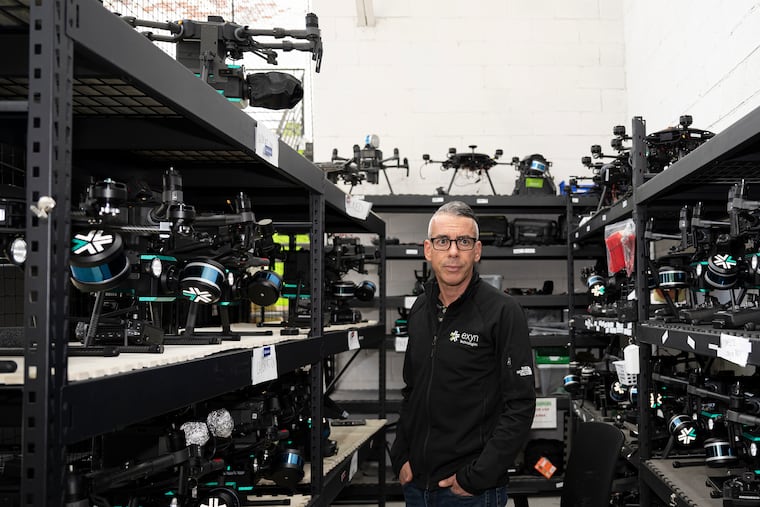
A Philly-based tech company, whose Point Breeze warehouse buzzes with flashing drones testing hardware and software, went public on Monday as it looks to grow.
Exyn Technologies Inc., the robot-guidance systems maker, grossed $19.4 million in an initial public stock offering (IPO) on Monday.
The company employs 45, many of them engineers, and is adding to its sales and business staff. Exyn plans to use the share money for growth and working capital, to pay its IPO underwriters, and to repay around $6 million to its lenders, led by Western Alliance Bank.
Why go public now?
“The vision I laid out was to grow faster. To do that, we could have raised more venture capital, or we could get acquired, or we could take the company public,” said CEO Brandon Torres Declet.
“Given the excitement in the public markets around drones, and all the attention our robotics has been getting, our timing was perfect to take the company public,” added Torres Declet, who has led the company since 2023, when he took over the CEO role from Exyn cofounder Nader Elm.
In its statement to prospective shareholders, Exyn said its mission is “to deliver world-class autonomous robots to data-hungry industries.”
Exyn’s products include its ExynAI navigation and mapping software platform, and its Nexys drone mapping systems. Buyers include robot-makers and mining, construction, and military supply companies, which have deployed Exyn systems in a total of 27 countries, the company says. Some Exyn products are sold through distributors in China, India, Australia, and across Latin America.
Under trading symbol EXYN, the stock went public at $7.75 and soon traded lower, changing hands Tuesday for around $5 a share. Each share sold incudes a warrant giving investors the right to buy an additional share of Exyn at the IPO price, once the stock reaches $9.69 per share.
Exyn was taken public on the Nasdaq Capital Market by Lucid Capital Markets, a New York investment bank. Lucid’s previous tech IPOs this year, drone software maker Swarmer Inc. and data center operator SharonAI, also slipped after their IPOs but now trade far higher.
Exyn’s earlier investors included military-focused Anzu Partners, a firm linked to the Japan-based Softbank Vision Fund; In-Q-Tel, which invests in tech companies that sell to the CIA; Pennsylvania-funded Ben Franklin Technology Center of Southeast Pennsylvania; and Penn Alumni-funded Red & Blue Ventures. Early funding also came from the Defense Advanced Research Projects Agency, the research and development arm of the U.S. Department of Defense.
Exyn’s sales totaled $5.8 million last year and $5.6 million the year before. Torres Declet attributed slower growth to “a shift in revenue mix from single-use sales to recurring products,” and said it’s his job to boost sales faster.
Exyn cut research and development spending in 2025, while sales and operating costs remained steady and financial costs rose. The company’s losses totaled over $12 million in each of the past two years as the company built the products it is now marketing.
“My goal is a pretty good growth trajectory in 2026 and beyond,” Torres Declet added.
Exyn was founded in 2014 by Penn robotics scholar Elm and professor Vijay Kumar, now dean of Penn’s engineering school. At Penn, Elm worked for Kumar’s General Robotics, Automation, Sensing and Perception (GRASP) lab that did groundbreaking research in the development of drone quadcopters. The company’s initial clients included mining companies hoping to reopen closed deep mines in the U.S., Canada, and other countries.
Some Exyn employees were initially leery of military work. The IPO prospectus says the company’s Exyn Defense Inc. subsidiary now focuses on such military uses as “autonomous systems for reconnaissance, contested logistics, and force protection,” for use in underground tunnels and on city buildings. Exyn’s Range-brand products offer “uncrewed” navigation and mapping to military and national-security users on battlefields and in other places where GPS doesn’t reach.
The company plans to sell more systems to mining companies in Australia, South America, and Africa. It’s also looking to sell to builders of bridge, tunnel, power plant, and transportation infrastructure. And it’s planning to provide technology for underwater and unmanned-ship applications, as well as uses in space.
Exyn also hopes to acquire other companies, despite what it acknowledges is its “history of losses” so far. Torres Declet says he’s confident Exyn will grow sales and attract more investment.
The lease on the company’s Washington Street headquarters ends next year.
“As we grow the team, we have more revenue, from more products, and we will need more people. So we will need more space,” said Declet Torres. The company has been looking for new, larger quarters, preferably in the Philadelphia area, the CEO added.