Women hold 9 CEO positions at Philadelphia’s top 100 public companies
Women have taken on more leadership roles in Philadelphia’s largest public companies, according to an annual report from the Forum of Executive Women — but lack of parity continues.
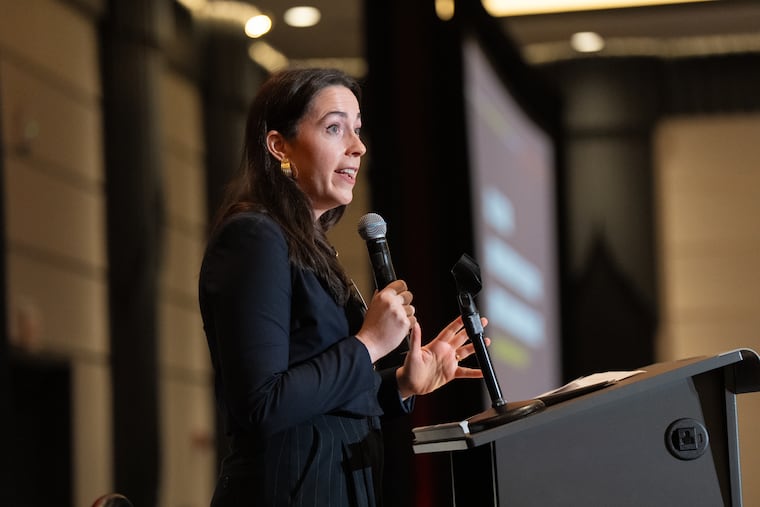
Women filled more of the top leadership positions at large public companies in the Philadelphia area in fiscal year 2024 than they did the previous year. But workplace parity remains to be achieved.
“We’re showing measurable but slow progress,” said Meghan Pierce, president and CEO of the Forum of Executive Women, which this week released its annual report measuring women in CEO positions and on corporate boards. “As we look at this data year to year, we are definitely discouraged by how slow progress is.”
The Forum counted women in leadership positions in fiscal 2024 across the region’s largest 100 public companies by revenue, using data from U.S. Security and Exchange Commission filings.
Pierce says the forum is using its platform to highlight some factors holding women back in the workforce, such as the lack of paid family leave in Pennsylvania and lack of pay transparency. These are “structural issues that might prevent someone from getting to where they deserve to be,” she said.
Who are the region’s female CEOs?
Still, the number of women CEOs in the Philadelphia area more than doubled last year, from four in 2023 to nine last year.
Three were on the list last year:
Ellen Cooper at Lincoln National Corp.
Denise Dignam at Chemours Co.
Susan Hardwick of American Water Works Co.
Hardwick, however, recently retired and was succeeded by John Griffith.
The newcomers are:
Lori Koch of DuPont de Nemours Inc.
Winnie Park of Five Below
Mojdeh Poul of Integra LifeSciences Holdings Corp.
Suzanne Foster of AdaptHealth Corp.
Natalia Shuman of Mistras Group Inc.,
Nicholle Taylor of Artesian Resources Corp.
Carole Ben-Maimon, of Larimar Therapeutics, was included on the list last year and remains CEO of that company, but Larimar is no longer among the top 100 local public companies by revenue.
Getting more women in to CEO roles, Pierce said, will require “making long-term investments in women and putting them in the pipeline for those top jobs.”
More female board members
On the boards of 100 Philly-area businesses in 2024, women occupied 15 more seats than the previous year, bringing women’s representation on boards up to 30%.
Despite that progress, six companies still have no women on their boards, an increase from three last year. That number has not increased since 2013.
“We have to call that out,” said Pierce. “A company with no women on their boards is troubling for us.”
In 2013, 35 of the 100 companies didn’t have women on their boards.
A “troubling” decline in DEI reporting
This year’s report noted that fewer area companies had chosen to report their DEI policies, racial and ethnic makeup of their boards, and/or of their workforce. In 2023, 87% of the region’s top 100 companies had shared at least some of this information, but that dropped to 62% a year later.
Pierce said this is “troubling.” She said she expects that number to continue dropping amid President Donald Trump’s curtailing of DEI efforts, “just given the environment that we’re operating in — but maybe I’ll be pleasantly surprised.”
The Trump administration has called for the end of federal DEI programs, and offered universities greater access to federal funding if they agreed to make certain changes, including removing gender and ethnicity from admissions decisions.
A recent Gallup and Bentley University report also indicates that fewer people believe DEI should be a top business priority. This year, 69% of people thought DEI was “extremely or somewhat important for businesses to promote,” down from 74% in 2024, the report said.
Editor’s note: A previous version of this story contained a percentage that could not be verified. It has been removed.
