With gold near $5,000 an ounce, Americans empty their attics, and buyers hire to keep up
Americans are selling family treasures to raise cash.
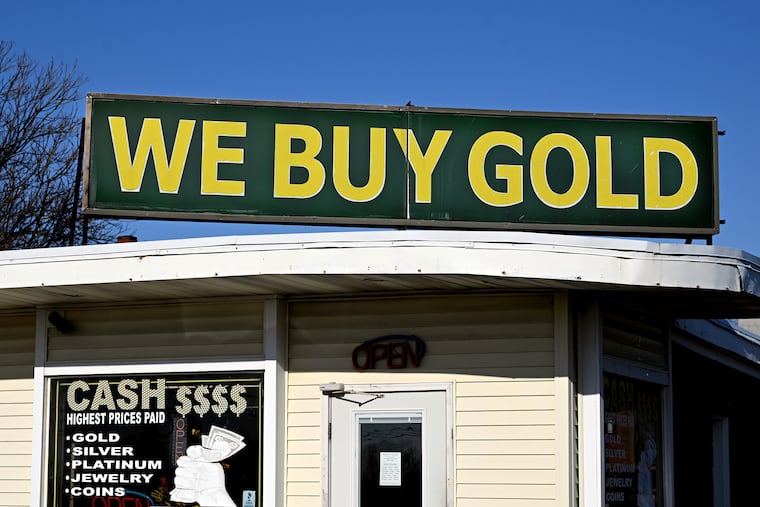
Gold doubled in price over the past two years, briefly topping $5,000 a troy ounce on Jan. 28. Since then, it’s stayed close to that price, a record high even after discounting inflation.
Around the same time, silver topped $100 an ounce for the first time, and the price has been bouncing since, from $70 to $90.
Precious metals buyers say higher prices have enticed more Americans to cash out their late parents’ jewelry and other gold and silver items, some of which have been in families for generations.
“The traffic has increased dramatically in all four stores,” said Mark Schimel, who runs the Center City store of California-based Stack’s Bowers Galleries, which auctions rare coins and sells the rest to industry. “Our staff has not been able to keep up. We’ve had to bring in additional people to process and ship.”
Alloy Market, which buys precious metal coins and jewelry online from its industrial park offices near Newtown, Bucks County, has increased its staff to more than 20 people as transactions doubled, said Brandon Aversano, its founder. Sales topped $10 million last year and are on track to double this year.
Alloy uses weighing and imaging equipment to determine precious metals content and assign prices. The company has had to schedule appointments, set security protocols, and add guards to handle customers who have been finding their way to the office despite a lack of advertising,
What’s driving precious metal inflation?
“The key driver is uncertainty — political uncertainty, inflation, interest rates, belief in the future value of the dollar, all of those things are in flux now,” Aversano said.
Meanwhile, “central banks are buying tons of gold. Some high-net worth individuals want more,” he said.
And the U.S. Geological Survey, which collects metal mining and demand data, says the new generation of giant high-speed and AI-generating data centers are demanding more precious metals for server boards and circuits. Nvidia and other chipmakers require gold.
“All of that results in a supply squeeze,” Aversano said.
More people are treating the family jewelry box as a savings account for special needs, he said.
“Maybe they have medical bills. They want a vacation,” Aversano said. “We’re starting to get millennials with their parents’ 1970s jewelry they don’t want to wear. We offer 90% and greater vs. the spot price” for gold content.
His business, backed by state-funded Ben Franklin Technology Partners and private investors, has been profitable for the past two quarters, he said.
On April 20, Alloy launched an online jewelry resale market as an alternative to melting down items, giving sellers a cut of any resale price.
When Alloy Market opened in 2023, individual sellers would send in a pair of gold earrings or a ring and a charm bracelet. This year Alloy is averaging eight pieces per deal, for more than 500 customers on the busiest weeks, Aversano said.
Quick turnover
Most jewelry is only worth the value of its gold, minus a discount that covers handling, measuring, and profit. Jewels don’t add much value.
“People fall in love with their items and think it’s worth a premium,” said Schimel, the store manager. His advice: “Lose that attachment.”
He says $5,000 an ounce seems to have been a “psychological pressure point” that brought out more sellers.
”Not everyone is watching the spot prices of gold and silver. A lot of people don’t know it’s hit a record,“ Schimel said. ”But their neighbor or their cousin sells it, they get the money, and then they decide to come in, too.“
Silver’s volatility forces a bigger discount from the quoted price of silver, compared to gold. “We can price close [to market prices] because we work on volume. But if we don’t sell right away, we can lose money on it,” Schimel said.
For example, on Jan. 28, silver hit $120 an ounce. Two days later it was at $85.
“We want people to be satisfied, but we also have to protect ourselves,” Schimel said.
What happens when prices inevitably fall into a cyclical funk? “It’s a two-sided marketplace — small sellers, industrial buyers — traders can make money either way,” said lawyer Gregory L. Seltzer, a partner at Ballard Spahr who specializes in startups and tech-based businesses. Alloy is a client.
Digital traders like Aversano have taken gold sales “into the open, with clear certainty on both sides,” Seltzer said. “You want to eliminate getting caught in the middle, in the fluctuation of the pricing.”
If unsold metals pile up, a dealer has to store them, which boosts expenses. “I’d be nervous if that became the business model long-term,” Seltzer said.
Aversano says Alloy Market has had customers from all states. Four customer service representatives, working remotely, each average over 100 calls a day.
He’s glad the staff has grown to where he can turn over routine work to employees, but he also feels the responsibility of supervising a larger business.
“I think of the kids on our health insurance, the families we pay,” Aversano said. “It’s hard to math everything out and be sure when it’s time to hire another person.”
Editor’s Note: This story has been updated to correct the number of precious-metals transactions Alloy Market performs.