J&J’s baby powder caused a woman’s fatal cancer, a Philly jury finds, awarding her family $250,000
There are 176 lawsuits in Philadelphia claiming Johnson & Johnson's baby powder causes ovarian cancer. The jury awarded $250,000 to Gayle Emerson's family.
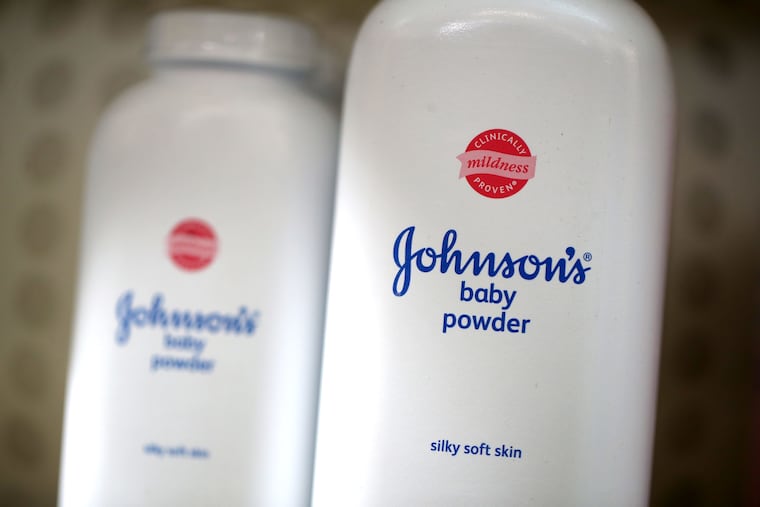
A Philadelphia jury ordered pharmaceutical and cosmetics giant Johnson & Johnson to pay $250,000 to the family of a York County woman after finding the company’s baby powder product led her to develop cancer.
Gayle Emerson sued Johnson & Johnson in 2019 as part of a nationwide wave of litigation accusing the company’s talc-based baby powder of causing ovarian cancer. Emerson, who was diagnosed with cancer in 2015, died at age 68, months after filing the complaint.
The complaint accused the New Jersey-based company of selling a defective product and failing to warn about its risks.
After a three-week trial, which Common Pleas Judge Sean F. Kennedy presided over, the jury began deliberating Tuesday afternoon and reached its verdict Friday around 2 p.m. During deliberations, jurors asked the judge questions that suggested they grappled with how strongly the evidence showed that external use of baby powder could allow a cancer-causing substance to reach the ovaries.
The verdict was comprised of $50,000 in compensatory damages and $200,000 in punitive damages.
“This token verdict reflects the jury’s appreciation that the claims were meritless and divorced from the science,” Erik Haas, Johnson & Johnson’s worldwide vice president of litigation, said in a statement.
The company plans to appeal the verdict, Haas said.
Johnson & Johnson specifically advertised the product for women, the suit says, stating on the bottle: “For you, use every day to help feel soft, fresh, and comfortable.”
Studies have connected talc to ovarian cancer since the early 1970s, according to the complaint. The mineral is excavated from the mines that also contain asbestos, risking contamination from the cancer-causing substance.
The Federal Drug Administration asked condom manufacturers in the 1990s to stop dusting their product with talc because of the risk to women.
Johnson & Johnson stopped selling its talc-based baby powder in the United States and Canada in 2020.
The company was aware of the research about the increased risk of cancer for women who use the powder on their genital area, the suit says, based on internal documents and public statements.
“Gayle Emerson trusted Johnson & Johnson, and Johnson & Johnson betrayed that trust,” Leigh O’Dell, a Beasley Allen attorney representing Emerson’s family, said in her opening statement.
» READ MORE: Unsealed emails show how Johnson & Johnson shaped report on talc’s links to cancer
Attorneys in Pennsylvania aren’t allowed to advise jurors on how much to award in damages, but O’Dell noted in her closing argument that Johnson & Johnson’s net worth is $72.3 billion and a verdict should be “enough” to get the attention of the company’s boardroom.
Emerson didn’t rely on any false statement or misrepresentation by Johnson & Johnson before purchasing the baby powder, the company said in court filings. Further, the FDA considered and rejected requests to add a cancer warning to talc powders in the 1990s.
During the trial, attorneys for Johnson & Johnson said the baby powder, which Emerson used externally, wasn’t responsible for the cancer. Other parts of her feminine care routine, such as douching, are also associated with increased risk of ovarian cancer, the attorneys said, and Emerson had other risk factors such as family history, obesity, and age.
Emerson’s attorneys ignored those risk factors because they have “talc blinders” on, Shaila Diwan, a Kirkland Ellis attorney representing the company, said to the jurors at the outset of the trial.
“Ms. Emerson would have still developed cancer if she never used Johnson’s baby powder,” Diwan said in closing.
It’s important that the jury found that Johnson & Johnson was directly responsibe for Emerson’s cancer but the award is “significantly less than the amount necessary to punish J&J,” O’Dell said in a statement.
Friday’s verdict follows a $40 million December verdict out of Los Angeles for two women who similarly claimed the talc-based powder caused their cancer.
While the Philadelphia trial was proceeding, a three-judge panel of a New Jersey appeals court disqualified Beasley Allen from the baby powder litigation in the state for ethical violations. The Alabama-based firm has been accused of receiving privileged information from an attorney who previously represented Johnson & Johnson. The firm said it would appeal the decision.
It’s unclear if the ruling will impact the Pennsylvania verdict, or future Beasley Allen cases outside New Jersey.
Emerson’s is the second talc-related lawsuit to reach a verdict in Philadelphia, after a 2021 trial concluded with the jury siding with Johnson & Johnson.
There are 176 lawsuits similar to Emerson’s pending in the Philadelphia court, and thousands across the nation. Another trial against Johnson & Johnson in a City Hall courtroom is scheduled for April.
The city has a significant and dark place in the history of talc.
Records from a 2021 case in California revealed that Johnson & Johnson hired in the 1960s a University of Pennsylvania dermatologist to study talc on the bodies of people incarcerated in Philadelphia’s now-defunct Holmesburg Prison.
In 1971, Albert Kligman injected asbestos, talc, and other substances into the backs of incarcerated Black men for payments as low as $10 a shot. The study was one of hundreds of human experiments conducted by Kligman, with funding by entities such as Dow Chemicals and the U.S. government.