Don’t deport our workers, Philly-born union president tells U.S.
James A. Williams Jr. heads a union of 140,000 painters and glaziers. Many are immigrants, and he is opposing Trump administration plans for mass deportations of workers.
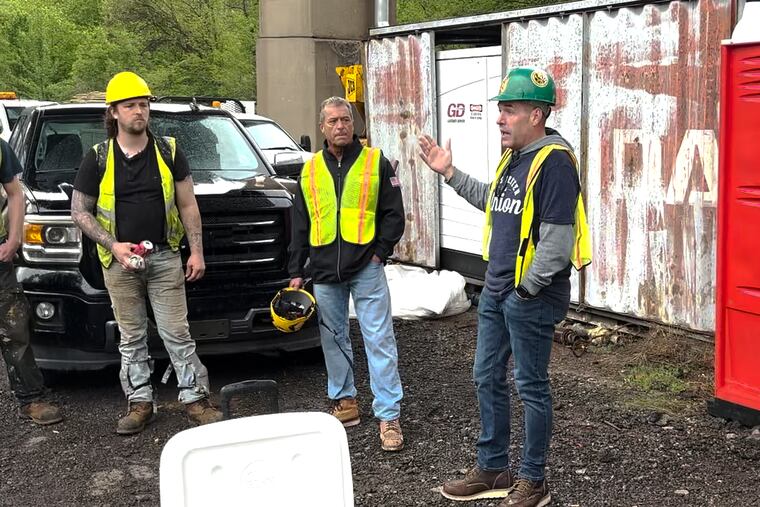
Philadelphia native James A. Williams Jr., president of the 140,000-member International Union of Painters and Allied Trades, which has many immigrants and descendants of immigrants among its members, has been visiting members across the U.S. urging solidarity as the federal government revokes legal protections for immigrant workers from many countries and deports more foreign-citizen workers.
Williams, also vice president of the AFL-CIO union federation, took questions from The Inquirer just before Labor Day. Responses have been edited for clarity and brevity.
How did you come into the labor movement?
I’m a glazier, a member of Local 252, here in Philadelphia. My father was leader of that local, and he headed our international union in the U.S. and Canada (2003-2013.) My late uncle Ralph Williams was head of the Philadelphia building trades council (in the 1980s).
Is there a lot of work for your members this year?
In Philly, it’s busier than it was a year ago. The Navy Yard is carrying the city, along with Drexel, and the other universities. At the Navy Yard, it’s office projects.
Around the country, work has flatlined. Certain parts of the country are slower than others.
You’ve spoken in support of immigrant workers and for diversity. What moved you to do that?
The workforce in this country has diversified, especially in construction. It’s been going on for many years.
I hate to bring up politics, but it’s there. The policies of the federal government affect us.
First-generation immigrants have always gravitated to construction. The older immigrant groups that made up our unions were Irish, then Italian and Eastern European. In the fourth and fifth generation, their kids are going to college; they are taking white-collar jobs. In the last 30 years, we see more Central and South American immigrants.
The problem we have is the lack of immigration policy in this country, where we can greet these workers in ways that are humane, and we have pathways to citizenship.
You hear it from construction owners, big general contractors, the entire construction industry. And from the union sector and from the Associated General Contractors [of nonunion or as Williams says “unorganized”] employers.
Our individual employers are saying, “Where is the workforce of tomorrow?” Even where work is slower, our unemployment is still very low. But workers are retiring.
So in our industry, employers and unions agree we need a solution. But in Congress, there’s nobody in the middle saying, “Let’s get work authorization and make it work for both parties.”
Are American-born workers concerned?
It depends on where you are. The East Coast, it’s always been a melting pot from Europe, Latin America, the Caribbean. Puerto Ricans come here as U.S. citizens. In Florida and Georgia, you have Cuban immigrants. Out West in California, our union is 85% Latino, mostly Mexican immigrants.
And in the middle of the country, there are people who will say, “Those workers are here to take our jobs.” There’s that tension.
Are other unions in the same struggle?
There’s a coalition of labor leaders with us. We work closely with SEIU, the hotel workers, the laborers, the bricklayers, the ironworkers, and some others to try to set policy and talk to the workforce, vs. this political divide.
Do you see leadership in Congress? Is anyone working toward a solution?
You can sit and talk to Sen. Dave McCormick [R., Pa.] and Sen. John Fetterman [D., Pa.] and say, “This is the reality.” But neither one is willing to step away from their party leadership and say, “This is crazy.”
Our belief is it’s one of these wedge issues that has permeated our politics. Not many are talking sense on it.
Our coalition started around TPS, Temporary Protected Status, which Congress set up for workers in countries facing an armed conflict or other extraordinary conditions. We have many workers from Central and South America, Eastern Europe, Africa, Asia, who have had that status for 15 or 20 years. We’ve lobbied together on this for 30 years. It’s been United States policy. We welcomed these immigrants with work authorizations.
It was difficult to find them a pathway to citizenship. That got deferred.
But this current administration has made every effort to strip that status out. They are removing countries from the list. They are putting another million and a half people under the roles of the “undocumented.”
The previous administration had this right but was afraid to [publicly advocate] their policy.
The Department of Labor also gave authorization for victims of workplace crimes, such as wage theft or retaliation for organizing, to continue working [while their cases were reviewed]. I never heard anyone in Congress oppose that.
There’s an H2-B visa program that allows workers in for employers who request people [with specific skills]. It’s broken. It’s an employer-driven program; it should be industry-driven. The way it stands today, if a worker with an H2-B visa loses their job, say the company goes under, they lose their employment authorization. And they go into the shadows.
We are going to need a lot of construction workers. Why not allow that they move from one employer to another when the time comes?
Is this a big change in federal policy?
President George W. Bush ran on trying to find a solution. He ran on a pro-immigrant platform. Being from Texas, he knew the value immigrants have on the economy.
President Barack Obama had the votes, but he played it soft. There was a “Gang of Six” bipartisan senators under Obama, when they came really close to passing comprehensive immigration reform.
But since then, neither party seems to think they can get the votes.
President Donald Trump has said from time to time he might make new permits for farmworkers. Any sign he’ll call off U.S. Immigration and Customs Enforcement raids?
Trump in his first administration tried really hard. And the door was open.
Trump 2.0 is way different. He’s weaponized U.S. Immigration and Customs Enforcement. The amount of money that just got approved in the “Big Beautiful Bill” shows it. The rhetoric today is much different from eight or nine years ago.
How are the unions dealing with this switch by the president?
It’s the issue that divides our membership from within more than any other. We do the best we can. We have some really knock-down, drag-out conversations with our members about where the real enemy lies: It’s with the employers who knock down labor standards.
They are having a harder time making that connection when the president of the U.S. is demonizing the immigrant. You never hear him say anything about industries knocking down the workers.
Brett Murphy, a white dude, third-generation bridge painter in Philadelphia, recently gave one of the best testimonies at a gathering of our members: “We work in dangerous settings. We climb bridges every day. My brother to the left and my brother to the right, they are my life. I depend on them. You take away my brother, you put my life at risk.”