How unknown Chinese ‘insider traders’ cost Jeff Yass’ firm more than $70 million
Susquehanna Investment Group won an injunction against a “John Doe” gang.
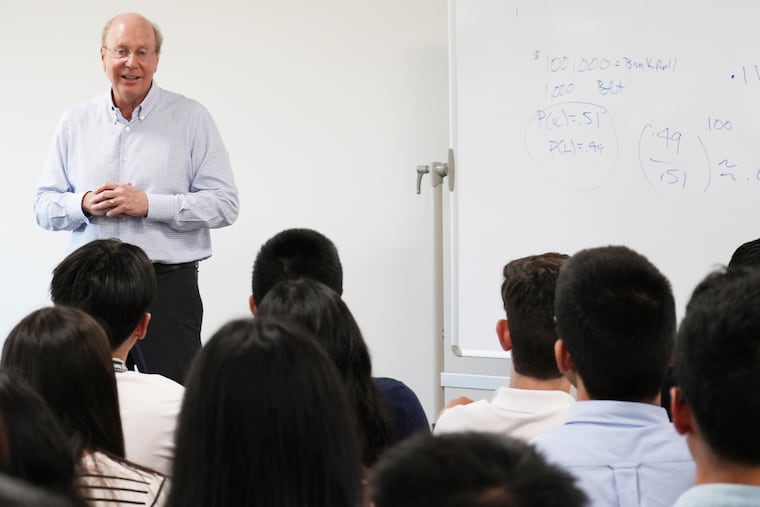
Susquehanna Investment Group, the Bala Cynwyd investment and trading firm that has made cofounder Jeff Yass the richest man in Pennsylvania, on Monday persuaded a federal judge in New York to freeze accounts of up to 100 options traders, who the firm contends used inside information to book illegal profits of over $100 million, largely at Susquehanna’s expense.
The firm won the temporary injunction even though Susquehanna acknowledged it didn’t know the names of any of the alleged inside traders. It hopes the freeze will force them into the open.
Susquehanna’s lawsuit, accusing them of illegal insider trading and unjust enrichment, identifies each as “John Doe” and asks the court to order the traders to pay back their illegal profits, plus expenses.
“The timing, size, type and pattern of their trading, and the lack of any plausible alternative explanation” for some 200,000 “short-dated put options” are “powerful evidence” of the scheme, according to Susquehanna’s June 29 complaint. The company alleges that someone traded illegally on inside information about the Chinese government’s planned May 22 crackdown on international trading platforms.
At the firm’s request, Judge Arun Subramanian of U.S. District Court in Manhattan signed an order that day freezing the unknown traders’ profits from suspiciously successful bets that the valuations of two online trading firms would shortly crash:
Futu Holdings Ltd. (which trades under the share symbol FUTU), a Hong Kong-based, Nasdaq-listed online brokerage
UP Fintech Holdings Ltd. (TIGR), the Singapore-based, Nasdaq-listed owner of New York-based TradeUp Securities, another electronic trading platform.
The preliminary injunction stopped the unknown traders from cashing out Futu and UP Fintech options held in their accounts at brokerages associated with both of the firms and with Interactive Brokers Group Inc., billionaire online-trading pioneer Thomas Peterffy’s Connecticut-based trading platform. The brokerages themselves were not accused of wrongdoing.
The traders will have a chance to ask the court to release their assets at a hearing July 10 in New York, after posting $100,000 in advance — effectively identifying themselves as defendants in Susquehanna’s suit. The court order also authorizes Susquehanna to subpoena broker records in an effort to learn their identities.
On Wednesday, Bloomberg reported the SEC is investigating the case.
According to Susquehanna’s complaint, the traders, operating through their brokerage accounts, bought $12 million worth of low-cost options in Futu and UP Fintech, betting the stocks would decline in the days before China announced stern penalties on brokers accused of illegally moving cash to foreign markets.
The purchases were many times the usual volume of Futu and UP Fintech options trades and accounted for most of the trades in those options during that period, according to the suit.
Futu and UP Fintech announced on the day of the crackdown that they were, in fact, facing enforcement actions by China regulators, with proposed multimillion-dollar penalties.
That news sent each stock crashing more than 30%, according to the lawsuit — a loss for shareholders and for other options traders who were betting the stocks would rise, but enriching the unknown traders who had bet on a drop.
In all, the news boosted the value of the unknown traders’ investments by more than $100 million, according to the suit.
More than $70 million of the profit was made on options purchased from Susquehanna, the suit says.
The options purchases were so closely coordinated, their expiration dates so soon after May 22, that the trades “suggest inside knowledge” of the crackdown, the suit contends.
Susquehanna suggested two possible groups of insiders, who either “tipped” favored traders to buy the options, or illegally traded on the inside information themselves:
Futu and UP Fintech staff “who had knowledge of discussions with Chinese securities regulators” or
Corrupt Chinese securities regulators who knew in advance of their agency’s own enforcement actions.
Acting on such insider information is illegal under Chinese and U.S. law, according to the lawsuit, and adding the scale of the profits makes this “one of the largest documented cases of insider trading in recent memory.”
Susquehanna asked for a jury trial, the return of $71.4 million it lost to the traders, plus costs and other payments.
Susquehanna is one of the biggest U.S. “proprietary trading” firms that buy and sell securities, mostly using their partners’ funds.
Under Yass, it has also been a pioneering, long-term investor in China-based digital companies. That includes large positions in TikTok owner ByteDance.
Because of the fraught U.S.-China relationship and concerns by Congress members of both parties about TikTok’s influence over U.S. consumers, President Donald Trump and other U.S. officials have mulled potential restrictions on TikTok’s ownership and operations, and Susquehanna and other investors in that business have been obliged to engage with them. Yass is a prolific political donor.
Susquehanna has reinvested profits from its large, lucrative trading operations into more than 350 China-based tech, retail, and industrial companies. Some of them have prospered, and for many more profits have been elusive.
The firm also has funds that invest in U.S., European, and Israeli private and public companies, and in South and Southeast Asian companies.