How Philly helicopter makers cope with uncertainty at today’s Pentagon
“Destabilizing and difficult” changes in payments keep the manufacturers on edge, while managers scramble to prevent worker layoffs.
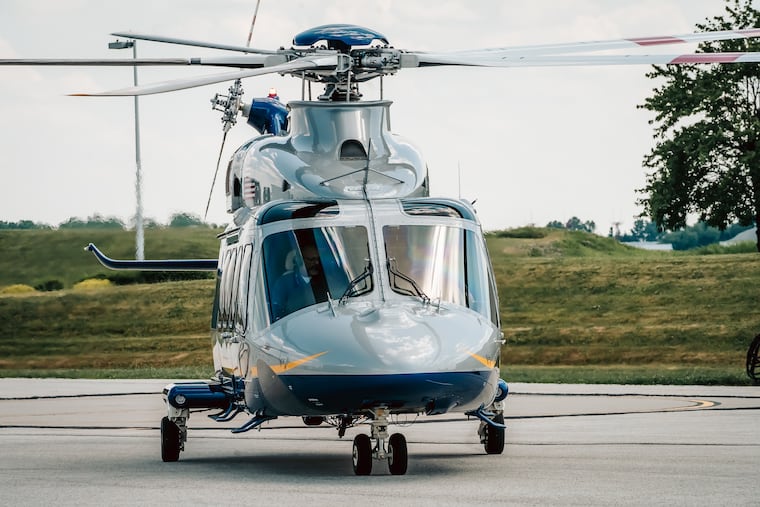
Helicopter manufacturer Leonardo has nearly doubled employment at its Northeast Philadelphia factory since the Rome-based multinational aerospace company began winning U.S. military orders for that factory in the late 2010s.
But the company, whose owners include the Italian government and U.S. investment funds such as BlackRock and Vanguard, has learned what dominant U.S. defense contractors like Boeing have long known: Military planners, policy, and political shifts can stop, delay, or revive long-term contracts, leaving managers scrambling to keep workers and factories busy.
Given the complexity of parts supply, skilled labor, and other aspects of helicopter production, “it is destabilizing and difficult if you don’t know if you are going to build two or 16 aircraft for a given program year after year,” said Andrew Gappy, vice president of Leonardo Helicopters USA Inc., a retired Marine whose duties included flying Presidents Bill Clinton and George W. Bush on Marine One helicopters.
In 2018, Leonardo and Boeing celebrated a signal victory. The Air Force ordered 84 MH-139A Grey Wolf helicopters, worth an expected $2.4 billion.
Grey Wolf is based on Leonardo’s civilian, two-engine AW139, part of a movement by military planners to speed production and streamline costs by basing more big-ticket military machines on large-production civilian products and private-sector construction managers. It’s a model that Korea-based Hanwha hopes to use in winning Navy contracts for its shipyard in Philadelphia.
More than half the Grey Wolfs would defend nuclear weapons bases in several western U.S. states. Most of the rest would be used to ferry political leaders around Washington in case of an attack on the nation’s capital, replacing aging UH-1N Huey helicopters on duty since the 1970s.
So far, 19 of those helicopters have been paid for and delivered. Another 12 are funded and nearing completion. But funding for future construction hit unexpected snags.
After Air Force design changes and a challenge by Lockheed Martin’s Sikorsky unit, which had proposed rival helicopters of its own, Leonardo and Boeing said they started production on the first Grey Wolfs in 2023.
They planned to keep building a dozen a year for seven years — about a quarter of the Leonardo plant’s annual output. They hoped to win more contracts along the way.
Last year, the partners had expected to fund future production with $173 million in appropriations as laid out in President Donald Trump’s 2025 budget, plus $210 million in his Big Beautiful Bill, backed by the two Republican senators from North Dakota, home to Minot Air Force Base.
But those payments didn’t materialize on schedule. The Big Beautiful Bill payments were held up, frustrating the Grey Wolf partners.
And then in November, Congress’ new National Defense Authorization Act listed more than $100 million retrofitting previously-delivered Lockheed-built helicopters to transport VIPs but just $10 million for the Grey Wolf program — not enough to build a single helicopter.
The Air Force had justified upgrades of unused aircraft in a budget proposal earlier last year as a cheaper way to acquire helicopters. Grey Wolf defenders objected that the Air Force studies had already verified the new helicopter would be much less expensive to operate.
The cuts would “starve” the Grey Wolf program, Mike Cooper, Leonardo’s government relations chief, said in December. “It’s hard for businesses to plan, when competitively bid procurements can be abruptly and unilaterally changed.”
Last fall, a bipartisan group of five Congress members, headed by Rep. Donald Norcross (D., N.J.), whose South Jersey constituents include workers at Boeing and Leonardo, sent Air Force Secretary Troy Meink a letter that they were “troubled” to hear reports that the Air Force was now planning to update old helicopters for VIP transport and evacuation missions, instead of funding the new ones.
They noted that the Air Force already had selected the Boeing-Leonardo aircraft over two proposals from Lockheed Martin.
They called the switch an “unprecedented change in procurement,” which “undermines the integrity of the acquisition process, calls into question the criteria” for the original selection, “and raises concern about why an otherwise performing program would be truncated without clear explanation to Congress” or the companies that agreed to the contract.
They asked the Air Force for any studies it had made to justify the more expensive Jolly Green program, which they said would cost far more to buy and operate. They also noted the impact on workers, suppliers, and finances at Boeing in Ridley Park, Leonardo in Northeast Philly, Leonardo’s Florida testing site, and contractors who had already invested in the program the Air Force has now failed to fund.
Congress members who represented districts that include additional Boeing or Leonardo facilities support Norcross’ effort. They are Reps. Carlos Gimenez (R., Fla.), Salud Carbajal (D., Calif.), Robert J. Pittman (R., Va.), and John J. McGuire III (R., Va.).
Lockheed Martin officials said they hadn’t taken business from Leonardo. The military planned to convert older helicopters to VIP carriers by adding new seating at Air Force bases, not at the company’s Sikorsky military helicopter factories in Connecticut or New York.
Sikorsky’s civilian helicopter plant in Coatesville, Pa., closed in 2022. It was taken over in 2024 by Piasecki Aviation, a Delaware County-based company that has had its own federal contracting and hiring hopes deferred by government and private-sector contracting delays, according to industry sources. Piasecki didn’t respond to inquiries.
“The MH-139 Grey Wolf is vital to our national defense and supports American jobs,” Norcross said in a statement Jan. 15. “Congress funded the MH-139 because it offers major improvements in speed, range, and survivability.”
He said the Air Force had not directly responded, “but I will continue pressing the administration.”
The same week, a key Air Force commander confirmed in an Air Force publication that the first Grey Wolfs had completed their first Minuteman III convoy operation between two Western air bases, noting they are significantly faster, fly farther, and lift more than the helicopters they replace.
Two sources familiar with the program said the first payments from Congress’ $210 million have been received since that test.
And on Jan. 20, a new federal appropriations proposal added $60 million to the Grey Wolf program — not the whole $173 million, but more than the $10 million in the earlier law.