Pension advisers reach $30 million settlement over teachers’ complaint they invested poorly
Teachers and other school staff will recover an average of around $112.
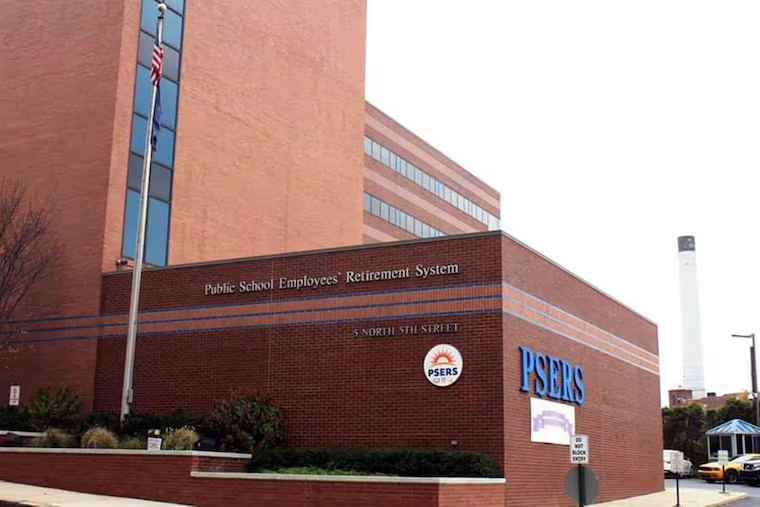
Three investment firms that advised Pennsylvania’s largest pension system have agreed to pay $30 million to settle legal claims alleging that their bad advice cost Pennsylvania teachers far more.
The firms had pumped billions of dollars into often poor-performing “alternative” investments such as hedge funds, private equity, urban demolition sites, and an illegal Kurdistan pipeline.
The investment firms are Chicago-based Aon Investments USA, West Conshohocken-based Hamilton Lane Inc., and Portfolio Advisors LLC, now part of FS Investments of Philadelphia. Lawyers for school staff had alleged that they helped the PSERS public school pension fund select hundreds of high-fee but collectively underperforming investments when they could have been making more owning U.S. stock-index funds, according to a complaint initially filed in 2021.
PSERS’ performance was so weak in 2011-20 that the state’s “shared-risk” law, which requires teachers to pay more for their future pensions when investments perform poorly, kicked in for the first time.
That law compelled 176,000 Pennsylvania school employees hired since 2011 to pay an extra $87 million in payroll-deduction surcharges from 2021 to 2024. The pensions are financed mostly by investment profits and state treasury payments, with a smaller portion from school staff’s standard payroll deductions of around 7.5%.
Teachers and other school staff paid extra charges of 0.5% to 0.75%, averaging nearly $500 each over the three years, to help cover PSERS’ poor performance. They each will recover an average of around $112.
“The lawsuit shined a light on the industry and will result in a significant recovery to these hardworking teachers. Our work on this case will result in better decision-making for this fund and other funds,” said Gerard Mantese, the teachers’ lead counsel along with John J. Conway and Gregory B. Heller.
The lawyers will be paid $10 million from the settlement for their five years of work on the case.
The former PSERS advisers had denied in a pre-settlement court filing “that their actions and/or inactions caused an increased contribution” from the teachers. They maintained they did the work, for which PSERS paid them millions, “fully and lawfully.”
FS and Hamilton Lane officials agreed to settlements last fall. Checks began arriving at teachers’ homes in February.
“We have consistently denied the assertions in this lawsuit” and “are glad to put the matter behind us” with a settlement that ends the claims, Hamilton Lane said in a statement. FS declined to comment.
Aon, whose recent settlement is awaiting court approval, didn’t respond to queries.
“Teachers across the state of Pennsylvania should be thrilled” — even if the checks, averaging enough to pay for a restaurant dinner for two, are mostly “symbolic,” said Kevin Steinke, the lead plaintiff in the teachers’ suit.
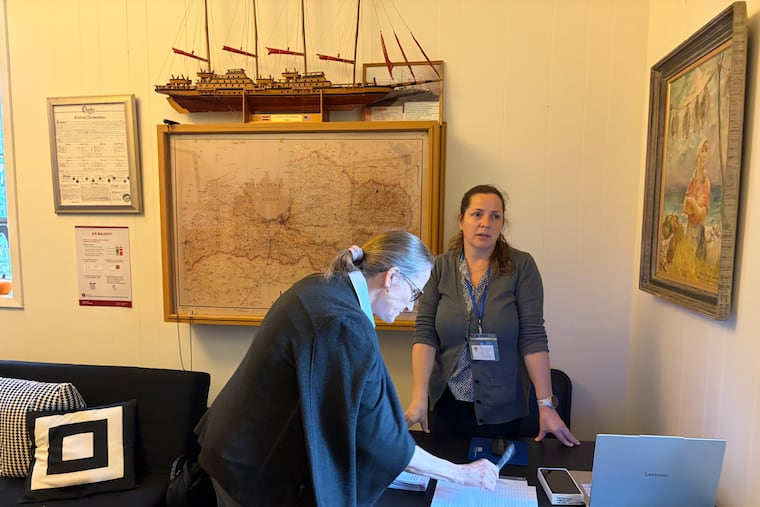
Steinke teaches anthropology, sociology, and law at Springfield High School in Delaware County, and coaches middle-school track.
“Anything that can be done to reassure younger teachers these days they are getting into a field where someone is looking out and caring for them is important,” he said. “There is still work to be done — in police pensions, in hospital pensions — but it’s a start.”
Steinke said he decided to sue after reading about PSERS’ unusual investments and weak returns in The Inquirer.
He said he hasn’t discussed the lawsuit with leaders of the Pennsylvania State Education Association, the union representing staff at most suburban and upstate schools, including Springfield.
Local union leaders held five seats on the 15-member PSERS board and regularly supported hiring high-fee private managers, even when state treasurer Stacy Garrity and her predecessor, Joe Torsella, warned that the high fees and low returns endangered the fund.
In 2021, The Inquirer reported two federal investigations of the fund. No one was charged, but top officials left PSERS, and trustees agreed to drop hedge funds, reduce private-equity investments, and sell unproductive investments such as a declining Florida mall.
Performance improved and the surcharge was dropped in July 2024, though PSERS returns have continued to trail those of more mainstream investors like the Philadelphia city pension fund, which divested of most of its private assets years ago and has bet heavily on U.S. stocks, which have reached record levels in the long bull market.
Steinke and a handful of other named plaintiffs who spent many hours reviewing the litigation and settlement as it progressed over five years will receive at least $10,000 each under terms of the settlement.
Mantese said his fees would cover costs including expert witnesses, such as labor economist Teresa Ghillarducci and former Harvard endowment tech fund manager Marty Dirks, who confirmed PSERS’ poor performance. Their analyses, along with comments from officials of the three firms, were redacted from the public record at the parties’ request by Philadelphia Common Pleas Court Judge Nina W. Padilla, who oversaw the cases.
A fourth adviser, Aksia LLC of New York, hasn’t settled and still faces a pending complaint.
The lawsuit also cited public reports critical of PSERS and its advisers, including conclusions of the 2019 state pension study commission (PPMAIRC) report, which found that PSERS and the smaller Pennsylvania State Employees’ Retirement Fund owned far more private “alternative” fund investments, paid some of the highest investment fees to private managers, and posted some of the lowest returns, among state pension funds over the previous decade.
PSERS hired hundreds of specialized U.S. and foreign firms recommended by staff and advisers. Bridgewater Associates, the world’s largest hedge fund manager, collected over $700 million in Pennsylvania pension management fees. By the late 2010s Bridgewater managed one-tenth of PSERS’ outside investments, far more than any other firm, before PSERS began canceling its contracts due to poor returns. Bridgewater’s former chief executive, David McCormick, now serves as one of Pennsylvania’s U.S. senators.
The settlements include:
$15 million, paid by Aon, which served as PSERS’ general investment adviser, collecting $7.2 million in PSERS fees from 2010 until it was fired for poor results in 2023. Aon was hired to recommend how PSERS should invest its assets, which now total $80 billion. But in its “willful blindness,” Aon did “little or nothing to recommend that PSERS reduce the [proportion] of its risky and expensive alternative investments,” according to the complaint. Aon had previously paid PSERS $7 million to compensate for “miscalculation” that exaggerated PSERS’ performance for 2011-20 and $1.5 million to the SEC for failure to investigate “discrepancies” between PSERS’ annual reports and the unaudited data used to calculate long-term results.
$11.25 million to be paid by Portfolio Advisors, which Steinke and his fellow teachers accused of recommending “numerous investments that were inappropriately and unduly expensive.” The payment almost equals the $11.45 million that Portfolio Advisors collected from PSERS to advise on private investment purchases in 2010-17.
$4 million to be paid by Hamilton Lane, a publicly traded advisory firm that replaced Portfolio Advisors as PSERS’ private investment adviser from 2017 to 2023 and collected $10.2 million in PSERS fees over that period. “Hamilton Lane’s failure to keep a close eye on the private market returns” resulted in “excessive” fees — and the firm “took virtually no action” to secure lower fees, even though that’s one of the things it was hired to do, according to the complaint.