At a new Goodwill in South Jersey, customers are flocking for the deals and the resale potential
The massive location opened last month after the chain recorded a record year. The thrifting resurgence is fueled by younger consumers and social-media influencers.
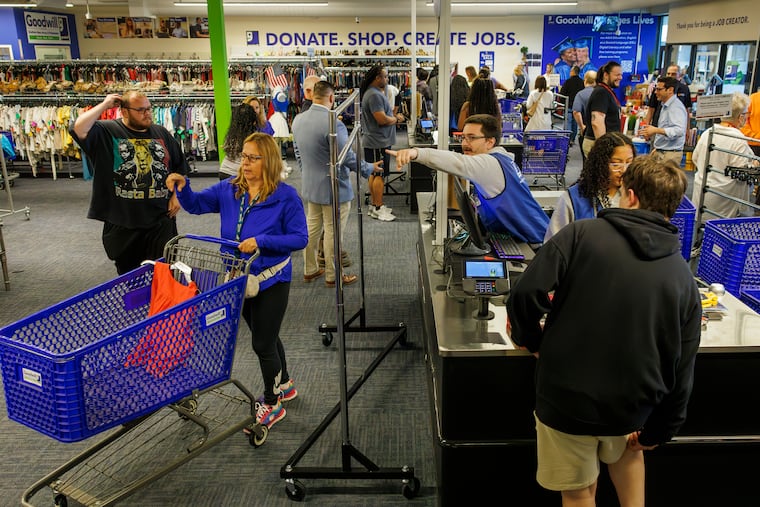
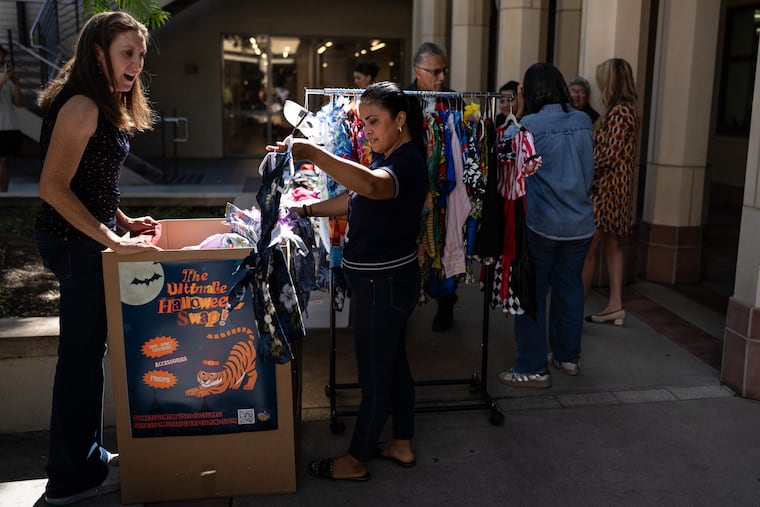
Mia Garcia showed off her clothing haul: a multicolored tank top, a backless white tee, a lacy maroon cardigan, and white tights for an upcoming trip to the New Jersey Renaissance Faire.
The 19-year-old was as excited about the bill as she was about the fashion.
Her grand total: $15.
She and her friend, Salsbee Jahan, scored the deals at a massive new Goodwill store in Deptford, where local executives say a growing number of Gen Z shoppers are flocking for clothes, shoes, decor, and more. Young customers are increasingly fueling the world’s largest thrift store chain, which posted record revenue last year.
At Goodwill, “it’s definitely cheaper and easier to find older-style clothes,” like popular Y2K-inspired fits that are sold at a premium elsewhere, Garcia said. At some name-brand stores, “$20 won’t even get you get a shirt.”
The women, both Deptford natives attending Rowan College of South Jersey, say they frequent malls, too. But Jahan, 18, said they’re trying to thrift more because “everything is going up” in price.
The sentiment was echoed by several other customers at the 19,000-square-foot store, which was buzzing with dozens of shoppers around lunchtime Tuesday.
“Gas prices have gone up. Groceries have gone up,” said Kaitlin Deegan, a 38-year-old nurse from Salem County. She was wearing a graphic tee and denim shorts that she had bought for under $10 at another Goodwill. “Now it’s all about thrifting.”
Nearby, one woman put a $6.49 denim skirt in her cart, next to a pair of $7.99 sparkly shoes she’d grabbed earlier. Across the room, children perused shelves of toys, games, and stuffed animals — most under $10 — and teens eyed rows of $1.99 DVDs and 99-cent CDs.
» READ MORE: Philly-area malls aren't dead yet. But they are changing.
In its first 12 days, the new location on Clements Bridge Road averaged about 600 customers a day, more than double the foot traffic recorded at a smaller Goodwill retail store that recently closed in nearby Woodbury Heights, said regional manager Josef Fortun.
Each Deptford customer has spent about $31 on average, he said, exceeding managers’ goals.
This early success in South Jersey comes amid a larger thrifting resurgence. Last year, the U.S. resale market grew nearly four times faster than the broader apparel market, according to an annual report from the online consignment platform ThredUp.
Goodwill recorded more than $7 billion in revenue last year, the New York Times reported, and annual sales across its 3,400 stores have risen 50% since 2019. Smaller secondhand shops, such as Savers Value Village and ThredUp, have also reported revenue increases, according to the Times.
In the same Deptford shopping center as the new Goodwill, there are three other thrift stores: Once Upon A Child, Plato’s Closet, and Play It Again Sports. All are owned by Winmark Corporation, which has been adding more thrift stores and reporting year-over-year revenue increases.
» READ MORE: Shopping secondhand for kids’ stuff is getting more popular in Philly
In nearby Cherry Hill, a Red White & Blue Thrift opened this spring, a half-mile from a 2nd Ave thrift outpost — owned by Savers Value Village — that opened in 2024.
Goodwill also opened a store a year ago in a former Rite Aid in Voorhees. And its Woodbury Heights location, which is still accepting donations, is set to reopen June 15 as a Goodwill Home Medical Equipment Store.
Boyd said the nonprofit chain is looking to expand into Cape May County in the near future.

- The new 19,000-square-foot Deptford store has more than 40,000 items on the floor.
- The Deptford store logged an average of 600 customers in its first 12 days.
- Each Deptford customer has spent about $31 on average. Managers aim for an average cart of at least $30.
- In Philly and South Jersey, the no. 1 store in terms of sales is the Whitman Plaza Goodwill in South Philadelphia.
- The territory’s no. 2 store in terms of sale is in Egg Harbor Township.
- More than 40 Goodwill stores are in Goodwill Keystone, the district that includes 22 counties in southeastern and central Pennsylvania.
- 27 Goodwill stores fall under Goodwill Industries of Southern New Jersey and Philadelphia, which includes the city and 11 suburban counties.
Sources: Goodwill Keystone; Goodwill Industries of Southern New Jersey and Philadelphia’s Mark Boyd, president and CEO, and Josef Fortun, regional manager
Why are more people thrifting?
More people are buying secondhand right now for many reasons, said Mark Boyd, president and CEO of Goodwill Industries of Southern New Jersey and Philadelphia.
“Challenging economic times definitely bring people into the Goodwill store, maybe for the first time,” Boyd said. At the same time, “there’s a lot of people out there who care a lot about reuse, and that’s driving particularly younger shoppers into Goodwill.”
And while thrifting is one of the most “tactile” experiences, Boyd said social media is playing a role in its rebirth. Many Goodwill customers are resellers, he said. They find steals in store aisles and then mark up the products to sell online or at flea markets.
On Deptford Goodwill’s opening day last month, professional reseller Anthony Nunez was first in line. He had arrived with a friend around 4:30 a.m., ready to hunt for sports jerseys, Pokemon memorabilia, video games, and vintage clothing to resell on eBay.
Since losing a job in compliance during the pandemic, the 34-year-old Sayreville resident has been reselling full-time, making more than $100,000 a year, he said.
At the Deptford Goodwill, Nunez made a beeline for items with a high resale value, including a still-in-the-box Pokemon Stadium video game for Nintendo 64. He bought it for $18, Nunez said, and later resold it for $150, recouping the cost of his entire Goodwill trip.
It helped that Goodwill executives had invited several resellers to a store preview, he noted.
“They understand we help them too,” Nunez said. “I don’t know if they would be able to exist without us.”
» READ MORE: These Philly-area residents bring in hundreds of dollars a month selling stuff online. Here’s how.
How social media has promoted thrifting
Some longtime thrifters have started using social media to make extra cash.
Melody Appel got into thrifting decades ago, when she was a student at Drexel University.
Now 47 and living in Monmouth County, N.J., Appel recently got a TikTok account at the urging of her teenage daughters. At first, she just used the account to show off her thrifting hauls. But over the past month, she said she has started reselling items, too, making around $1,500.
Many of her TikTok followers seem to be between the ages of 30 and 60, she said, but she has noticed many younger customers in stores.
“People are seeing what they can find,” said Appel, who works as an educator and interior decorator. “And maybe their perception of what thrifting was is different from what thrifting is.”
While some found their way to thrifting through social media, others get hooked when they stumble into a store, said Fortun, the Goodwill regional manager. He has noticed more young people at the Deptford store than at the old location in Woodbury Heights, he said, and he attributes some of that to the Edge Fitness Club right next door.
Customers often come in on a whim, he said, and are in awe of the wide selection and the price tags.
“People always look for deals,” Fortun said. “You go to discount stores like Ross and Burlington, you still don’t find items as cheap.”
Goodwill is trying to keep these customers hooked with a new online loyalty program, which will offer special deals and send push alerts to shoppers when their favorite brands are stocked at a local store, said Boyd, CEO of the South Jersey and Philadelphia locations.
Executives are also looking into using artificial intelligence to optimize parts of their operations, such as pricing, he said. But he doesn’t think technology could enhance the customer experience much, he added, and over-digitization could detract from it.
“I really think thrifting is like one of the most human experiences you’re going to have, and it’s a great shopping experience,” Boyd said, “and that’s why it’s so popular.”
Intimidated by secondhand stores? Experienced thrifters Melody Appel and Anthony Nunez gave the following advice:
- Start small. Perhaps check out a community or church consignment shop before going into a larger chain store, where the selection can be overwhelming, Appel said.
- Check out estate and garage sales. Nunez goes to estatesales.net and garagesalefinder.com to locate sales in his area. He said flea markets are great, too.
- Hit up Goodwill on Sundays. Each Sunday, Goodwill stores marks certain items down to $2 or $3, Appel noted.
- Go prepared. “Make sure you’re well fed and caffeinated,” and have enough time to fully peruse the store, Appel said.
- Have an open mind. Appel said she prefers not to go in with one specific item in mind: “Just be curious,” she advises.