Rita’s latest owner hopes year-round sales will finally make the Philly-centric chain a national name
Rita’s has been trying to go national for 20 years. Are winter custard and drive-throughs the key to water ice profits?
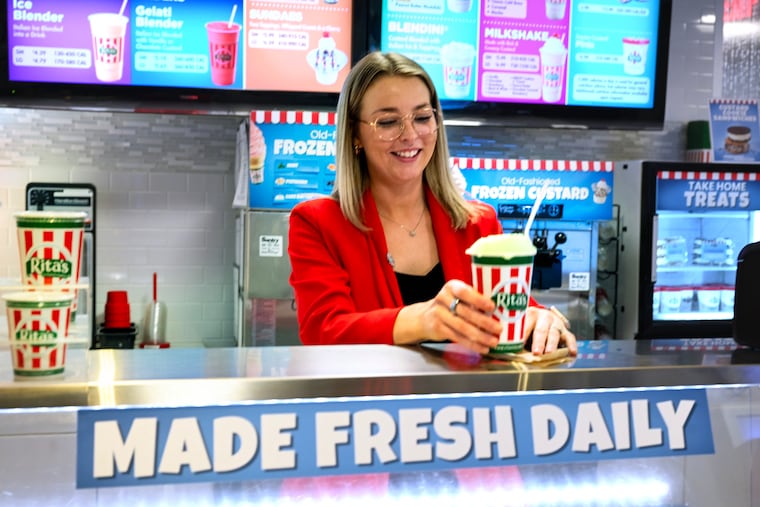
It’s not quite spring, but at Rita’s Cool Support Center, the company’s Trevose headquarters, it’s bright as summer in the test kitchen, with its gallon jugs of sugary mix and drums of fruit and candy flavors.
Beg a trial of today’s test flavors from Stacey Miller Lare, a senior manager for the 605-store Rita’s Italian Ice & Frozen Custard chain, and she scoops-and-serves with easy grace: “It’s all in the wrist.”
She would know. Lare ran the Rita’s stand in Folsom, Delaware County, during business school at Temple University.
Rita’s has 80 flavors, and a Peeps-marshmallow-based “mystery flavor” will debut March 20, when the company offers free water ice to mark the beginning of spring. Stores opened for the season on March 1.
Rita’s is on its fourth private-equity owner since the founding Tumolo family sold out in 2005.
Each of these owners announced ambitious plans: add menu items, boost the store count to over 1,000, and take Rita’s national, even worldwide.
There was a short-lived push to establish the chain in India, China, and other countries over a decade ago. There are a handful of stores in the Philippines.
But Rita’s store count hasn’t changed much since its second sale, in 2011. Now Maple Park Capital Partners, which bought the company last year, is looking for new operators in 40 states for its own growth plan.
Today’s stores are busier, the company says. Since 2017, under CEO Linda Chadwick, the focus is on what the company calls “sustainable, long-term locations across the U.S.”
Maple Park kept Chadwick, a former Burger King executive, in Rita’s top job. The company hopes to operate 800 stores in five years and maybe a few more overseas. The plans emphasize drive-through locations to allow year-round sales.
Investors and bankers who have looked at Rita’s say it could use more sales per store to attract larger franchisees and more capital.
Will winter custard sales make that happen?
What is this stuff?
What Philadelphians call “water ice” — Rita’s dropped water 20 years ago — has a stirrable, melt-on-your-tongue granularity, not the coarser textures of snow cones or shaved ice.
Home-stirred fruit ices were sold from carts and vans, and dozens of neighborhood stands like John’s in South Philly, Morrone’s in West Philly, and Pop’s in Havertown. Versions of water ice are sealed into cups and boxed for schools, cafeterias, and supermarkets by suppliers such as Rosati Ice in Clifton Heights, Port Richmond-based Philadelphia Water Ice Factory, and Pennsauken-based J&J Snack Food’s Luigi’s Real Italian Ice plant in Scranton.
Rita’s is distinct because it has franchised local shops into a chain, with its footprint concentrated from New Jersey to Washington, D.C., and stretching west and south.
“We haven’t changed our secret formulas,” except by adding flavors, said Lawrence Brown, Rita’s chief development officer, who scouts franchisees and locations. Brown’s favorite, shamrock, includes cream and mint.
“Cream is not shelf stable, so we use local distributors,” Brown said. “That’s the benefit of franchising. A gelato in Florida or Houston will taste the same.”
Still an experience?
“It is difficult to take a regional chain and expand nationally,” said Jonathan C. Fornaci, a former Rita’s CEO in the early 2010s who now runs ThePicklr, a Utah-based pickleball franchise.
What’s the attraction for investors?
“If you grow the prices 5% a year and are taking 7% in royalties from the franchisees, you’re going to make money,” Fornaci said.
Rita’s says current royalties are 6.5%, and franchisees set and increase their own prices.
But the chain needs more stores to really prosper, Fornaci added.
A year-round custard push appeals to him, he said. “I’m a firm believer in ice cream in wintertime, absolutely. I now live in Utah. I love custard in the middle of winter.”
The brand could use renewal, said Philadelphia publicist Leo Levinson, who takes credit for writing the “Be Cool, Eat a Rita’s” tagline and jingle in 1992 for the Tumolos.
Levinson said he’s worried the succession of “bean counter” private equity owners have “kind of commoditized their new brand.”
In the old days, he said, the Tumolos would organize school discounts, gifts for kids, free ice at senior citizens homes — the kind of feel-good, family-friendly promotions that were moved to franchisees’ discretion as the chain grew larger.
Lower costs
“Our number-one product is Mango Gelati,” which is the top-selling ice, mango, with vanilla custard, Brown said.
Rita’s declined to confirm whether it still relies on locally made staple ingredients such as I.Rice flavorings from Northeast Philly or Cumberland Dairy custard base from South Jersey. Brown said Rita’s enforces its own quality standards on all suppliers.
The cost of the syrup and other ingredients is less than 20% of Rita’s product price. That’s well below the 30%-plus that’s standard in food chains, Brown said, allowing a larger profit margin.
With total sales reported at $210 million last year, Rita’s shops sold an average of around $350,000 worth of ice and custard.
That’s small by industry standards, but Rita’s can still make money, thanks to its lower product costs.
Looking at Rita’s from an investment banker’s perspective, “in higher-rent retail corridors, a store that isn’t doing at least $500,000 in annual sales will have a hard time producing compelling earnings” after paying rent, insurance, and other costs, according to Michael Mufson, a Philadelphia investment banker who values and sells retail franchises.
“Even if there are some year-round stores in warmer geographies, my assumption is the system’s ‘center of gravity’ is still seasonal,” with about seven months to generate sales, Mufson said.
Boosting sales to $500,000 — a level Rita’s says its best stores exceed — would more likely attract larger franchisees, Mufson says.
Doubling that to $1 million, with labor and marketing expenses increasing apace but rent and utilities fixed, would make stores attractive for big franchise operators and outside investors, Mufson said.
Rita’s is “a near commodity product that works on a small scale” but hasn’t yet proven it can reach the next level of interest from large investors, says Philadelphia-area investment banker Andy Greenberg.

1984: Bob Tumolo, a former Philadelphia firefighter, opened Rita’s Water Ice on Bristol Pike in Bensalem, joined by his brother, John, and their mom, Elizabeth. Together, they built a chain of over 300 stores in 11 states.
2005: Tumolo sold Rita’s to McKnight Capital Partners, a Pittsburgh-based private-equity firm led by Jim and Bill Rudolph, former Wendy’s franchise operators. The Rudolphs grew the chain to 550 stores.
2011: David Moross’ Falconhead Capital of New York purchased a controlling interest in Rita’s and hired CEO Jonathan C. Fornaci, who had been president of California franchise Straw Hat Pizza. Rita’s adds 100 stores in California, planned the first overseas outlets in India, and made plans to add 300 locations in East and South Asia and the Caribbean, but those ambitious plans fizzled.
2016: Argosy Private Equity of Wayne and partner MTN Capital bought a controlling stake in Rita’s Franchise Co. and its 600 stores, including stadium and other temporary locations, with plans to add 50 stores a year. They hired Burger King veteran Linda Chadwick to improve sales. When Argosy eventually sold, Rita’s had 580 permanent locations.
2025: Newly formed Maple Park Capital Partners of Dallas announced its purchase of Rita’s, keeping Chadwick as CEO, and plans to expand with an emphasis on year-round takeout sites. They plan 800 stores by 2030.
You need to love the product
Brown, the franchise chief, joined Rita’s a year ago. A North Jersey native, Brown knew water ice from his undergrad years at Villanova, and he knew CEO Chadwick from when they both worked for Burger King in the early 2010s.
Brown says he spends half the year on the road, meeting potential franchisees. “It’s like The Dating Game,” he cracks.
The main requirements for franchisees are fairly simple, he said. “You need to love the product. No offense to accountants, but if you’re anchored by numbers it’s not for you.”
Second, he said, people skills. And finally, capital.
Rita’s says it takes hundreds of thousands of dollars to get a store started, depending on the location.
The company has around 300 franchisees for its 605 stores and hopes to attract large, multi-franchise operators who can invest in groups of stores. The chain has also revived plans to operate some stores directly. The newest markets include coastal Georgia and Louisiana.
Once a store is open, “the secret is guest service. Have great people in here. We give you the playbook and support you,” Brown said.
A longer summer
Rita’s current focus “is to extend the season. It’s hard to hold your water ice or gelato outside when the weather is inclement. But being able to keep the kids in the car seat” changes the equation, Brown said.
Since COVID, he added, “people aren’t just asking for drive-through, they demand it.”
It’s getting easier to find locations as retailers shut down stores, Brown said, noting Pizza Hut and Starbucks as examples.
And labor hasn’t been a problem for Rita’s, Brown says, with plenty of high-school-aged applicants. “We’re a fun, easy environment. A 15- or 16-year-old can’t get this job anywhere else.”
Like other shops, Rita’s has a digital system to track orders. But don’t expect robots at the scoops or on the counters anytime soon, Brown concludes: “Our product is made hand-fresh and fluffy every single day.”