Shwego helps home service companies get plumbers and painters to you faster
The local start-up tracks trucks and tradespeople, including plumbers, painters, electricians, and HVAC repair.
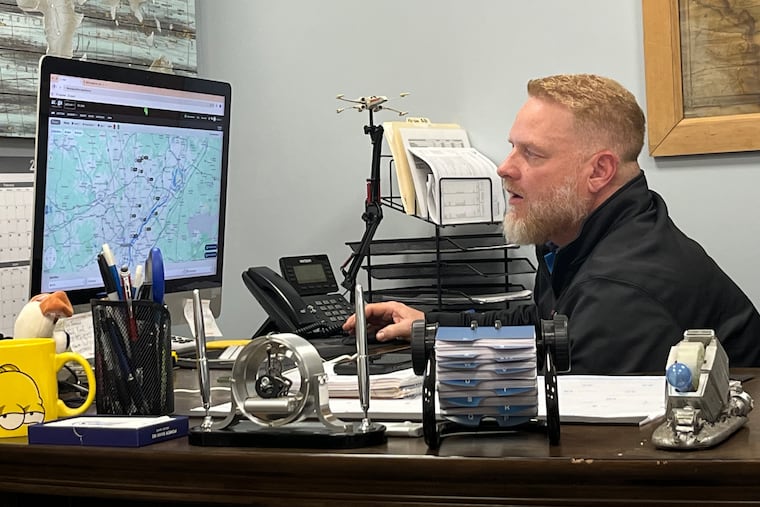
Shwego is Philly-speak for “‘Should We Go?’ Go here, go there, go where you need to be,” said Sam Puleo, a former door-to-door sales manager who gave his software start-up that name.
Launched last year, Fort Washington-based Shwego tracks trucks and tradespeople for a collection of home service companies: several plumbers, a painter, electrician, mover, air-conditioning and heating, and solar electric contractors. Most serve Philly’s rowhouse neighborhoods and suburbs, plus outposts from Brooklyn to Miami.
Contrasting expensive, feature-laden enterprise packages from big Silicon Valley companies, Shwego says it offers “easy-to-use software to contractors for quoting, job scheduling, dispatching, invoicing, and payments.”
“This app makes it so much easier to steer the ship. You can’t order pizza this fast,” said Ryan Larrimore, founder of Express Drains, an early Shwego client.
Puleo said he and business partner Junny Kim, a past Accenture IT consultant, are in growth mode, meeting demand from small businesses looking for simple digital systems without the expensive features the Silicon Valley giants sell.
They are family men who spend less time than they’d like at home. Puleo sold his digital marketing firm to focus day, night, and weekends on Shwego. Kim has kept his day job, running a Gong Cha bubble-tea franchise in Chalfont.
Not ‘the dinosaur way’!
Their first and so far biggest client is Larrimore’s Express Drains, which contracts with plumbers to unstop customers’ pipes.
“Those guys streamlined my whole business,” he said at his Warminster office and truck-repair garage. “They save me hours every night. They made it so simple. With notes, like in grade school. We do a job, the pin goes off the map. New job comes up, we see who’s nearby that can do it faster. We know where guys are. It’s like now we are playing a chess game three moves ahead.“
Larrimore and a partner started Express Drains in 2008 after they lost their jobs when package-delivery giant DHL shut the hub where they worked. They began with a set of Spartan tools, Larrimore’s Teamsters union severance, and a $20,000 loan from Philadelphia Police and Fire Federal Credit Union.
“I felt like Indiana Jones, stepping onto that invisible bridge,” Larrimore said.
The service caught on fast. “Six months later we were doing 25-30 calls a week, and we figured we could use another truck,” Larrimore said.
Soon he was paying off truck loans, buying a $4,000 sewer camera — “Worth it!” — and training friends. Apartment building owner Allan Domb is a regular client.
Larrimore hired workers he now pays more than $30 an hour. By last year, Larrimore had a problem other small businesses might like: Too much work.
“We were doing 100 service calls a day,” he said. “Guys were working 10 hours a day running through the whole city. It was getting crazy.”
Revenues totaled $3.6 million last year; an average job paid $180.
But Larrimore’s management tools hadn’t kept pace. Orders went out on a single Gmail account to which all drivers had access. Updates were a challenge.
Someone would accidentally delete a job, he said, which meant lost work.
Financial records were kept on paper. “Saturday night, me and my wife would separate all the bills and put it into an Excel spreadsheet. Every Monday, I’d drop a printout on [clients’] desks, and they’d give me a check for the previous week.”
Larrimore’s brother, Josh, disapproved. “I yelled at him: ‘You can’t do everything via email. This is the worst idea ever. This is the dinosaur way.”
Ryan Larrimore finally went shopping for business software — but warily.
From ServiceTitan, the $800 million yearly sales Silicon Valley company whose software platform focuses on home-service providers, he got a quote of $5,000 a month, a big expense for a subcontractor with tight margins. Josh yelled at him some more.
Larrimore connected with Shwego after a cold call from Puleo. “I was doing digital advertising for plumbers,” Puleo recalled. “I saw these guys got good reviews on Google.”
Larrimore paid Puleo to update his website and online ads. On his next visit, Puleo asked, “What else do you need?”
“I said, ‘Build me an app for dispatching,” Larrimore recalled. “He changed my life,” delivering the Shwego app for $1,100 a month.
Simplify
“Our number one thing is: Keep it simple,” Puleo said.
Neither he nor Kim is a software engineer. Backed by a loan from a Lehigh Valley utility auditor, Puleo built the Shwego prototype using a Google app builder and tested it with Larrimore’s company in 2023: “I know enough to be dangerous.”
Kim, he said, is the “logical and level-headed” partner, who oversees the five outside software developers who built the commercial app Shwego, rolled out in late 2024.
Son of a doctor, Puleo graduated St. Joseph’s Prep in 2006 but dropped out of Temple University during what he now calls his “knucklehead” youth. After a disastrous foray into deregulated electricity brokerage (he pleaded guilty to a fraud count for his role in a 2012 price-changing scheme), Puleo went into natural gas sales, with the Pennsylvania Public Utility Commission’s blessing.
When COVID rules stopped in-person selling in 2020, he started the digital-marketing firm, which he sold last year to a Lancaster company to concentrate on Shwego.
As an IT consultant, Kim, a Neshaminy High School and Penn State graduate, was on the road “90% of the year.” As his family grew, he sought to work for himself, close to home.
Puleo met Kim through his office landlord. By the time they connected, Kim had already committed to running the bubble-tea store.
Kim researched, like a good consultant: “The home-services industry is shrinking; prices are going up; there’s a lot of interest, even from private equity. And they are moving toward technology, then to AI.“
They got a business license, bank account, and insurance. After a bad initial experience with software development, they hired professional programmers in Eastern Europe, where Puleo’s wife has family.
Last Thanksgiving, with Kim’s store shut for the holiday, the pair met at 6:30 a.m. to begin final prep for taking the improved Shwego app live.
“We burned the midnight oil” evenings and weekends, Kim said. “We probably speak to each other more than our spouses.”
Last December, they put Express Drains on the new app, “just the basic bones,” as Kim put it.
“It still looks the same now, like pins in a map. But we have added a lot of efficiencies and features,” Kim said. “Now we are ramping up to allow payments over mobile phones.”
Next in line: adding QuickBooks integration and an improved calendar feature. Customers are asking for project management and inventory.
Happy customers
Shwego has a function for drivers to mark failed calls and route them back to the dispatcher, then move right to the next job.
“We are making the product more streamlined and efficient,” Kim said. “Our main goal is to keep this product simple, so we don’t overwhelm clients” who are going electronic for the first time.
“There’s a sense of satisfaction, fixing something,” Larrimore said. “It feels pretty good, and the customer’s happy.”
Puleo said Larrimore has referred additional customers from the plumbers who hire his drain service.
“I swear we have plumbers that still run paper,” Larrimore said. “You can hear it rustling when you talk on the phone. They are still stuck in their ways. I tell ‘em, ‘You should talk to Sam.’”