Your Surfside variety pack was sorted by robots at this Bucks County factory
Robotic packing system company Sojo, which has a laboratory in Bucks County, is using automation to create your favorite beverage variety packs.
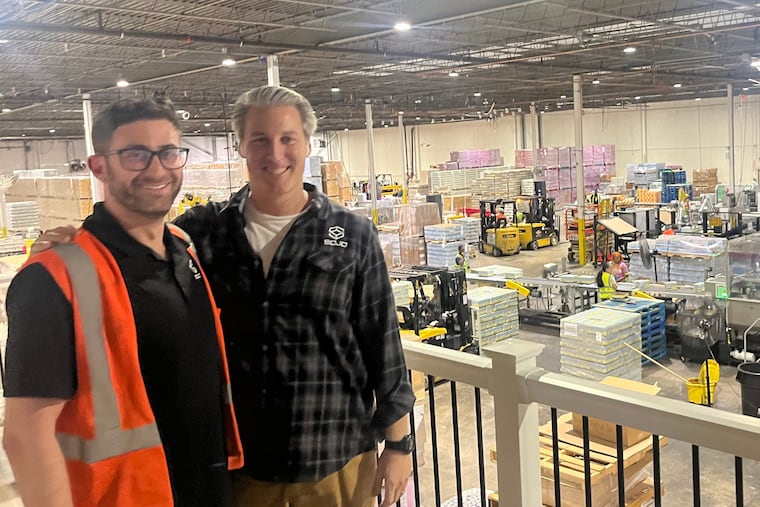
At first glance, Sojo’s Bristol plant looks as busy as any old-time soda canning plant, with clusters of bright-shirted workers sending long lines of drinks along clanging conveyors into colorful boxes for delivery.
But the plant in Bucks County is also an automation laboratory, where robots, sensors, and custom-made, big-tired vehicles are tested for Sojo’s larger, quieter, highly automated regional plants in Langhorne and in California, Texas, and Indiana.
Those plants are bases for the company’s picking and packing machinery, driven by the company’s tracking software, to sort clients’ products into variety packs for shipping straight to Aldi’s, Amazon, BJ’s, Costco, Target, Walmart, and other giant retailers.
At its headquarters on McNulty Road in Northeast Philadelphia, fast-growing Stateside Vodka, maker of Surfside Hard Tea and other sweet alcohol drinks, faced an extra challenge: Store chains want its sweetened hard seltzers to arrive presorted into boxes of many flavors for fickle young drinkers.
“Consumers like to try a little bit of everything. They want options. If they’re going to a party, they want to bring an item that has a flavor for everyone,” said Ryan Seckinger, Stateside’s top supply officer.
That means sorting and matching different flavored cans into mixed, store-friendly boxes.
Creating a mixed pack used to mean shutting down production lines to switch products, hiring extra workers to haul boxes of each flavor, sorting flavors into variety boxes, loading the mixed packs onto trucks, and then delivering mixed and unmixed boxes to each retailer.
But now there are robots. Stateside has turned to Sojo, a 130-person operation that in June raised $40 million from private-equity investors to build a 1-million-square-foot national network of robotic packing systems. It also upgraded its can-tracking software, which makes sorting simpler and cheaper in a competitive business where fractions of a penny per can are significant.
Clement Pappas, who cofounded Stateside, grew up in his father’s fruit-juice and cranberry-concentrate business. He knew Barak Bar-Cohen from the Sojo founder’s earlier career as an investor and chief operating officer at BAI Brands, a Princeton “antioxidant-infused” water company sold to Dr Pepper Snapple Group for $1.7 billion in 2017.
That made Bar-Cohen a natural salesperson for solving the packing challenges that Stateside faced.
How Sojo solved the mixed-pack problem
“Stateside, Whiteclaw, High Noon — for all these [hard seltzers], most of their sales are now variety packs. Young people want to take ‘em to the beach,“ Bar-Cohen said. ”Sounds like a simple exercise to make and sell variety packs. But it’s incredibly challenging. At BAI, that work was 80% manual. And manual is getting more expensive as it’s harder to find labor.
“This has become a major pain point in our industry.”
He found a potential solution in the wine business: “In wine, corking and bottling comes to your vineyard. I thought: Why not use the new mobility models and robotics automation and figure out how to bring this variety-pack capability to the warehouse where the product is sitting? You take out the freight costs and the CO2 emissions, and the administrative cost of shipping notices and shipping conversations.”
Bar-Cohen founded Sojo in 2021. The name is short for Sojourner, the NASA robotic Mars explorer that his late father, thermal scientist Avram Bar-Cohen, collaborated on in the 1990s.
With early backing by state-funded Ben Franklin Technology Partners and others, Sojo leased a 100,000-square-foot warehouse in Bristol. He set up an initial robot-assisted production line and began by outsourcing variety packs for small producers, such as Shippensburg-based Schreiber Foods and Utah-based Blue Chip Beverage.
Automation requires fewer mechanics, Bar-Cohen said. “A line used to have gravity-fed rollers and a simple pneumatic push system. Now we have four robots and a high-speed wrapper at a much faster rate.”
But robots themselves require human labor: “We are bringing on mechanics who are expert at swinging a wrench, fixing automation lines, and interpreting error codes.”
To the original Bristol plant, Sojo has added a string of large regional facilities — 315,000 square feet in Langhorne; 285,000 square feet each in Redlands, Calif., and Tempe, Texas; and 150,000 square feet in Indianapolis.
‘A warrior mentality’
At the Bristol plant, a former furniture factory with the robust electrical connections needed for power-gobbling robotics. engineers start at 7 a.m., said chief technology officer Josh Schwartz-Dodek, who said he left Tesla to join Sojo for the challenge of working at a start-up.
His model: a “warrior mentality” of long days and aggressive problem-solving under the formula FItFO: ‘Figure it the f — out.” Schwartz-Dodek says the goal is to add production lines and reduce crews from dozens to “four or five on each shift.”
The company advertises two innovative systems:
There’s Sojo Flight, a system based on “rover” robots dropped into a manufacturing facility to take inventory and reconfigure it into variety packs on-site.
“The robots have eyes. They are smart,” said Chad Hagen, a beverage-industry veteran hired in October as Sojo’s chief commercial officer. Cans using the system are coded for easier sorting. Robots “recognize a case. They can build a pallet.” Since the system is portable to client factories, it cuts trucking as well as packing-line costs.
“We are targeting the beverage industry, but there are multipacks across the food and consumer-product categories, the snacking industry, pharmaceuticals,” he said. “Whatever you see sold in a Sam’s or a Costco or BJ’s Wholesale. There’s a lot of runway for us.”
And there’s Sojo Shield, a “track-and-trace” software platform that uses sensors, geolocation, and blockchain-based updates to read codes and track cans.
Selling to a big retailer like Walmart, product makers have to guarantee they can track products “within hours” in case of recall, Hagen said. “Shield can provide this within minutes.”
Why private equity bet $40 million
Sojo’s recent growth is funded by S2G (Seed to Growth), a Chicago firm with $2.5 billion committed to more than 100 mostly energy- and food-related companies, such as Philadelphia-based Burro (formerly Augean Robotics), which makes self-driving farm carts.
“We’re investing in those food businesses that respond to changing demographics, environmental pressures, changes in what people put on their plates — where there’s a chance to make money because of access to consumer information,“ said Matt Walker, an engineer turned mergers lawyer and investment banker who heads S2G’s food and agriculture team. ”That is where the food system is going.”
The “supply shocks” of the past few years — COVID shutdowns, Trump tariffs, a West Coast port strike — have sent shippers looking for flexible supply systems that can be quickly changed to other product sources when another source stalls, and small efficiencies, such as setting up a temporary repacking line right in a production plant, as Sojo does, Walker said.
“Every tenth of a penny [per can] counts,” he said.
Walker says Sojo’s services could be adopted rapidly by the biggest beverage makers.
“This business has tremendous potential to scale,” he said. “We are in the early stages of automation.”