Malvern-based Vanguard plans to hire 2,000 workers at new India office
As Trump urges companies to ‘hire American,’ Vanguard has moved away from sponsoring visas and plans to directly employ workers abroad.
Malvern-based Vanguard Group is the latest in a growing group of U.S. financial and software giants to pick India to grow its technology workforce, even as President Donald Trump has urged companies to “hire American.”
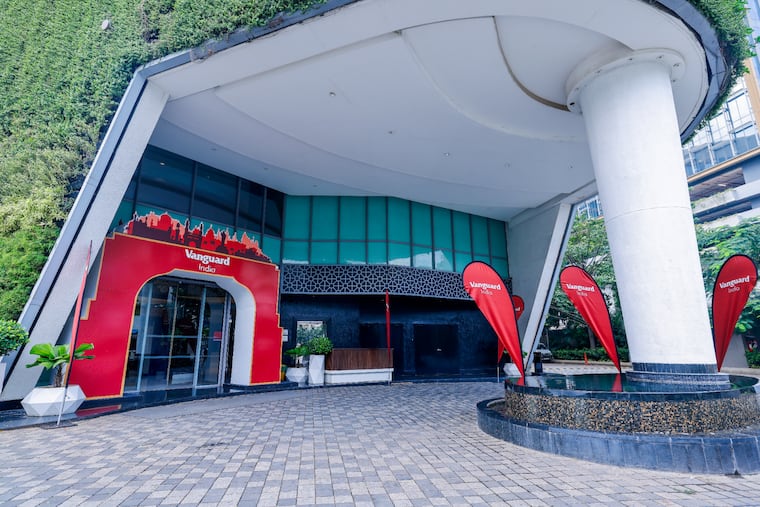
Vanguard India has hired more than 200 staff and plans to add more than 2,000 over the next three to four years. The office center opened last fall, in a technology park in Hyderabad where many other U.S. financial and software companies have major tech centers.
Vanguard is one of the largest corporate employers in the Philadelphia area, with over 10,000 at its Malvern headquarters and nearby offices.
Vanguard says its IT group is expanding worldwide and the majority will remain in the U.S. The company says its current IT headcount in the U.S. and other countries will not be reduced by adding jobs in India.
U.S. staff who already work with colleagues on U.K. and Australia time have begun accommodating the growing workforce in Hyderabad, where local time is 9½ hours later than in Malvern.
Some U.S.-based Vanguard IT staff, who spoke to The Inquirer on the condition of anonymity because they are not authorized to speak to the press, have noted the India expansion is taking place concurrently with buyout offers — two weeks’ pay for every year worked — and with testing to determine some professionals’ preparedness for new technology.
Among those affected are middle managers, such as project leads and managers, and “scrum masters” for Agile-style software development teams.
The timing of recent buyouts and testing as the Hyderabad operations expand has fed anxieties for some workers.
“People are gutted that an American-born company could do this,” said a project manager with more than 15 years’ Vanguard experience. “It’s like, ‘Maybe we can get you for cheaper in India, so let’s give you a test you can’t pass.’”
Vanguard says that the steps it is taking reflect existing company practices and the need to adapt staff in all offices to new technology and that important IT goals have not changed as a result of Vanguard India.
Talent acquisition
Vanguard India opened in November under Salim Ramji, who left rival Blackrock to become Vanguard’s first outside-hire CEO in 2024.
The company manages $10 trillion in clients’ money, with much of it in low-fee funds based on the S&P 500 and other stock indexes, as well as in bond funds. It was founded by the late John C. Bogle in 1974 and was later run by a succession of his former aides.
Vanguard India is located in the Sattva Knowledge Park in Hyderabad, one of India’s best-known software centers.
The Sattva center also houses sprawling operations centers for U.S. tech giants Apple, Amazon, and Intel, and giant Wall Street banks Goldman Sachs and JPMorgan Chase & Co., among many others.
The Vanguard India operation is headed by Venkatesh Natarajan, a former executive at West Chester-based home-shopping giant QVC, Lowe’s, and Walmart. He joined Vanguard in 2019, and was elevated to his current role in 2024.
“Our presence in India is focused on expanding Vanguard’s access to top technology talent,” making the company’s IT more reliable, and bringing outsourced work back into the company, Natarajan said in a statement.
The company sees India and its technology workforce as both a source of expanded IT support for current operations and a place to develop new systems. Vanguard India staff specialize in “AI and machine learning, data and analysis, mobile and cloud engineering, and cybersecurity,” according to Natarajan.
The Hyderabad center “is part of a long-term strategy to build leading technology capabilities while continuing to invest in our existing workforce,” a common model among large financial-services firms, both for ongoing operations, and developing new systems and applications, Vanguard said in a statement.
Fewer visas
Like some other big financial and tech companies, Vanguard is bulking up in India as the U.S. H-1B visa program, which helps bring in skilled foreign workers, has come under fire from Trump and his allies, who have blamed the program for reducing opportunity for U.S. tech workers.
H-1B applications declined by around 25% last year, according to the U.S. Department of Labor. Trump imposed high fees for new H-1B applicants in an attempt to curb what he called abuse of the program.
Vanguard in January said it would offer jobs to most of the nearly 250 workers on Vanguard projects who will be laid off this year by Infosys, an India-based contractor to which Vanguard had outsourced 1,300 information technology workers in 2020. Vanguard is taking some of that work back in-house.
At its peak in the late 2010s, Infosys employed tens of thousands of Indian workers who lived in the U.S. on H-1B visas for Vanguard and many other employers, but in recent years cut its participation in the program to a few thousand new visas a year. Vanguard says it will still rely on Infosys and other outside contractors for some IT services.
India’s Global Capability Centers
Tech complexes with thousands of local workers serving multinational companies, sometimes called global capability centers (GCCs), have proliferated in Eastern Europe, Southeast Asia, and Latin America, but especially in India.
India has five times the U.S. population, six times the number of annual engineering graduates, and the second-largest population of English-speaking people in the world. India is also home to more than half of all GCCs across the globe, according to Flexiple, an India- and Delaware-based tech recruiting service.
Companies like Vanguard have shifted their focus, from bringing in foreign engineers, to employing them more directly in their home countries, often under India-native managers well versed in U.S. business from years at American companies.
Advocates for foreign tech centers in India say there are now more than 1,700 global capability centers, including those in Hyderabad and smaller tech centers throughout the country. That’s up from 1,400 in 2023, with hundreds more planned this year.
India is now home to major tech centers for companies such as Goldman Sachs, Microsoft, and Google, as well as Vanguard.