Verizon stores chief shows off tech and talks AI
Matt Coakley, market president for the Northeast region, oversees more than 1,500 Verizon sellers.
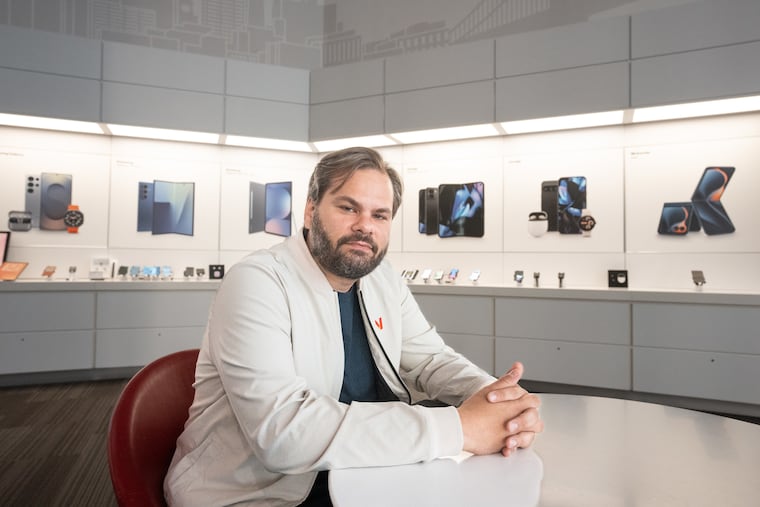
As market president for Verizon in the Northeast since May, Matt Coakley spends a lot of time on the road.
He’s visited 90 of the 280 Verizon-owned stores from Maine to Virginia. He also oversees 1,500 franchised Verizon stores and Verizon desks at Best Buys. An eight-year Verizon veteran, he used to run national promotions, and advised the company on pricing.
Coakley calls each store “unique.” Based in Basking Ridge, N.J., he recently took questions from The Inquirer at the glass-walled Verizon store at 1430 Walnut St., one of more than a dozen in the city and 100 in the area. Questions and answers have been edited for clarity and brevity.
Verizon’s predecessor, Bell Atlantic, was based at its own Philly skyscraper, but the company long ago moved to New York. What does Verizon still have here?
We have 600 people in the city of Philadelphia, more than 3,000 in the Greater Philadelphia area.
In Philadelphia, we agreed with the city to bring fiber connectivity to 183 community centers, so customers can go to their public gathering areas and transact, go on the internet, be part of the digital economy. We are committed to making sure all are wired by the end of next year.
Is it hard to find store workers?
One thing we offer a lot of other companies don’t: Reps have a chance to grow. They can be part of marketing, operations, a headquarters team. Mark Rutkowski, our associate vice president who heads home pricing, worked in our stores.
What are your big sellers?
We sell Meta’s glasses. Sometimes we offer them as a promotion for new subscribers. I have them at home, Ray-Ban Meta glasses. We have two kids, 7 and 4 years old. It’s wild, they’re always doing something hilarious [with the glasses].
We were in Costa Rica recently. We found a place that does zip-lining through the jungle. And I did the video of the kids doing it, using the camera on the Ray-Ban Metas.
If I say, ‘Meta, where are we? What is down this corridor?’ it speaks right back to you. The voice recognition is great. It’s exciting to see what’s possible.
Are these more than toys?
A lot of businesses are starting to use these as tools to help with training and day-to-day tasks, to add a voice assistant in a hands-free way. [We’re seeing it] in offices, industrial settings, warehouses.
Flip phones are back. A local company, Universal Display, makes OLED lights for Samsung’s bendy screens. You sell a lot of those?
The latest cool device is the Samsung Galaxy Z Fold7. It just launched July 25. It’s about the size of a Samsung Ultra or an iPhone Pro Max — just as thin — but it unfolds, and you have tablet capacity. You can put spreadsheets on this thing.
What’s worth more, a Z Fold, or my 25-year-old Buick?
Z Fold lists at $1,899, manufacturer’s retail direct. You can get up to $1,000 off with the plans. It has an excellent camera. You can get the new Pixel cameras on the Google devices, and AI tools to improve the nighttime photos.
Verizon stock is about where it was 10 years ago, or 20 years ago. How can you grow?
Some of our cable competitors are losing subscribers. But we’re still growing both Fios and fixed wireless. Household penetration is rising.
We have home wireless internet in every part of the country, so net migration doesn’t [hurt Verizon the way it does] some of our competitors. We’re capturing the growth that is happening right now. We have speeds up to 2 gigabytes per second. Uploads as fast as downloads.
And we serve every part of the market. Postpaid services [monthly billings based on use, for people with good credit] like Verizon myPlan offer the latest and greatest devices at good value.
We have value brands — Straight Talk, Total Wireless, our digital-first Visible network — for customers who say, ‘I just want it to work.’
If a customer is not able to finance, we can serve them with a prepaid service.
We have a whole-home Wi-Fi product, and the right set of extenders so the signal goes where you do, and software tools. In stadiums we deliver 5G ultra-wideband.
We sell a lot of service plans, [where] customers can choose what they want, the plan that meets their needs, whether you do a lot of international travel, if you want a lot of hot spots.
Customers want consistent pricing. No surprises. No extra fees, no equipment charges.
Will artificial intelligence tools make customer service less onerous?
There are days we can [use AI to] see something is not quite right in a customer’s flow, right as it happens. For example, a customer trading in a phone marks the phone as “sent,” but we don’t see it. Instead of an email that ‘we didn’t receive your trade-in,’ we use AI to proactively identify that the phone isn’t yet on its way to us.
In the home, we have a good handle on network management. If we see a customer is having connectivity issue with their phone, [AI] can suggest you need a little additional coverage in this room. Each device on your network has an identifier, so we can help diagnose and improve the coverage.
Doesn’t that freak customers out, that you know so much about us?
Customers can opt out at any time. But when customers see how you’re improving the value, they are happy to have that nudge.