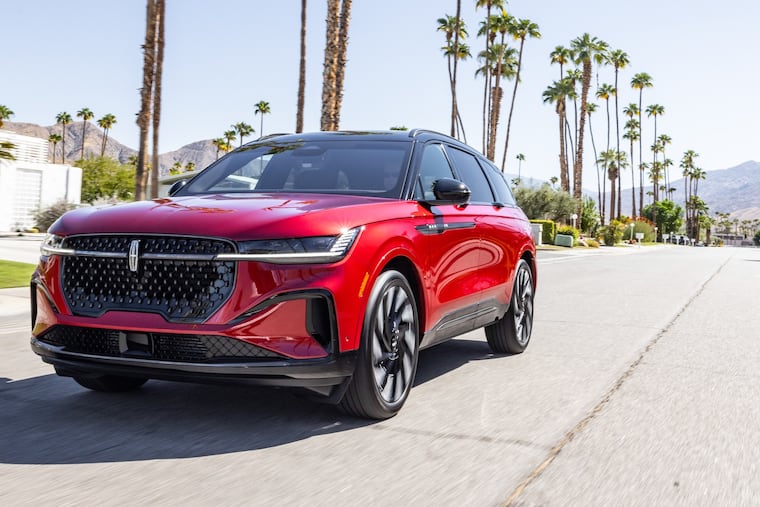
All-electric Volvos now pull some of the famed tram cars on the Wildwoods boardwalk
A new look for the Sightseer tram system debuted Memorial Day weekend with trams towed at 8 mph by an all-electric Volvo.

Blue and yellow tram cars have rumbled the Wildwoods boardwalk since 1949, providing a repetitive Jersey Shore summer soundtrack: “Watch the tram car please!”
But a new look for the Sightseer tram system debuted Memorial Day weekend with some of the conjoined tram cars towed at 8 mph by an all-electric Volvo serving as the new engine.
The cost for a one-way trip along the 2.5 mile boardwalk while rumbling over 70,000 wooden planks remains $5.
Patrick Rosenello, executive director of the nonprofit Wildwoods Boardwalk Special Improvement District, said Volvo is providing three vehicles for free in return for ads placed on the individual tram cars. Four of the older engines remain in use for now.
Without that deal, Rosenello said, the tram system might have faced closure.
Unlike many transit systems in the U.S., the tram cars are not supported by tax dollars, Rosenello said. “The tram cars are operated by a nonprofit and are 100% self-supported. They have to make financial sense.”
Barely breaking even
The original trams were built with diesel engines in 1939 for the New York World’s Fair. They were brought to the Wildwoods in 1949 and converted to electric.
The tram system has been run by private businesses, but the last gave up in 2003. The district took over in 2004 to keep the system alive.
Rosenello said fares bring in about $1.3 million a year, but the system barely breaks even when operating costs, labor, maintenance, parts, and insurance are factored in. That leaves no room for capital improvements, such as buying new engines.
“We have spent a lot of time trying to figure [out] a reliable, economical way to maintain the system,” Rosenello said. “We reached the firm conclusion that it’s just not financially sustainable.”
Scouring for parts
The traditional engines are difficult to maintain, with some of their parts almost impossible to come by, he said.
“We have people scouring the internet and eBay for parts,” Rosenello said.
In addition, batteries pose major issues. Each weighs 2,000 pounds and has to be removed with a hoist before being connected to a large charger.
The engines operate only six to eight hours before heading in for battery replacement daily between 4 and 6 p.m. in a labor-intensive process.
As a result, the district began experimenting in 2025 with a hybrid Ford Maverick to pull a tram.
Volvo’s offer
Jim Nichols, a vice president at Volvo Car Americas with New Jersey connections, learned of the Sightseer’s plight and approached the district with the deal for his company to supply cars for free.
Each Volvo EX40 can pull a tram for four days without a recharge. The cars have been modified with a governor to prevent them from exceeding 8 mph, some other safety features such as a 360-degree camera system, and will play the familiar recording.
Nichols called the tram cars “a cherished part of the Jersey Shore experience.” He said in a statement that the Swedish company is “proud to help preserve such an important part of New Jersey culture.”
Rosenello said that with Volvo’s cars in place for 2006 and beyond, the Sightseer tram system can survive, and recharging is a nonissue. More Volvo cars could be added.
Reaction on social media has been split, with some believing the tram system has lost its quaintness, others objecting to a foreign car at the helm, and still others acknowledging it’s time to move into the future.
“More like Tram SUV,” wrote one man in a snarky post on the Wildwoods Welcome Center Facebook page.
“Love the new tram car,” replied another.