Pa. workers have lost leverage in Trump’s economy, report says
The Keystone Research Center examined recent workers’ earnings, economic growth, and union representation among other factors.

Things have not gotten better for Pennsylvania workers in the last year, according to a new report from the Keystone Research Center. They have actually become “somewhat less favorable.”
The organization’s annual “State of Working Pennsylvania” report examined workers’ earnings, economic growth, and union representation in the last year, covering the change in presidential administrations from Joe Biden to Donald Trump. Keystone Research Center does economic and public policy research with an eye toward making Pennsylvania’s economy more equitable.
For those wondering “who damaged the economy for working people,” the report says, “most experienced economic sleuths point the finger to federal policies.”
But the impact of those changes — such as tariffs, funding cuts, and the loss of 2,600 federal government jobs in Pennsylvania — is just beginning to be felt, the researchers say.
“The data in this year’s report underscores the critical need for policy stability and worker-centered approaches as Pennsylvania navigates economic headwinds,” said the center’s executive director, Bernie Gallagher. “While uncertainty dominates the national landscape, what remains certain is that strong unions and robust worker protections create resilient economies.”
Worker power waning
Workers used to have more leverage in the job market to negotiate for better working conditions and wages in Pennsylvania — but they have lost some of that power recently.
The state unemployment rate has been inching up since last September, though it remains historically low.
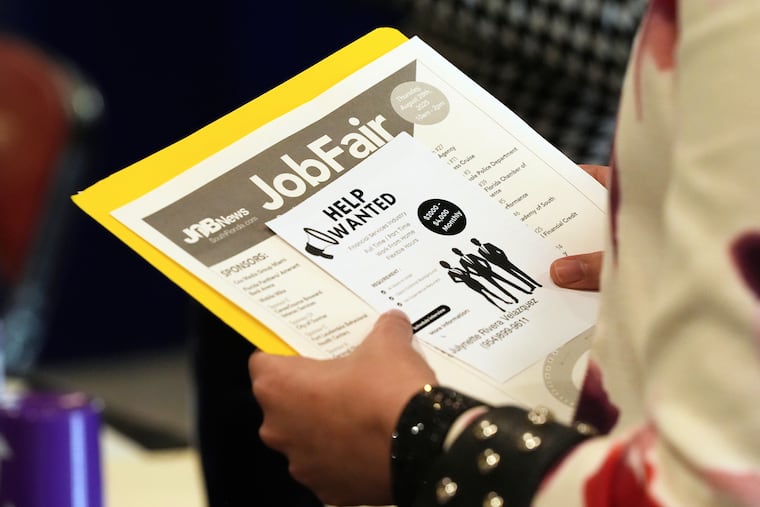
Fewer workers have been quitting their jobs in the last year, perhaps feeling less confident they can find a new one, the report notes.
“Pennsylvania’s economy favors workers today less than the tight labor market of a year ago,” said Claire Kovach, a senior research analyst at the center.
Still, Pennsylvania’s unemployment rate has been historically low in recent years, including now. Despite the slight increase this year, the state’s unemployment is below the national average, and job growth in Pennsylvania has outpaced the national rate.
But unemployment has been rising for Black and Hispanic Pennsylvanians in recent years, after declining for some time.
And Pennsylvania’s lowest-paid workers still do not make enough money to meet their basic needs.
The minimum wage in Pennsylvania, at $7.25, is the lowest among neighboring states and has not changed since 2009, despite efforts to increase it.
In Pennsylvania a single person without children needs to make $22.91 per hour to cover basic needs, according to the Massachusetts Institute of Technology’s living wage calculator.
Because of stagnant wages, Pennsylvania’s low-paid workers missed out on over $10 billion collectively from 2014 to 2024, the report indicates.
That needs to change, the researchers said, calling on the state’s lawmakers to increase the minimum wage to $15 an hour — although that, they note, is still not a living wage in Pennsylvania.
How tariffs and Trump policies are affecting jobs
Since January, the Trump administration has announced increased tariffs on nearly every country, but has also modified or delayed those changes a number of times. These “erratic tariff policies” may be “sparking renewed inflation and eroding investment,” Keystone researchers said.
That means employers may not be making the kind of investments that spur hiring. And, at the same time, working people are seeing the cost of living rise. This year, average inflation-adjusted wages, stagnant across the U.S., have declined in Pennsylvania.
Certain industries are more directly affected by Trump policies.
The administration’s rollback of clean energy and manufacturing grants and tax credits, for instance, may be hindering private investment in those kinds of projects, researchers indicated.
Legislation passed under Biden sparked a “boom” in public investing in clean energy and manufacturing, which was then followed by private dollars, Keystone Research Center’s Stephen Herzenberg has said. Private investment in U.S. manufacturing construction tripled between 2021 and 2024, the report notes, and appears to have declined recently.
That could mean fewer jobs and less economic growth, Herzenberg said.
How are unions faring?
Worker organizing has not halted in the Philadelphia region — local employees formed unions this year at Starbucks, Whole Foods, the University of Pennsylvania, and several health systems.
But overall, the percentage of Pennsylvania workers represented by unions has continued to decline since the 1970s.
Last year, the share of Pennsylvania’s private-sector workers who are in unions shrank, after increasing slightly from between 2016 and 2023.
At the same time, the Trump administration has taken some “anti-union actions,” researchers wrote.
Trump fired one member of the National Labor Relations Board earlier this year, which has left the board without a quorum, so it cannot issue rulings. The situation “gives anti-union employers even more freedom not to cooperate with proceedings related to unionization,” the report said.
» READ MORE: Philadelphia workers at Whole Foods voted for a union. This Trump firing brings a new challenge.
The Trump administration also recently moved to end union rights for federal workers, including many across the Philadelphia region. Union leaders have vowed to continue supporting government workers however they can.
Meanwhile, the administration has been laying off employees and paring down the federal workforce across the country. Those cuts have contributed to slower job growth, the report noted.
Pennsylvania lost 2,600 federal employees this year up through July, Keystone researchers found, citing data from the U.S. Bureau of Labor Statistics.
What comes next?
Herzenberg said it is still too early to see the full effect of tariff policies and cuts in clean energy subsidies.
And, he noted, recent changes to SNAP food benefits “will reduce income and buying power of low-income families.” Medicaid cuts will not start until after the 2026 midterms, and cuts in research and university funding “will have very long-term effects,” he said.
“We’re going to see much bigger impacts from shifts in federal policies in the future,” Herzenberg said.
» READ MORE: 139,000 Pa. jobs at risk
In order to fend off “greater inequality‚" researchers wrote, Pennsylvania’s minimum wage must increase, Congress should extend deadlines for tax credits around clean energy and manufacturing, and elected officials who support union rights “should counter the Trump Administration’s assault on labor.”
They wrote: “If one set of public policies rig the economy further against working families, another can put us back on track to shared prosperity.”