2026 Genesis G80: Something old, something new
The elegant sedan from Hyundai’s luxury division continues to bring a lot for the money. Unfortunately, sometimes a lot is just a lot.
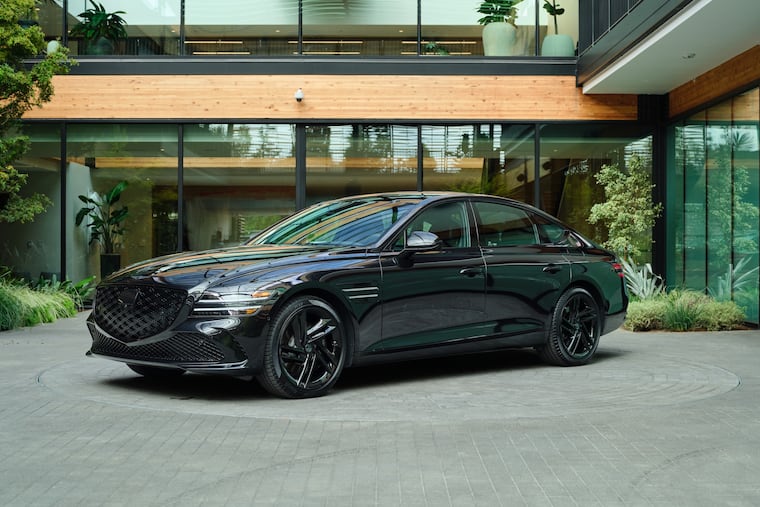
2026 Genesis G80 3.5T Sport Prestige AWD vs. 2026 BMW i5 x Drive40 Sedan: Two ways to get your elegant sedan on, this week using gasoline, next week electricity.
This week: Genesis G80
Price: This trim level starts at $78,350, while the G80 starts at $58,450.
Conventional wisdom: “Pros: Good power, decent quickness, cosseting ride, still a great value. Cons: Not cohesively sporty, worsening fuel economy, underwhelming new combo screen,” says Motor Trend. (Cosseting, Motor Trend?)
Marketer’s pitch: “Evolved elegance.”
Reality: A touch of the old, a touch of the new. Best of both worlds, right?
What’s new: The Genesis G80, despite all its bigness and suppleness, has never done much for me. I took this as a loan in hopes that I would find it’s been redeemed over the years from its old-time Lincoln feel, even though it’s pretty much soldiering on since 2021. Hyundai and Kia have made such great strides, and the GV60 and GV70 are just awesome.
Competition: In addition to the i5, there are the Audi A6, BMW 5 Series, Lexus ES, Mercedes-Benz E-Class, and Volvo S90.
Up to speed: The G80 was off to a great start from the first tap of the accelerator. A long, low sedan with the right amount of power is destined to press occupants into their seats, right?
This 3.5-liter turbocharged V-6 definitely brought some game. The 375-horsepower engine gets the vehicle to 60 mph in 5.2 seconds, according to Motor Trend. It seemed even faster.
On the road: The first turn in the tight Sturgis family driveway also boded well. The rear-wheel steering is a super nice touch when the G80 is being maneuvered around snug parking spaces and in low-speed maneuvers. The long sedan gets around like a vehicle that’s far less roomy.
But careful with that feature on low-speed turns. I came close to clipping a couple curbs as the sedan seemed to steer quite abruptly. It got better, though, with practice.
The steering also aims to help stability, but here it was less noticeable. Comfort mode does the driving just fine; sport mode kicks the handling up a notch. Sport plus turns the sedan into a nervous vehicle, far beyond the cosseting you might otherwise expect. It’s like finding your married, cardigan-wearing neighbor on Tinder.
Shifty: Like most Genesis models, the G80 features a dial shifter that twists one way for Reverse and the other for Drive, a system that normally gets my blessing. But it’s the same size and shape as the infotainment control dial, so it can become confusing in some situations.
Driver’s Seat: Genesis wants your attention focused on the big screen in the front. And it sure is pretty and eye-catching, as are the carbon fiber trim, microsuede headliner, and the rest of the details.
But the dial-shifter confusion is a pretty nice representation of the troubles with the G80. It’s all just a couple inches away from perfection.
The shifter is in the wrong spot, too far back on the console to make the infotainment dial easy to access. The drive mode control is too far back and too close to the passenger to be useful. It really requires a hard look down and away to find, every time.
The interior came in a red and black leather combination that gives Alfa Romeo a run for its flashy money. The Nappa leather seats are supple, with heating and ventilation standard. Cosseting.
Friends and stuff: The long sedan leaves one with visions of cavernous legroom and foot room, though headroom might be stingy. The second row actually has fairly decent headroom, but also only fairly decent legroom and foot room as well. I expected more. (The chauffeured right rear seat occupant can move the front seat waaaay up, though, with buttons on their armrest. Cossety.)
Cargo space is 13.1 cubic feet. There’s a small armrest pass-through but no fold-down seat.
Play some tunes: Despite my incessant whining about the screen and its complexity, it does fine for queuing up the tunes. The home screen features six large, clear icons, although they could be balky, a problem more apparent when I explored beyond music. The icons do have little subheads explaining a bit about what they do, which I noticed when I sat in the car for 10 minutes trying to figure things out, so not what you’d call great on-the-fly functionality. This needs to cosset me more.
There’s also an old-school pair of dials and row of buttons for the usual functions that helps quite a bit.
Sound from the Bang & Olufsen system is pretty good, about an A-.
Keeping warm and cool: The HVAC main control features dials for temperature control and an ebony touch pad with lots of numbers and graphics for the rest of it. Not the simplest but it works.
Fuel economy: Darned if I know where to find it, try as I might. It’s rated for 15 mpg city and 18 combined.
Where it’s built: Ulsan, South Korea. Parts are 80% Korean and 3% U.S./Canadian.
How it’s built: Consumer Reports predicts the G80 reliability to be a 2 out of 5.
In the end: The new is too new for me. Perhaps there’s a Genesis University to teach buyers, but the rest of us are left to flounder.
Next week: Will the BMW i5 compare in the cosseting department?