How Inquirer staffer Mel Greenberg’s poll changed women’s college basketball forever
Even before the eyes of the NCAA, women's basketball was alive and well, especially here. Greenberg's poll brought cohesiveness to the sport and created a platform for household names today.
When the NCAA decided to go all-in on Division I women’s college basketball by adding a national championship tournament in 1981-82, it marked a fascinating turnaround. By grabbing the reins from the Association for Intercollegiate Athletics for Women — the longtime governing body of women’s hoops — the NCAA set out to make the game bigger and better forever.
The sport did change, vastly. Television exposure finally found big-name programs. Title IX brought more girls and women into play, literally and figuratively. All-American players and Hall of Fame-worthy coaches promulgated. What should not be lost is this: the roots of the game were plentiful, but none more important than what grew strong at schools throughout this tri-state region.
Here, programs and players were so impactful that to ignore the flood of talent became indefensible by 1982. So, the NCAA bit.
Why? One needed to look no further than the locals that dotted the all-important 50-year-old Mel Greenberg national poll early on.
Think back …
Before the dynasties at UConn and Tennessee, there were giant-killers on the courts of tiny Immaculata and Cheyney State.
Before there was a Geno Auriemma or Pat Summitt, there were legendary coaches like the Mighty Macs’ Cathy Rush and Cheyney’s C. Vivian Stringer. Rush’s and Stringer’s reputations and extraordinary programs surely caught the attention of the NCAA as they traveled the path to the Naismith Basketball Hall of Fame.
Before there were all-Americans like Dawn Staley, Maya Moore, and Caitlin Clark, future Hall of Famer Theresa Shank-Grentz and the fabulous talent, Yolanda Laney, were dealing here in the Delaware Valley.
Shank-Grentz, star of the Mighty Macs’ improbable AIAW championships, helped put a school of fewer than 3,000 students on the map. The Macs ruled the game for a near decade, winning three AIAW crowns while reaching five consecutive AIAW Final Fours.
At even tinier Cheyney State, the All-American Laney and other talents who desired to play for Stringer helped the nation’s oldest historically Black college or university become the first HBCU to play in an NCAA Division I national championship game. Stringer’s team, with not one athletic scholarship to give, made that possible in 1982.
“When you look at our team, we were part of God’s plan … a team of All-American, all-state players turning down scholarships [from larger schools] but we had one common denominator, and that was the great Vivian Stringer,” the team’s star center, Valerie Walker, said in her acceptance speech at the Women’s Basketball Hall of Fame ceremony in 2024. The Lady Wolves were enshrined as “Trailblazers of the Game.”
» READ MORE: Born in The Inquirer’s newsroom, the AP women’s basketball poll ‘has stood the test of time’
The NCAA certainly was watching and calculating how to build off the growing women athletes’ import. But it arguably would not have had the curiosity or the vision if Greenberg had not provided the cohesiveness and foresight to champion programs, big and small.
The Philadelphia Inquirer’s women’s basketball savant did so by founding his national poll 50 years ago. By connecting the dots of powerhouses across the country, the poll allowed teams, whether big, small, or minuscule, to bring into focus what previously had been a guessing game of who, what, and why which teams and trends mattered. The clarity benefited not only the programs, but the players, recruits, fans, and media from coast to coast.
Greenberg gave even the most accomplished chroniclers of women’s hoops — as well as newbies such as this reporter — a divining rod. His informative and increasingly powerful poll beautifully grew in strength alongside the game. Local teams certainly benefited, as Greenberg shone a light on both with his polling and prose.
He helped me, a frenemy at the late, great Philadelphia Bulletin, appreciate the bushels of all-American players, future Hall of Fame coaches, and prominent teams that dominated the AIAW right in our own backyards. From Rutgers to Maryland, Cheyney State to Penn State, and rising Big 5 women’s teams, it fascinated me to see the seeds that one day sprouted so prominently.
To say that I saw the important contributions of the local teams growing the women’s game as clearly as did Greenberg would be beyond impudent. Rather, following the game in and around the immediate area as well as following the pollmeister was an education, one I and others needed to appreciate why the NCAA move was inevitable.
I missed seeing the Mighty Mac era by mere years. Still, I often was reminded of the footprints left during their legendary run through the ’70s. Greenberg, a walking encyclopedia of the sport, can to this day bring to life any tale about the Macs, starting with the 1972 team that won the first women’s national basketball championship.
Though I came to the job too late to witness the Mighty Macs magic, I saw what followed in their footsteps. For a similar miracle was unfolding at Cheyney State where Stringer was building a national behemoth at the tiniest of schools (today’s enrollment at Cheyney, which is now known as Cheyney University, is less than 1,000 students).
John Chaney, the Hall of Famer and Philly legend who was the coach of the men’s team at Cheyney when Stringer was leading the women there, knew which team was the stronger draw. “We were ranked No. 1 in Division II, but we’d play the first game so that we would have somebody there by halftime,” Chaney, laughing, told me for a column written for the New York Times. “The real show was our women’s team. They didn’t come to see me; they came to see Vivian!”
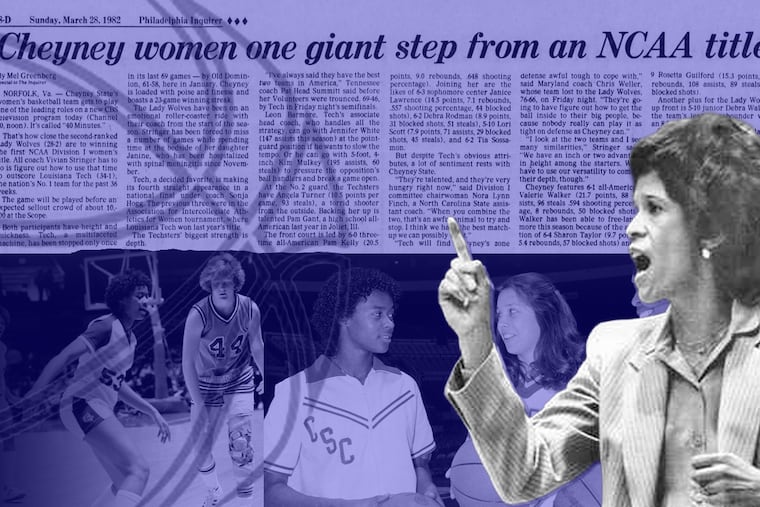
It always was standing-room-only in Cheyney’s compact Cope Hall, for the scribes and fans had a sense that what they were watching was special: Two Hall of Fame coaches in the making. Oh, and one Hall of Fame team. For Stringer’s 1981-82 team that finished the season ranked No. 2 in the nation.
That final standing in the polls reflected Cheyney’s having come within one win of claiming the first-ever women’s NCAA championship. Though the team lost to Louisiana Tech in the final, just getting there was the ultimate victory.
In those days, Stringer spoke of how her Lady Wolves had to sell cookies, cakes, and sandwiches to raise funds to travel to Norfolk, Va., for that first Final Four.
That Cheyney team finished 28-3. The 11 players and coaching staff were honored years later by the Women’s Basketball Hall of Fame in 2024. The team also was nominated for the Naismith Basketball Hall of Fame in 2025.
Alas, those David and Goliath stories no longer happen in a world where a Cheyney State or Immaculata wouldn’t even dream of being allowed to compete at a Division I championship level. Big universities and programs awash with NIL money now gobble up the best players in the land. The little guys play in lower divisions, noses pressed against windows of the massive arenas holding tournaments made possible by the Immaculatas and Cheyney States, the Cathy Rushes and Vivian Stringers … and Mel Greenberg’s vision of what could be.