These siblings were part of successful runs with Penn squash that ended with a national title
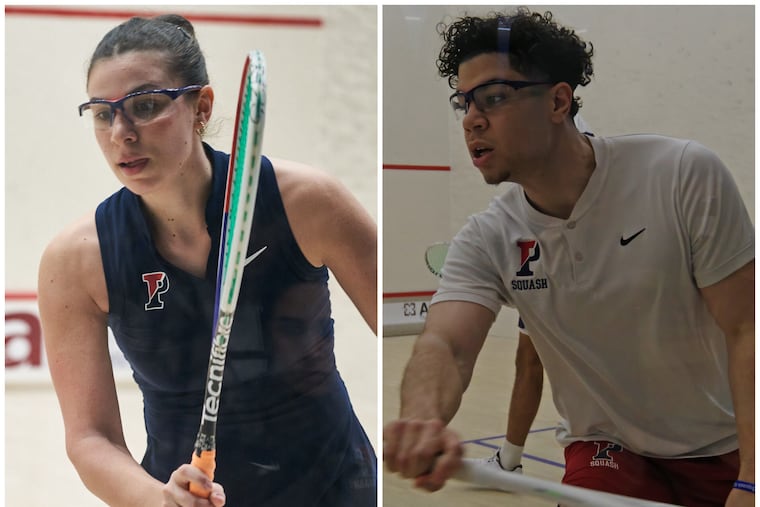
Jana Dweek watched her brother, Abdel, win back-to-back men’s titles. In March, she helped the women’s team to its first CSA crown in school history. They say it's from the program's tight culture.
Penn squash is built on family.
For some, it comes from how close the men’s and women’s programs are on and off the court. For Jana and Abdel Dweek, it’s a reality.
Siblings who moved from Egypt to Calgary, Canada, at a young age, the Dweeks have left a lasting impact with the Quakers. Both were part of College Squash Association championship-winning teams.
Abdel, who graduated last year, won back-to-back men’s titles in 2024 and 2025. His younger sister, Jana, won a title of her own on the women’s side on March 6, when she led Penn to a 5-4 victory over Princeton in the deciding match of the Howe Cup final. It was the women’s first national championship in program history.
“Winning nationals was like the perfect ending to the story,” Jana said. “We’ve never truly known what it’s felt like to win something so big. We’ve lived it through the men’s team that has won it back to back, and for us, it felt like something we truly earned.”
‘No better feeling’
In the first round of the national championship, Penn (17-2) lost Anne Leakey to a season-ending torn ACL against Cornell. Jana, the team’s senior captain, joined the starting lineup for the quarterfinal but gained more of a permanent spot in the rotation after Kay’s injury.
After the team’s victory against Stanford, the women looked ahead to a familiar foe in the CAA final: Princeton. Both of the Quakers’ losses came at the hands of the Tigers, including a painful defeat in the Ivy League final.
“At one point, I was thinking I might honestly not play Princeton,” Jana said. “Even though I was now at No. 9, I was thinking the match was going to be done before I went on.”
Penn’s Malak Khafagy, Franka Vidovic, Malak Taha, and Savannah Ingledew each earned wins in the first five rounds of the competition. Once the Tigers began to claw back — it dawned on Jana that the season would come down to her.
“I knew I was going to be playing the decider,” Jana said. “I did get a lot of advice from my brother, actually, before, and he said, ‘This is, as an athlete, all you can ask for — to play in these big pressure moments.’ That is when I truly play my best, I think, because I can only really compete when I feel like there’s a huge weight on my shoulders.”
Jana defeated Princeton’s Sonya Sasson in three sets in a clean sweep with scores of 11-8, 11-8, 11-9. Once Jana claimed the final point, her teammates erupted onto the court.
“There’s no better feeling than winning the biggest title in college squash with all your best friends,” Jana said. “Having all the support in the world, from alumni, from a coach who’s put everything in for this moment, who’s done everything for us, for a program, who’s made all of our dreams come true. It feels like we finally, in a way, kind of gave back to them.”
Fostering family unity
Jana and Abdel may be related, but their relationship is a symbol of the program’s larger culture.
Jack Wyant, Penn women’s squash head coach, took over the helm in 2004. In his time at Penn, Wyant has intermittently coached both the men’s and women’s teams and became the winningest coach in Penn squash history with a record of 235-96.
Wyant wanted to adopt a culture that encouraged unity between the men’s and women’s programs, a unity he sees as an advantage over other teams. The promotion of Gilly Lane, a former Penn squash player, to head coach of the men’s team in 2016 helped push that vision forward, with the pair working together like “brothers.”
“My first year at Penn was Gilly’s sophomore year at Penn,” Wyant said. “So if you want to go with the big brother, little brother deal, yeah, I think he refers to me as his big brother … it’s sort of inconceivable that we would run it any other way.
“My initial goal was to win a championship with the women. When the men’s coach retired, I took over both roles, coaching both the men and women. I did that for six years. It was during that period that we hired Gilly as an assistant, and I knew pretty quickly that he was a great coach and or would be a great head coach.”
» READ MORE: How past stardom led Moa Bönnemark, one of Sweden’s best in squash, to improve at Drexel
Both programs held joint practices and team outings together. By combining practices, the support system doubled on match day.
“I would describe it as having an extra 15 to 16 brothers,” Jana said. “We go to them if we need anything school-related. Anything in general. … Our practices overlap three times a week, so we’re together pretty much all the time. One reason I came to Penn, even in the first place, is because of the culture that they have here with men’s and women’s.”
Abdel added: “There were some weekends where the men would have a horrible defeat and the women’s team would have a big win, but on the way back in the bus, the women, instead of celebrating, are sitting with us, making sure we’re OK, and vice versa.”
The men’s team secured an Ivy League championship, but fell to Harvard in the CSA semifinals. During the women’s championship, inside of Arlen Specter U.S. Squash Center was filled with supporters from the men’s team, along with alumni of the program and parents.
“I knew we would win because the cheers for our team were louder,” Wyant said. “The fans were 50-50 split, but our men were so much louder than their men, because of the way that Princeton sets up its program. It’s very separate. Ours, by intentionality, is woven much more closely together.”