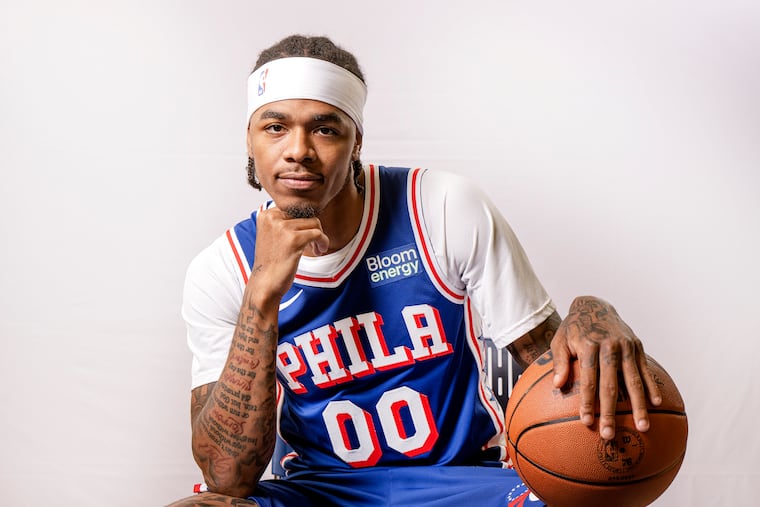
Villanova freshman Acaden Lewis is often praised for using his ‘off’ right hand. He’s actually right-handed.
“Everything about me in basketball is left-handed, I would say,” the point guard says. “But I’m right-handed so I’m ambidextrous basically. It’s weird.”

Because Acaden Lewis shoots a basketball left-handed, it is natural for observers to admire the way the freshman Villanova point guard uses his right hand.
The admirers often wear headsets and announce games on television.
There goes Lewis, using his other hand.
Look at that, with the off hand.
For most players, passing the ball with their nonshooting hand, dribbling to their nonshooting hand’s side, and using their nonshooting hand to finish a layup or floater takes a lot of practice. The movements can be unnatural.
To be sure, Lewis has worked hard to sculpt a skill set that has allowed him to play right away and be the lead guard on what looks like an NCAA Tournament-bound Villanova team.
But he isn’t left-handed.
“I can’t do anything with my left hand,” Lewis said by phone this week as he forked noodles into his mouth using his right hand following a post-practice film session. “I can’t palm a ball. I can’t write. I can’t eat.”
How did a right-handed kid growing up in the nation’s capital learn to play basketball left-handed?
“I actually have no clue,” Lewis said. “I think I just shot with my left hand when I started hooping.”
Whatever works. And it’s working. Entering Wednesday night’s game vs. Georgetown, Lewis is at 12.1 points, 5.3 assists, 3.4 rebounds, and 1.9 steals per game.
His ability to use both hands is all over that stat line.
“I think he has so much confidence in the fact that he can go both ways, and it’s not like you can shade him one way or send him to his weak hand,” Villanova coach Kevin Willard said.
» READ MORE: The NBA journey of former Villanova star Collin Gillespie seems unlikely to everyone — except him
Willard first recruited Lewis out of high school when he was the coach at Maryland, but Lewis initially committed to Kentucky. It wasn’t until April, a few months before summer workouts, that Lewis withdrew his commitment from Kentucky and was back on the market. Villanova needed a point guard.
During the recruiting process, Lewis told Willard and his staff that he actually was a righty.
“I thought he was full of s—,” Willard said. “Because he was doing everything with his left.”
Willard noticed Lewis was good going both ways when he watched him, but it took floater drills during preseason practices for the coach to finally become a believer. Lewis was better with his right.
“I was like, ‘Jeez, he must be right-handed,’” Willard said.
Then, in October, during the installation of Villanova’s pick-and-roll defense, Willard noticed Lewis’ ability to run offense and pass effectively using his right hand. For most players, Willard said, there’s a “dramatic difference” when running an offense to their supposed weak side. With Lewis, it’s a strength.
“We actually run some plays where he’s passing with his right hand because he can do it,” Willard said. “We don’t have to switch sides of the floor because he’s lefty. He gives me flexibility in the fact that we can run certain plays on the same side of the floor.”
» READ MORE: Villanova hits a ‘bump in the road’ after struggling with the physicality and experience of St. John’s
Lewis, who has been named Big East freshman of the week four times, agreed with Willard that passing might be the most critical component of him being ambidextrous.
“I think that’s the best thing I actually do with both hands,” Lewis said. “Either that or finishing. I think the passing ability is really dynamic. I can do all types of passing with both hands, so it’s never like I have to come across my body or have to make awkward movements to throw passes. It makes a lot of things comfortable for me.
“It’s a little unorthodox, and it’s kind of hard to guard.”
There is, however, no advantage to being strong with both hands on the defensive end, Willard said.
“I wish it did [help him],” Willard said jokingly. “I think he wishes it did, too.”
Lewis credited his knack for the ball as the reason he is averaging nearly two steals through his first 18 college games. But while Lewis is fourth in the Big East in steals, his defense and inexperience have landed him on the bench a few times this season, including for all but 19 seconds of the final 11-plus minutes of Saturday’s loss to St. John’s.
Lewis, Willard said, takes to coaching. He was similarly benched during the second half of a season-opening loss to BYU and responded well.
“I think one of the biggest things about a leader is, he admits when he [messes] up,” Willard said. “He owns it. I think other guys have really bought in to the fact that here’s a young guy that’s getting yelled at by the coach because he’s the point guard, but he’s the man taking it.”
» READ MORE: Fran Dunphy speaks for the first time about how the NCAA point-shaving scandal touched La Salle
Having two dominant hands and arms on the basketball court has been key for Lewis during his first season, but beyond that, Willard said Lewis’ commitment to learning and studying has enabled him to play well right away. That part he expected. Eric Singletary, Lewis’ coach at Sidwell Friends School in Washington, which previously fed Villanova stars like Josh Hart and Saddiq Bey, raved about the student of basketball Willard was getting.
What Willard didn’t know until Lewis got on campus was that Lewis is a “monster competitor,” the coach said.
“I just never knew how much of a competitor, how much he wanted to win, and how much he wants to be good. I don’t think you ever really find that out until you start coaching a kid. He’s blown me away with how much of a competitor he is.”
That, and the right-handed floaters.
Those, and Lewis’ ballhandling skills, were developed during early-morning training sessions that started when Lewis was a freshman in high school. While Lewis is right-handed, he spent his youth mostly using his left on the court. His trainer, Kevin “Uncle Skoob” Kuteyi, would pick Lewis up full-court during 6 a.m. workouts and force the teen to beat the pressure, often dribbling to his right, and finish at the rim, again mostly with his right hand.
It came naturally, thanks to Lewis’ right hand being his dominant hand.
“Everything about me in basketball is left-handed, I would say,” Lewis said. “But I’m right-handed, so I’m ambidextrous, basically. It’s weird.”
Weird, even ambiguous.
Does Lewis consider himself right-handed, left-handed, or ambidextrous?
“I’m a right-handed person who is left-handed when I hoop,” he said. “That’s how I would put it.”