2026 Land Rover Defender 130: The price of invincibility
The big SUV of British aristocracy is like riding in an armored car on stilts. And, yet, it’s a lot of fun for the whole family.
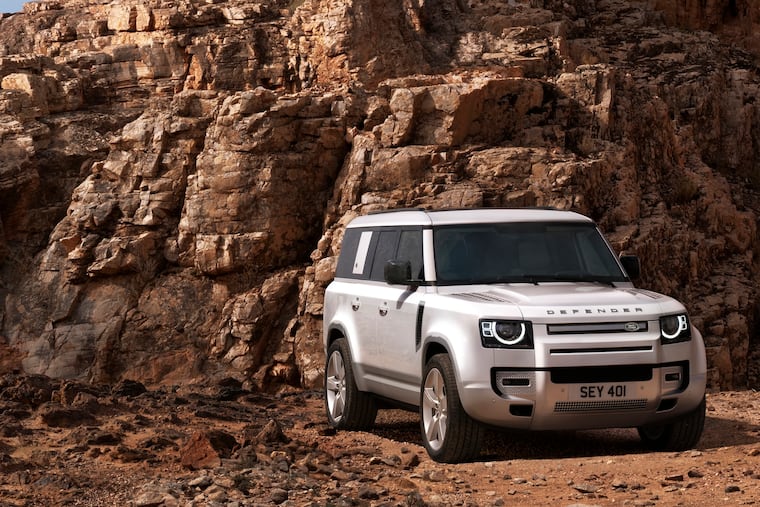
2026 Genesis GV80 Coupe 3.5T E-supercharger vs. 2026 Land Rover Defender 130 V-8 vs. 2026 Mercedes-Benz GLE 450 4Matic SUV: Off-roading in high style.
This week: Land Rover Defender 130
Price: $118,900 as tested.
Conventional wisdom: Car and Driver liked the “unmistakable Land Rover styling, unquestionable off-road capability with on-road civility,” and that the “interior deftly blends utility and comfort.” They were less thrilled about the “disappointing fuel economy,” and that “this sure isn’t priced like the original.”
Marketer’s pitch: “Freedom for all. Eight seats for shared exploration.”
Reality: Feels pretty cool, but is it worth the $30,000 upcharge from the Genesis?
What’s new: The Defender gets a revised look, a bigger 13.1-inch touchscreen, and optional off-road cruise control.
Competition: In addition to the GV80 Sport and the GLE 450, there are the BMW X5, Lexus RX, Lincoln Nautilus, and Toyota Land Cruiser.
Up to speed: The 5.0 V-8 engine creates a whopping 493 horsepower, but as it tries to move the buffalo that is the Defender, it has its work cut out for it. I found getting the accelerator to move the vehicle briskly could be a challenge, but over time this became easier.
A plethora of engine options and horsepower ratings make nailing down the 0-60 time cumbersome. Motor Trend estimates it gets to 60 mph in 5 seconds, a number I thought was optimistic. Land Rover claims 5.4 seconds.
The Defender really was a little lackluster in passing, a more useful measure of performance than pole position moves at the stoplights. It was about a draw with the GV80 Coupe for acceleration until here.
Shifty: The joystick takes a push ahead for Reverse and a pull for Drive with a button for Park. Shift from the lever or the paddles if you want to move your own gears.
On the road: The Defender does a fantastic job smoothing out rough Pennsylvania roads.
The handling is not bad for its size; the Defender has a fairly narrow profile for a behemoth SUV, and I found snaking through country roads pretty enjoyable, especially considering its 11.5-inch ground clearance. Still, neither Land Rover nor Genesis stands out yet.
Driver’s Seat: The seats provide plenty of comfort and enjoyment; it is quite nice riding above all the other cars on the road. Adjustments were plentiful and everything seemed easy to operate.
The Lovely Mrs. Passenger Seat remarked on the comfort and captain feeling of her seat frequently. Big advantage Defender.
Of course it’s a bit of a stretch into the Defender but it never seemed too awful. But unlike a lot of other parts, my knees still work fairly well.
Passing can be a challenge because the mirrors are narrow, the spare tire makes rearward visibility a challenge, and the door post behind the driver’s door is huuuuge.
Friends and stuff: It’s big, so of course there’s lots of space in the seats, and to get around, right? Well …
The seats all sit up high, all three rows, so everyone should be happy with the view from their location.
The middle-row captain’s chairs are nicely supportive, although they’re a little narrow. They do run back and forth to accommodate the third row, and there’s plenty of room to get around inside.
The rear-row seats are much smaller and sit low to the floor. And, surprise, the mechanism for the seat belts for the middle row impedes legroom in the corners.
Headroom is a little tight in the middle row and very tight in the back.
Cargo space is 15.3 cubic feet in back, 43.7 with the third row folded, and 89.9 with the second row also folded. Of course, all are far larger than the GV80 Coupe.
The barn door in back could be awkward. I couldn’t get the second-row captains chairs to lie flat. Still, three rows and some comfort, advantage Defender.
The Defender 130 tows up to 8,200 pounds, so here’s where the extra $30K is well spent. That’s like $10/pound over the GV80, basically the price of ground beef.
Play some tunes: Sound from the Meridian surround sound system is pretty good, about an A- or so. I expected better.
Operation was not too difficult. The USB-C was very plug and play and CarPlay popped right up. Getting to sound adjustment in the screen was not hard. Still, advantage GV80 Coupe for playback.
Keeping warm and cool: A pair of dials focus on temperature at first glance. Changing the fan speed requires hitting the toggle button in between to change the one dial to fan speed, which is about as confusing as it reads. Buttons all around set the blower. Still, it’s easier than the Genesis HVAC.
The vents are set at the top corner of the dashboard. They do clear out the stodgy air up front, as expected, but they also blow nicely across the occupants and keep everyone feeling nice without being too forceful.
Fuel economy: 15 mpg on premium fuel. Urp. I don’t care if you just forked out six large for this SUV; that still has to sting a little.
Where it’s built: Nitra, Slovakia. The United Kingdom provides 31% of parts, Germany 19%, and the U.S. and Canada just 1%.
How it’s built: Consumer Reports predicts the Land Rover Defender reliability to be a 2 out of 5.
Next week: It’s all up to you, Mercedes.