2026 Nissan Murano: I’ll probably forget I drove it this time, too
The midsize SUV is definitely comfortable and roomy. But the performance and user-friendliness make Mr. Driver’s Seat as hesitant to recommend one as the Murano was about accelerating.
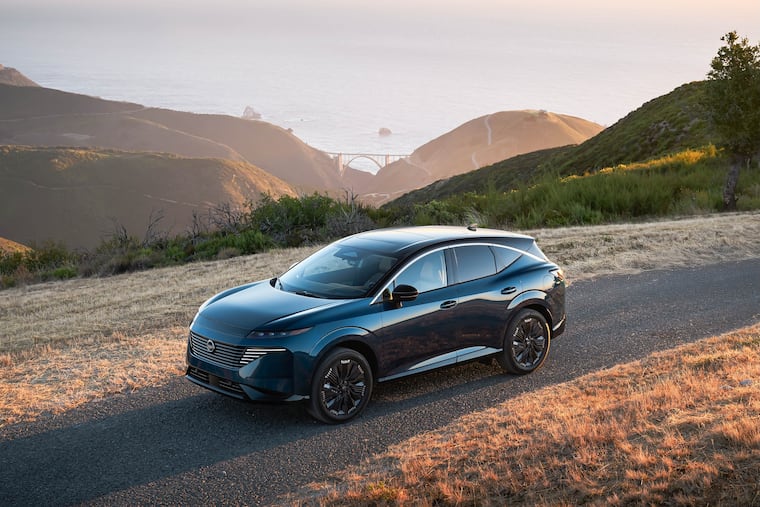
2026 Nissan Murano Platinum AWD vs. Volkswagen Atlas SEL Premium R-Line: Midsize SUV comparison.
This week: Nissan Murano
Price: $53,950 as tested
What others are saying: “Highs: Comfortable front seats; short stopping distances. Lows: Rough-shifting transmission, uneven power delivery, stiff ride, unintuitive controls,” says Consumer Reports.
What Nissan is saying: “Energetic elegance.”
Reality: I promise I checked Consumer Reports after I wrote the column.
What’s new: I was excited to have a Murano in my lineup because after all these years of columnizing, I would finally get to review one.
(Googles “Scott Sturgis” “Inquirer” “Murano.”) Well, huh. I drove 2015 and 2018 models.
Memorable, evidently.
This is not the same Murano, naturally. A redesign for 2025 gives the awkward old two-row, midsize SUV an awkward new look, along with a new engine and transmission.
Competition: In addition to the Volkswagen Atlas, there are the Chevrolet Blazer, Honda Passport, Jeep Grand Cherokee, Mazda CX-70, Subaru Outback, and Toyota Crown Signia.
Shifty: Hooray! A Nissan without a CVT! The Murano came with a 9-speed automatic, so I should be this delighted. But read on.
Up to speed: Gone is the V-6 that powered the old model. The 2.0-liter turbocharged engine creates 241 horses, which is not a ton for this size of vehicle. It gets the vehicle to 60 mph in 7.2 seconds, according to Car and Driver.
But the acceleration story has many more chapters. When I first pulled out of my neighborhood, the Murano seemed to alternate between lag and lurch. “OK, it’s cold,” I thought, offering the benefit of the doubt even while it was probably 85 degrees outside. “I’ll give it some time.”
But the unsteadiness continued. Sometimes SUVs and minivans can have an awkward accelerator-foot interface, so I looked into that. But, no, it felt comfortable.
“Aha! Here’s a drive mode selector,” I cried. “I’ll try that.” When I shifted to sport mode, it got sporty all right — in the way that your eighth-grade gym teacher forced you to run laps around the gym at 8 a.m. until you felt like throwing up. It was even rougher than before, although the roughness came at you faster.
“All right, I never do this,” I sighed and shifted into eco. Surprisingly, the power didn’t completely die out. The Murano felt smooth. Sure, it took a lot of foot stomping to get the Murano on highways and such, but the SUV delivered power much better.
On the road: Mode, schmode, driving the Murano was never more than OK. Country roads are blah; highways are a faster blah. There are just so many more enjoyable competitors to get around in.
The lane-keeping system drove me nuts for a few days, and the menus to adjust it are inscrutable. Press one of two little dotted lines on the steering wheel to change them. The screen says “OK Menu,” and there’s a tiny OK button next to a microphone/button, and that seemed to function at somewhat regular intervals. I’d need practice to do it again.
Driver’s Seat: The seat itself is on the plush side, roomy and wide. Nissan has long offered classy interiors even down to the Sentra (sorry, Versa, not you). Silver buttons and trim with nice colored material add to the upscale feel.
But here’s a better place to complain about the transmission controls. Why did some designer think a row of buttons at the front of the console would be a great idea? My phone and other items forever covered them. Also, they’re just not intuitive, so when you’re in a tight spot and have to maneuver forward and back to get out, it requires far more concentration than it should.
Friends and stuff: The rear seat is roomy, comfortable, nicely appointed, and well positioned. Heads, legs, and feet have no shortage of space, even in the middle seat.
Cargo space is 32.9 cubic feet in the back, and 63.5 with the rear seat folded.
In and out: The Murano rides at a height perfect for entry and exit without leg stretches.
Play some tunes: A single large volume knob is available outside the touchscreen. The 12.3-inch screen sounds like a good size, but it’s very short and wide, and a row of icons along the side and HVAC display along the bottom eat into the space.
Sound from the Bose Premium system is OK, about a B+ or so, and leaves me wondering what the not-premium system sounds like.
Keeping warm and cool: Going one better (or worse) than the popular ebony touch pads, which Mr. Driver’s Seat doesn’t love, the Murano offers a cheap-looking black plastic controller pad with temperature, fan speed, and source, and it requires a forceful push to engage your choices.
While you’re fighting with that, a teeny tiny display at the bottom of the touchscreen shows the changes. Let’s all say it in unison: “Eyes on the road!”
Fuel economy: I couldn’t get the trip display to do more than show me how each individual trip went, and the car said the best fuel economy was 22.8 mpg. So, the rest were worse. Let’s call it 20.
Where it’s built: Smyrna, Tenn. Half the parts come from the U.S. and Canada, including the transmission. The engine hails from Japan.
How it’s built: The Murano gets a predicted reliability of 3 out of 5 from Consumer Reports.
In the end: Nissan has a comfortable, roomy, attractive (on the inside) SUV here. If they can tweak the engine and suspension and start over with infotainment and HVAC controls, this could be a winner.
Next week: 2026 Volkswagen Atlas