The new Bruce Springsteen museum is a giant scrapbook that validates New Jersey’s role as a music incubator
The $50 million center at Monmouth University examines the Boss’ place in American culture.
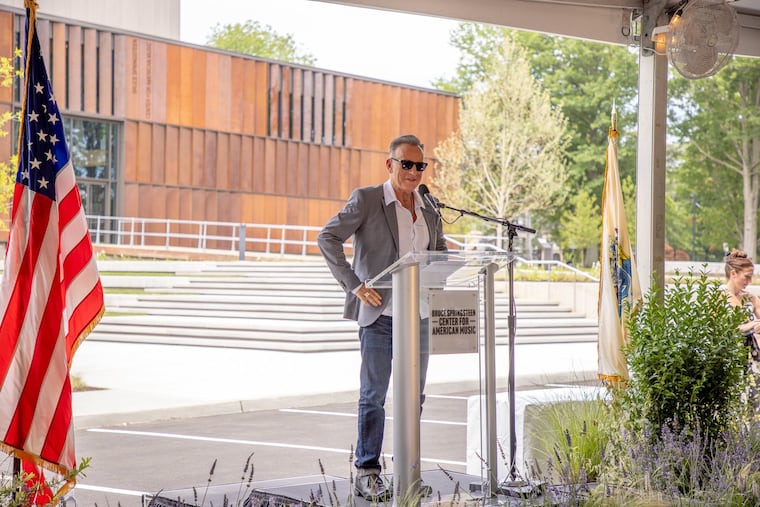
There has always been a Church of Bruce. Now it has its own building.
Officially called the Bruce Springsteen Center for American Music, it’s located on the Monmouth University campus, four miles north of Springsteen’s old Asbury Park stomping grounds. As the name suggests, the center — part museum, part archive, part concert venue — is seeking to broaden the conversation by situating the Jersey rocker along a continuum, one that starts with Indigenous drumming rituals and stretches into the hip-hop era.
And yet, as you stride up the center’s boardwalk-style entrance ramp, past the memory tree that commemorates the one from Springsteen’s childhood home, and come face-to-face with the building’s rust-hardened steel walls, there’s little doubt that you are really entering Bruce’s house.
Springsteen has been such a cultural presence in American life over the last half century that it is hard to imagine it otherwise. Every detail of the building designed by New York’s CookFox Architects is keyed to some piece of his well-known biography. The joy in the architecture, particularly for the legions of Springsteen superfans, will come from decoding the references.
There is the site itself, on the shady university campus where Springsteen played one of his first big concerts in 1969, at a time when most of his gigs were confined to dive bars. The simple rectangular building is put together with the same devotion to craft you find in Springsteen’s lyrics, and it’s similarly infused with grit.
On the facade, vertical slats of weathering steel angle in search of sun and shade. Their calloused red surface evokes the aging factories that stood on the edge of Springsteen’s hometown of Freehold, and that form a recurring motif on “Born in the U.S.A.,” an early and prescient elegy for America’s dying manufacturing towns and diminished working class.
That industrial theme is reinforced once you step inside. Muscular columns and beams, made from environmentally friendly engineered wood, structure the interior. There are wood slats on the ceilings and chunky blocks on the theater floor. They are the same hardy, end grain cut that factories once used to support heavy machinery.
Why fans will come
While Springsteen’s work tends toward darkness, the new center, which opens Saturday, emphasizes the light, both in its design and in the content of the exhibits.
Most visitors probably won’t be making the pilgrimage to Long Branch for the architecture, good as it is. They’ll come for the same reason they have attended so many concerts over the years, standing for the Boss’ relentless, three-hour jams and chanting the lyrics by heart. His stories of yearning and defiance have become the soundtrack for their lives. The $50 million center promises to serve as a giant scrapbook for those memories.
The project’s origins go back to 2011, when a donor gave Monmouth University a collection of Springsteen memorabilia, mostly posters and magazine clippings. At the time, it seemed likely that Springsteen’s much larger personal archive would end up at the Rock & Roll Hall of Fame in Cleveland.
The university nevertheless continued to expand its holdings, and in 2016, several people connected with the collection decided to make a play for Springsteen’s personal archive. A delegation was sent to meet with the musician and make the case that the material belonged in New Jersey, not Ohio.
Springsteen’s longtime manager and friend, Jon Landau, “loved the idea,” recalled Eileen Chapman, the center’s director. Springsteen agreed to donate his archive to the university — gratis — and the university agreed to erect a suitable place to house it.
The Boss did make one stipulation: He didn’t want the exhibits to focus on him exclusively, said Robert Santelli, a Grammy-award winning music historian and Monmouth alum who is now the center’s executive director. Once again, the university agreed, and the center’s scope was expanded.
”The Bob Dylan archives are about Bob Dylan. The Woody Guthrie Center is about Woody. We felt the best way to tell Bruce’s story was to make him a chapter in an ongoing story of American music,” said Santelli, who has helped start several music museums, including the Grammy Museum in Los Angeles.
Everything went smoothly at first. CookFox Architects, who are known for their commitment to both green and healthy design, won the design competition for the center in 2018. Then the pandemic hit and fundraising slowed.
First exhibit: Protest songs
Although it has taken eight years to get to this point, there is a certain poetic alignment in the timing of the opening, as America celebrates its 250th anniversary. The center’s first special exhibit will be devoted to protest songs.
“Chimes of Freedom: Protest, Patriotism, and the Power of Song” takes its title from a Dylan song, later covered by Springsteen, and should help place Springsteen’s work in the tradition of traveling troubadours who sang about injustice. A vocal critic of the Trump administration, Springsteen made his new anti-ICE song, “Streets of Minneapolis,” a centerpiece of his just-wrapped tour.
Richard A. Cook, the CookFox partner who oversaw the design, considers himself a casual fan. But he said he was deeply moved by the passages in Springsteen’s autobiography about his father, who struggled with bipolar disorder, as Cook’s father did. As an architect, he has embraced biophilic design, which uses sunlight and nature to shape soothing interiors.
Entering the building from the boardwalk, visitors will be immersed in a calming, double-height hall flooded with natural light and smelling of wood. From there, they are directed to an intimate, 240-seat auditorium — where more light pours in from a floor-to-ceiling glass wall behind the stage — for an introductory film by Thom Zimny.
The theater is easily the most expressive space in the building. It is rare to see such large windows in a performance venue, which are typically hermetic boxes that overwhelm the street with blank walls. By offering views of the planted meadowland that encircle the center, Cook sets the mood for the entire visitor experience. Just before a film or concert starts, a curtain and screen will drop down, completely covering the wall.
Sound quality was a priority, and the theater is outfitted with the latest technology and acoustical materials. Unlike most stages, this one has no steps, which means performers who use wheelchairs can roll directly onto the platform. Even in this space, Springsteen’s presence is conveyed through the use of denim upholstery on the seats.
As Springsteen himself remarked at the June 7 dedication, “The building really feels like me, feels like where I came from.”
Springsteen’s archive, open to all
The rest of the building is divided neatly in half: A permanent exhibit on American music and a special exhibition gallery occupy the ground floor. Upstairs, it’s all Springsteen. Those second-floor exhibits include several interactive displays, including a room of instruments where visitors can don headphones and hear tips for replicating Springsteen’s music.
But the heart of the center is the archive. While many museums limit access to scholars, this one is open to everyone. Springsteen was known to labor for months on some songs, and Chapman says she wants to use the archival material to bring his artistic process to life.
Probably the most literal reference to Springsteen’s work can be found in the restrooms. The architects converted the cover of Greetings From Asbury Park, N.J. into bathroom tile, then cut it into sections and installed a piece in each restroom. It’s a nice idea, but I suspect only hardcore fans will be able to recognize the source of the scaled-up, pixilated image. A room filled with iconic photographs of Springsteen, donated by Philadelphia lawyer Robert J. Mongeluzzi, also feels a bit padded.
Outside, the center, which received a Gold certification from the U.S. Green Building Council, is surrounded by a sustainable and biodiverse meadow by LaGuardia Design Group. A small concert venue has been tucked in amid the flowers.
Plenty of museums around the world are devoted to individual visual artists (i.e., Calder Gardens) and important historic figures, but exhibits focused on popular musicians seem to be growing by the day, perhaps in response to the increasing sophistication of audio and interactive technology. Along with museums covering specific musical genres, shrines are devoted to the work of Dylan, Guthrie, Johnny Cash, Louis Armstrong, and, of course, Elvis. The Springsteen Center won’t be the last.
Although Monmouth University is a 90-minute drive from Center City, the center is close to several Springsteen-specific sites, including the Long Branch house on West End Court where he wrote “Born to Run,” as well as several Asbury Park venues.
The Jersey Shore has been an incubator for musical talent for nearly a century, from Count Basie — the “Kid from Red Bank” — to Jon Bon Jovi, yet that legacy has never gotten its due. While Springsteen’s name is the one etched onto this building, the project is really a validation of New Jersey’s enormous contribution to the history of American music.