Chaka Fattah Jr. said he couldn’t afford to pay restitution for his fraud conviction. A federal judge disagreed.
Chaka Fattah Jr. said he'd been struggling to pay because his job barely covered his bills. A judge told Fattah he was "clearly not taking your responsibilities seriously."
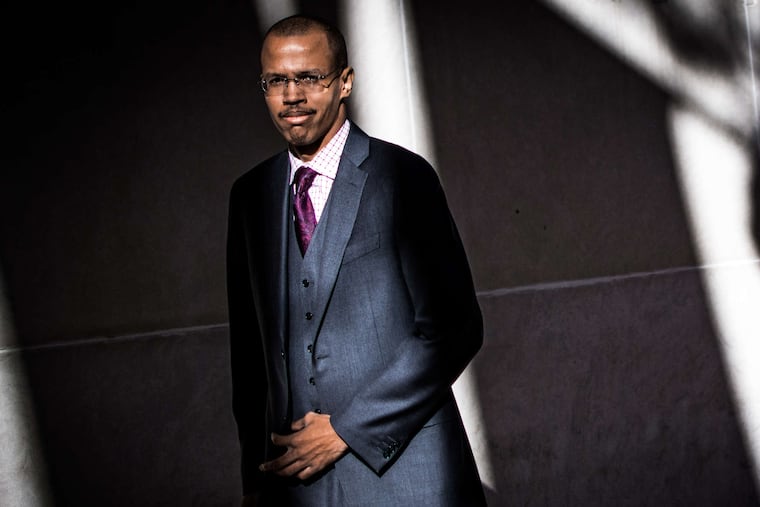
Chaka Fattah Jr. said he’s barely scraping by.
A decade after the former congressman’s son was convicted on federal bank and tax fraud charges, Fattah Jr. wrote in recent court documents that he’d been struggling to pay his $1 million in restitution because his job barely covered his bills.
But prosecutors said that’s not the case.
Not only should his six-figure salary at a communications firm have easily covered his monthly restitution payment of $350, they said, Fattah’s own financial records showed a string of discretionary expenses — including thousands of dollars in deposits at casinos last year, and about $15,000 spent at restaurants across the city.
On Wednesday, a federal judge agreed that Fattah was “clearly living beyond [his] means,” and blasted him for trying to say he was too financially strapped to pay what he owed.
“It just boggles the mind for someone to come in [to court] and claim hardship when you are clearly not taking your responsibilities seriously,” said U.S. District Judge Harvey Bartle III. “You just seem to be totally blind to your own financial situation. It just is amazing.”
The unusual dispute is the latest installment in the case against Fattah, the confident and outspoken son of onetime U.S. Rep. Chaka Fattah, a Philadelphia Democrat who also served time in federal prison for convictions in an unrelated racketeering and money laundering case.
The younger Fattah was convicted in 2015 on a host of fraud charges after prosecutors said he was a con artist who bilked banks, taxpayers, and business clients out of more than $1 million. Fattah had held himself out as a high-flying member of the city’s elite, authorities said, but in reality relied on fraud to secure loans, avoid creditors, and ultimately use the money for himself.
Bartle in 2016 sentenced Fattah to five years in prison, and ordered that he serve another five years on supervised release. The judge also ruled that Fattah must pay back the money he was found to have misspent — the majority of which would be directed toward the Philadelphia School District, a victim of his companies’ frauds.
But last year, prosecutors said in court documents, almost as soon as Fattah Jr.’s supervised release expired, he stopped paying his monthly restitution installment of $350.
Instead, prosecutors said, he began sending only irregular payments: $350 in two months, $150 in one month, $100 in another month, and, in six different months, nothing.
As a result, prosecutors last month asked his employer, TML Communications, to withhold his monthly debt and send it to them directly, a legal arrangement known as garnishing wages.
Fattah, acting as his own lawyer, filed a motion to stop that, saying prosecutors had “acted overzealously, in bad faith, and contrary to law in an ordinary payment dispute.”
One of the arguments he made was that garnishment would create a financial hardship for him — that withholding part of his earnings would crush his ability to cover basic expenses such as rent, groceries, and utility bills.
Bartle, over the past week, held several hearings to examine that issue. And Wednesday, he came away clearly unconvinced.
Fattah, the judge said, had been earning more than $100,000 per year as a contractor with TML Communications, a Center City PR firm. He’d also managed to find $37,000 to deposit into casino accounts, the judge said, and about $15,000 to spend on dining out at restaurants.
Fattah said his gambling was legal, that he recouped the majority of the casino deposit, and that the restaurant expenses were a legitimate way for him to conduct business and entertain clients.
But Bartle pushed back, telling Fattah: “You’ve done nothing to curb your expenses.”
And he was similarly baffled by a development that unfolded over the past week, in which Fattah decided to leave his job at TML Communications because they wouldn’t give him a raise. He does not yet have another job.
Bartle called that decision “totally irresponsible,” and added: “You quit your job making six figures, and you come in here and want to argue hardship?”
“Maybe all of us want to get more money than we’re getting paid,” he said, “but you don’t always get what you want.”
In the end, the judge agreed to allow the government to recoup about $1,700 in garnished wages that Fattah had tried to block.
It remains unclear what might happen moving forward if Fattah remains unemployed. He said late Wednesday that he’d appealed Bartle’s ruling.
In any case, the judge said, Fattah should re-evaluate his obligations.
“It is time for him to elevate the importance of that [restitution] order,” Bartle said, “and for him to take it seriously.”