In South Philly mass shooting, friends unintentionally killed each other, but it’s still murder, prosecutors say
Prosecutors can proceed with third-degree murder charges against four men charged with the Etting Street mass shooting.
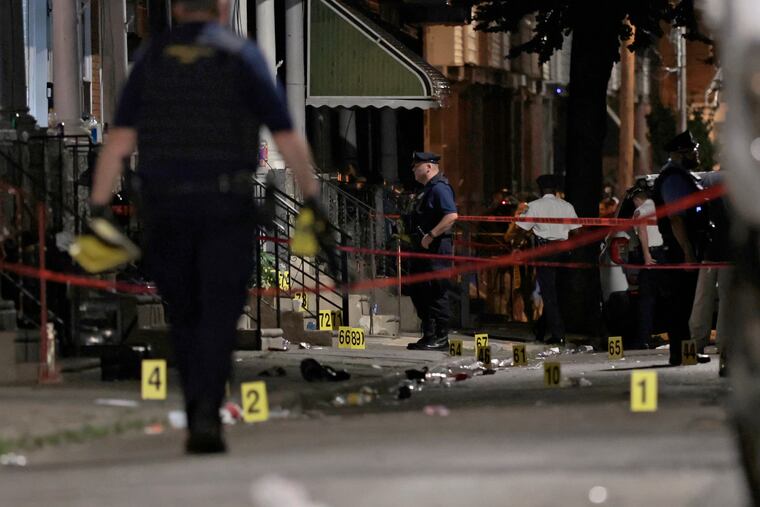
No one can say for certain what caused the first loud “pop” to echo down a South Philadelphia block — a single gunshot, a car backfiring, or something else entirely.
But within seconds, at least 15 people attending a party on the 1500 block of South Etting Street pulled out guns and started shooting, a chain reaction that left three people dead and 10 others wounded.
In the weeks that followed the July 7 mass shooting, police said they identified four people who fired weapons that night: Daquan Brown, 21, Terrell Frazier, 22, Brandon Fisher, 17, and Dieve Jardine, 45. Prosecutors charged each with three counts of murder, 10 counts of attempted murder, conspiracy, and related crimes.
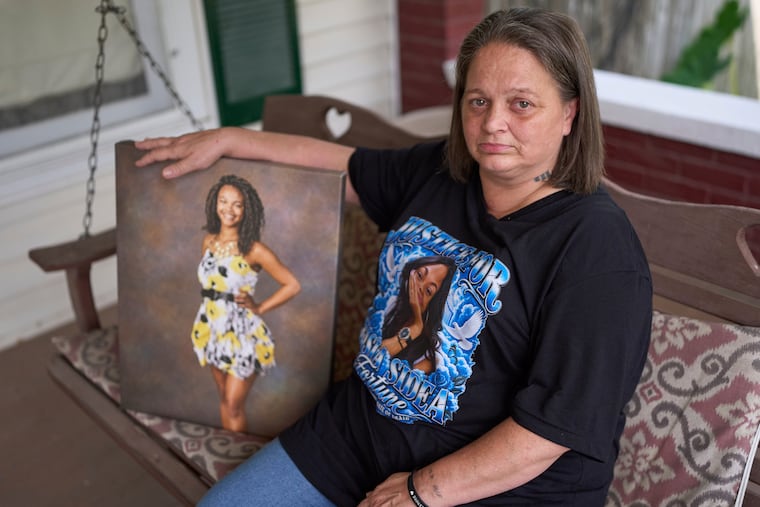
» READ MORE: Her youngest son was killed in a mass shooting. Now, her eldest is charged with committing one.
Municipal Court Judge Francis W. McCloskey Jr. on Thursday ruled that the cases against the four men could move forward to trial on charges of third-degree murder, aggravated assault, and inciting a riot. He dismissed all counts of attempted murder and causing a catastrophe.
Throughout the nearly five-hour hearing, prosecutors, using a compilation of video and social media evidence, laid out in greatest detail yet how the shooting unfolded.
Dozens of people had gathered on the street the night of July 7, the second block party in as many days. Gunfire erupted just before 1 a.m.
Assistant District Attorney Cydney Pope said the shooting was driven in part by paranoia.
Frazier and other young men at the party had been going back and forth with people on social media, she said, challenging someone who threatened to shoot up the party to “go ahead” in an Instagram Live video.
Less than 10 minutes later, she said, surveillance video showed a single loud “pop” that appeared to scare partygoers, who started to run down the block.
Eight seconds later, she said, at least 15 people at the party pulled out their guns and shot more than 120 bullets toward the end of the block.
But there’s no evidence anyone ever shot into the party, she said. The sound they believed was gunfire, she said, was likely a car backfiring.
“This is a tragedy because all of these defendants shot and killed their friends,” she said.
Three men were killed. Zahir Wylie, 23, was struck in the chest, and Jason Reese, 19, was shot in the head. Azir Harris, 27, who used a wheelchair after being paralyzed in an earlier shooting, was struck in the back as he sought cover between two cars.
Homicide Detective Joseph Cremen said he identified the four gunmen by combing surveillance video, phone, and social media records, and interviewing witnesses.
Fisher, he said, was seen on the porch of one of the homes using a gun with a “switch” attachment that caused him to spray dozens of bullets down the street, appearing at times as if he couldn’t control his weapon. In the teen’s phone, he said, were pictures of him with multiple guns, as well as the clothes he was wearing the night of the shooting and messages indicating he was selling firearms.
And Frazier, he said, talked about the shooting in text messages. About 12 hours after the shooting, he said, someone asked Frazier where he was when Wylie was struck.
“I was banging back,” Frazier wrote. He said the shooting was “bad,” and that Wylie “died from us.”
“He died from a stray,” he said, according to the texts.
Cremen said Brown admitted that he fired two shots with his legally owned gun, “then when he realized he wasn’t shooting at anything, he stopped and took cover.”
And Jardine, also known as Dieve Drumgoole, also told investigators he fired two or three shots after he saw someone come out of an alley on the block with a green laser attachment on a gun, the detective said.
Cremen didn’t recover video that showed anyone using a gun with a green laser beam.
Defense attorneys for the four men all argued that their clients were acting in self-defense, and only fired their guns because they believed someone was shooting at them. Police still do not know — and may never know — whose bullets struck each victim.
“There is no evidence that he struck anyone, there’s no evidence that he intended to strike anyone,” said Gina Amoriello, who represents Brown. “In all my years, I’ve never seen a case overcharged like this. This is extreme.”
John Francis McCaul, Jardine’s lawyer, said the father was “protecting his family” on the porch. Jardine’s son and nephew were also injured in the shooting.
No one, he said, intended to kill anyone by firing their guns.
The judge disagreed.
“The intent goes where the bullet goes,” said McCloskey. “The intent is established by producing the gun, pointing the gun, and pulling the trigger.”
He said it would be up to a jury or judge later on to determine whether or not the men were acting in self defense. At this preliminary stage, he said, prosecutors provided enough evidence to uphold a third-degree murder charge.
Prosecutors plan to address charges against a fifth person, Jihad Gray, who had been charged with the shooting at a hearing next week.
A sixth person, Christopher Battle, 24, remains at-large.
After the hearing, the families of the victims struggled to make sense of what they had just watched — friends killing friends.
“It’s really hard to digest,” said Troy Harris, whose son, Azir, was killed. “It was shocking. It was life changing to us. ... This domino effect can hurt generations and generations.”
“I still don’t even get it,” said Markeisha Manigault, the mother to Zahir Wylie. “I don’t understand why ... my son lost his life. It was just unnecessary.”