Haverford Township bars police from cooperating with ICE in noncriminal immigration enforcement
A township commissioner said it is "not our role" to act as a federal immigration authority.
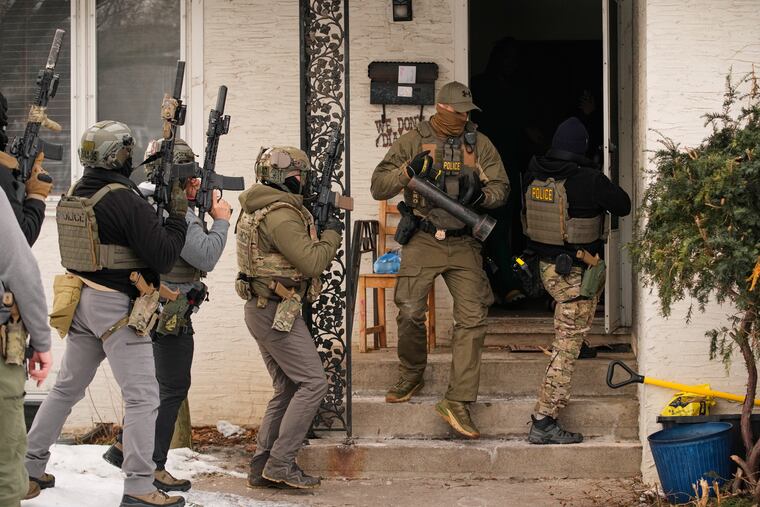
Haverford Township officials voted this week to bar the township’s police department from cooperating with U.S. Immigration and Customs Enforcement in the agency’s civil deportation efforts.
Township commissioners overwhelmingly approved the resolution, which says Haverford police officers and resources will not be made available for ICE’s 287(g) program. The nationwide initiative allows local police departments to perform certain federal immigration duties, should they choose to enter an agreement with the agency.
The Monday evening vote came after a weekend of anti-ICE protests in cities across the country spurred by the fatal shooting of 37-year-old Renee Good by an immigration agent during an enforcement operation in Minneapolis.
On Wednesday, Bucks County’s sheriff ended the department’s own 287(g) agreement with ICE, saying the “public safety costs” of the partnership vastly outweighed the benefits.
“The last thing I want to see happen is that our relationship with our police department be hurt by the reckless and criminal activity of ICE,” Haverford Commissioner Larry Holmes said before the vote. “We have the power to prevent that.”
Local law enforcement agencies that enter a 287(g) agreement with ICE are offered a variety of responsibilities and trainings, such as access to federal immigration databases, the ability to question detainees about their immigration status, and authority to issue detainers and initiate removal proceedings.
The program is voluntary and partnerships are initiated by local departments themselves, though some Republican-led states are urging agencies to enter them. The Department of Homeland Security recently touted that it has more than 1,000 such partnerships nationwide, as the Trump administration continues to make a sweeping deportation effort the focus of its domestic policy.
Critics such as the American Civil Liberties Union say the program turns local departments into an “ICE force multiplier” and that the agreements, which require officers to shift from local to federal duties, are a drain on time and resources.
Haverford Township’s police department has not made any request to initiate such an agreement with ICE, according to commissioners, who called the resolution a preemptive measure. While ICE has ramped up enforcement in Philadelphia and in surrounding communities like Norristown, there have not been sizable operations in Delaware County.
Judy Trombetta, the president of the township’s board of commissioners, said the resolution was about protecting the civil liberties of those living in Haverford, as well as the township’s public safety.
In Trombetta’s view, a 287(g) agreement could mean those without legal immigration status could be deterred from reporting crimes to Haverford police or showing up to court hearings, while leaving officers confused about their own responsibilities.
And as a township, she said, it is “not our role” to act as federal immigration agents.
“It’s our job as a township to keep people safe, [to] uphold the Constitution,” Trombetta said.
Commissioners voted 7-2 to approve the resolution.
The motion still requires Haverford police to cooperate with federal immigration agencies in criminal investigations. But because many cases involving those living in the country illegally are civil offenses, much of ICE’s activities are exempt.
Commissioner Kevin McCloskey, voicing his support for the resolution, said the week after Good’s killing had been “incredibly taxing on the American people,” and in his view, it was important to adopt the resolution even if ICE wasn’t active in the community.
But for Commissioner Brian Godek, one of the lone holdout votes, that reality made the resolution nothing more than “political theater.”
Tensions over Good’s killing were on full display during the meeting, as both the resolution’s supporters and detractors filled the seats of Haverford’s municipal services building.
“I do not want my tax dollars or Haverford’s resources to be used to support a poorly trained, unprofessional, and cruel secret police force that is our current federal U.S. Immigration and Customs Enforcement agency,” said resident Deborah Derrickson Kossmann.
Brian Vance, a resident and a lawyer who opposed the resolution, said he was approaching the matter like an attorney. He questioned whether noncompliance with a federal department would open up the possibility of lawsuits, or the federal government withholding funds for the township.
“It’s legal, it’s proper, whether we agree with it or not,” Vance said of ICE’s authority.
After the vote, McCloskey, the commissioner, made a plea for unity to those divided over the issue.
That included residents who said the resolution’s supporters had gotten caught up in the “emotion” of the Minneapolis shooting.
“I just ask that you take a step back,” McCloskey said. “On some level, we should all be able to appreciate that none of us wanted to see a 37-year-old mother in a car get shot.”