To find people to deport, ICE is increasingly turning to old, low-level arrests by local police
The number of illegal reentry prosecutions filed in Philadelphia’s federal courthouse this year is at its highest level in at least two decades, data show.
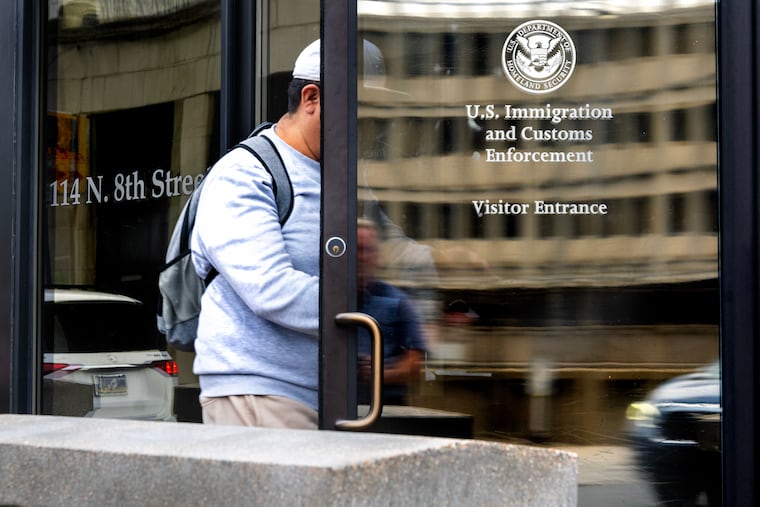
Gonzalo Hernandez Roque was arrested in Doylestown last May, accused of stealing about $500 worth of clothes and jewelry from Kohl’s. For the next 10 months, he remained free on unsecured bail as his misdemeanor case slowly worked its way through Bucks County’s courts.
But this spring, the consequences of the arrest suddenly escalated.
In March, court documents show, an Immigration and Customs Enforcement agent found records from the case that helped show that Hernandez Roque, a 29-year-old Guatemalan, had been living in the country illegally. He was jailed and charged with a federal immigration crime.
By June, Hernandez Roque was deported.
That sequence of events — a months-old arrest triggering a new federal prosecution — has been happening with growing frequency in the Philadelphia region over the last seven months, The Inquirer has found, as federal authorities seek to boost deportation numbers under President Donald Trump.
To understand the shift in enforcement patterns, The Inquirer reviewed records from dozens of cases in which federal prosecutors charged immigrants with the crime known as illegal reentry after deportation. In those cases, ICE typically arrests defendants and accuses them of living in the United States after having been deported before — sometimes years or even decades earlier.
While the majority of immigration arrests are handled in the civil administrative court known as immigration court, illegal reentry cases are considered felonies and are pursued by federal prosecutors in criminal court. Upon conviction, defendants can face a federal jail sentence before being placed into deportation proceedings.
The charge is not new: Under former President Joe Biden, records show, the U.S. Attorney’s Office in Philadelphia filed about two dozen such cases each year.
But with Trump back in the White House — and promising an unprecedented wave of deportations — prosecutors have more than tripled that pace this fiscal year, Justice Department data show.
If the trend holds, the number of illegal reentry prosecutions filed in Philadelphia’s federal courthouse this fiscal year will be at its highest level in at least two decades, according to the Transactional Records Access Clearinghouse (TRAC), a nonprofit that has been collecting immigration data since 1989.
Much of the boost appears tied to the tactic used in Hernandez Roque’s case, The Inquirer’s review found. In about half the cases the newspaper reviewed, ICE agents said in court documents that they began looking for a previously deported immigrant after receiving an automated notification of a new arrest — typically because the person’s fingerprints, taken by local police during processing and entered into a national database accessible by ICE, matched the prints on file from an earlier deportation.
Still, in many instances, The Inquirer found that ICE was notified of a fingerprint match last year — but did not pursue the suspect until after Trump returned to office in 2025.
In addition, The Inquirer found, many of ICE’s targets in these cases were arrested for nonviolent crimes such as retail theft or driving under the influence — a contrast to the Trump administration’s contention that it has been pushing out some of society’s most dangerous criminals.
Some previously deported immigrants had no criminal record: In at least two instances, ICE agents set out to pursue one target and ended up arresting someone else after discovering that person had been previously deported.
Brennan Gian-Grasso, a Philadelphia-based immigration attorney, said many of those tactics echo the changes he’s noticed in ICE’s approach to enforcement overall, which is that the agency has become more aggressive in pursuing people to deport.
In the past, Gian-Grasso said, federal authorities, particularly during administrative arrests, often used discretion to prioritize which suspects were worthy of apprehension, because seeking to remove all undocumented people — particularly those living and working here without issue — can be destabilizing to families and communities.
Now, he said, ICE’s approach is effectively indiscriminate.
“It’s all about the numbers, it’s all about getting people, it’s all about fear,” he said.
An ICE spokesperson did not respond to questions about how its approach to illegal reentry cases has changed in the Trump administration.
U.S. Attorney David Metcalf said in a statement that his office “continues to pursue and prosecute cases as it always has, guided by the rule of law, our responsibility to the people of the Eastern District of Pennsylvania, and the priorities of the DOJ.”
Quick resolutions
Noel Velasquez-Basurto was one of those prosecuted for illegal reentry without a new local arrest.
The Mexican man, who was living in Norristown and working as a day laborer, was riding to work in a pickup truck in February when ICE agents stopped the vehicle while seeking to arrest its driver.
When ICE asked for Velasquez-Basurto’s ID, agents said in court documents, he gave them his Mexican passport, which allowed them to learn that Velasquez-Basurto had been deported twice, both times in 2013.
He was arrested, and weeks later, prosecutors charged him with illegal reentry.
By July he’d pleaded guilty and was sentenced to time-served before being deported back to Mexico. During his sentencing hearing, he spoke through an interpreter and said little, generally only answering “yes” or “no” to a judge’s questions.
That swift resolution was mirrored in many illegal reentry cases The Inquirer reviewed: Prosecutions filed in 2025 have often wrapped up within a few months.
Attorneys say that is in part because the evidence in illegal reentry cases is generally straightforward, particularly if there is a fingerprint match between a new arrest and the deportation records. A quick guilty plea also allows defendants to be released from federal jail and sent home, they said.
But it does sometimes cause unusual consequences: Hernandez Roque, the man accused of retail theft in Doylestown, was deported before his Bucks County criminal case was resolved.
His case is still active, and another court date is scheduled for September.
Enforcement vs. public safety
Gian-Grasso, the immigration attorney, said preempting the local justice system was just one issue he had with illegal reentry cases, which he called “tremendously wasteful.”
His biggest critique is that the cases require federal prosecutors to divert resources from more pressing cases, such as violent crime, fraud, or corruption.
“If we are prioritizing numbers — and let’s be honest, numbers of a certain type of people, primarily Latinos — we’re not doing anything that actually impacts society or public safety,” he said.
Still, authorities seem unlikely to slow the pace of filing such cases anytime soon.
Just last week, prosecutors unsealed two new indictments charging defendants with illegal reentry, court records show. And this week, they announced that three others had recently been sentenced and would be deported.