A Liberian immigrant who lived in South Jersey will serve nearly 5 years in prison for concealing his past as a rebel general
Prosecutors said Laye Sekou Camara lied on immigration forms to conceal the fact that he shot people, killed civilians, and used violence to instill fear during a Liberian civil war.

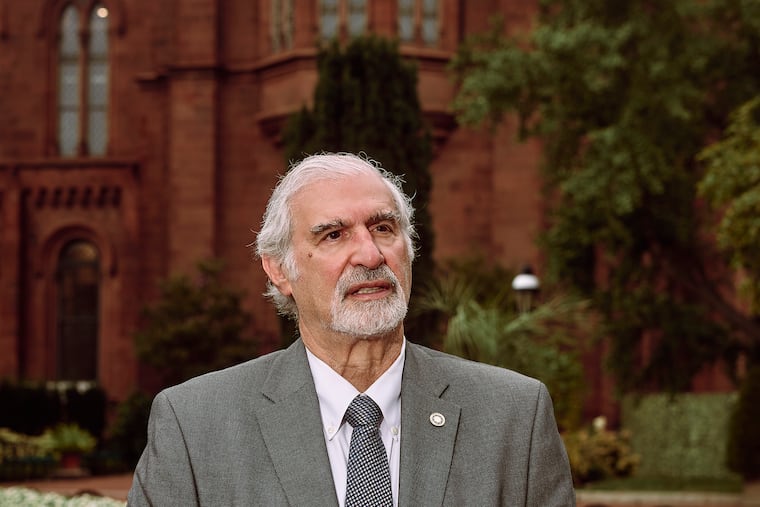
A Liberian immigrant who spent years living in the Philadelphia region was sentenced Thursday to just under five years in prison after a federal judge ruled that he had lied on immigration documents to conceal his murderous past as a high-ranking rebel general who oversaw executions, beatings, and other atrocities during one of his country’s civil wars.
Laye Sekou Camara, 47, of Atlantic County, had pleaded guilty earlier this year to relatively routine immigration fraud charges, admitting that he had provided incorrect information on paperwork as he sought to enter the United States more than a decade ago.
But prosecutors said Camara made those misstatements to conceal his brutal role in Liberia’s second civil war, a conflict that roiled the West African nation in the early 2000s and left tens of thousands of people dead.
While serving as a high-ranking member of Liberians United for Reconciliation and Democracy, or LURD, prosecutors said, Camara — who went by K-1 or Dragon Master — shot people, killed civilians, and used violence to instill fear as his rebel group sought to control the Freeport of Monrovia, a key port in Liberia’s capital city.
To support those assertions, prosecutors earlier this year called nine witnesses to testify in Philadelphia’s federal courthouse. All said they had seen Camara commit or order violence: One said he had a scar over his eye from being lashed by Camara; another said he had watched as Camara ordered a group of people lined up beside a creek to be shot.
Camara, for his part, denied participating in such violence. And he and his lawyers said he, too, had been victimized by Liberia’s long-standing instability.
At age 12, he said, he was forced to watch as his father was beheaded by rival tribe members. And he was then recruited to serve as a child soldier in a conflict that predated the 2003 war.
Several relatives and friends testified Thursday about how difficult it was to survive in the chaos and violence that plagued Liberia at the time. And they said Camara was deeply affected by the execution of his father.
Camara also told U.S. District Judge Chad F. Kenney there was no independent evidence that he had participated in the atrocities he was accused of, and said the people who took the stand against him were “paid agents” recruited by human rights organizations to blackmail him.
“I never committed any crime in Liberia — never,” he said. “I only helped people.”
Kenney said that he found Camara’s accusers credible, and that he believed Camara had participated in “horrible acts of violence.”
Still, the judge said his job was to sentence Camara for lying on immigration forms — not to assess his conduct in Liberia.
“This court is not an international tribunal,” Kenney said. “This is not a Liberian court.”
Kenney sentenced Camara to 57 months behind bars, and he is almost certain to be deported afterward.
Camara did not visibly react to the decision. He was taken into custody from inside the courthouse.
Camara’s case is another example of how Philadelphia has become an unlikely venue for accountability in Liberia’s war-torn past.
Over the last several years, federal prosecutors here have used immigration cases to pursue other alleged Liberian war criminals who had resettled in the area.
The first to be convicted — Mohammed “Jungle Jabbah” Jabateh of East Lansdowne — was sentenced in 2018 to three decades in prison. He had been accused of lying on immigration documents to conceal acts of murder, rape, and enslavement.
Jucontee Thomas Woewiyu of Collingdale — a former top official for Liberian warlord Charles Taylor — was convicted later that year of similar immigration crimes. He died in 2020 before he could be sentenced.
Earlier this year, Isiah Kangar, a former bodyguard for Taylor, was sentenced to a year in prison for using his younger brother’s name to gain entry to the United States and then apply for citizenship. Kangar was not accused by federal prosecutors of any wartime misconduct.
And another man, Moses Slanger Wright, is awaiting trial for accusations that he lied on immigration paperwork to conceal his participation in atrocities during Liberia’s first civil war.
Until the first of those prosecutions, there had been little criminal accountability for alleged brutality in Liberia in the 1990s and 2000s. (Taylor was convicted of war crimes in an international criminal court in 2011, but the charges stemmed from his conduct during a civil war in neighboring Sierra Leone.)
Camara insisted in court Thursday that he was a good person who had not contributed to the chaos that had once devastated his home country.
Kenney, however, said he believed witnesses who described Camara’s actions as “violent, cruel, and horrible.”