In a striking reversal, the Philly DA’s office said it no longer supports a man’s bid to overturn his murder conviction
Prosecutors accused some of their colleagues of filing documents that were "not supported by the record" and said the conviction should actually stand.
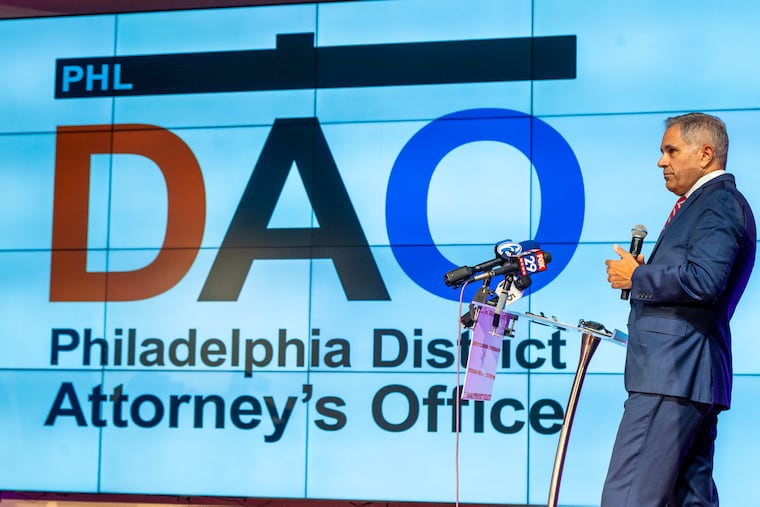
The Philadelphia District Attorney’s Office is attempting to withdraw a recommendation it made in federal court that a man’s murder conviction should be overturned, saying the prosecutors who oversaw that request did so by filing court documents that were “not supported by the record” or “legally erroneous.”
The about-face, made in a motion filed last week, represents a striking reversal of a posture that could have led a judge to wipe out a guilty verdict in a deadly shooting.
The filing was all the more unusual because the prosecutors who signed it named the colleagues who they said had made “material misstatements” about witness testimony in the case, and took a position the office no longer supports. Prosecutors now believe the conviction should be upheld.
“The Commonwealth respectfully requests leave to withdraw its prior response and apologizes to the Court for the errors,” said the new motion, which was signed by four prosecutors: David Napiorski, Steven Wildberger, Peter Andrews, and Katherine Ernst.
The filing was submitted Friday, just months after a panel of federal judges took the rare step of voting to ban another prosecutor in the district attorney’s office from practicing in federal court — one of the most serious penalties a lawyer can face. In that case, the judges accused the lawyer, Paul George, of being “misleading and dishonest” while seeking to overturn an inmate’s death sentence, and they were extremely critical of what they called George’s repeated misrepresentations on behalf of his office, saying the conduct threatened the integrity of the legal system.
“Lies like those George told … are even more problematic when asking a federal court to disturb a state-court conviction,” the judges wrote in a sternly worded opinion.
One of the judges involved in that disciplinary decision, U.S. District Judge Paul S. Diamond, is the person who will now have to decide what to do with accusations of misstatements in the most recent case. An evidentiary hearing is scheduled for next month.
Diamond had initially ordered that hearing to learn more about the strength of the evidence against Dennis Johnson, who was convicted of second-degree murder in the 2007 killing of Kenyatta Smith outside a corner store in North Philadelphia.
It was not clear whether Diamond would follow through with his plan to hear witness testimony about Johnson’s role in the crime — or if he might use the hearing to instead ask prosecutors how and why their office had urged him and a federal magistrate judge to undo a conviction based on assertions they now say were wrong.
The assistant district attorney who signed that original request, Jaclyn Mason, resigned on June 2, according to court documents. She declined to comment.
Her supervisor in 2022, when she filed the request, was Matthew Stiegler, who has since become the chief of the office’s Conviction Integrity Unit. He did not respond to a request for comment.
A spokesperson for District Attorney Larry Krasner did not respond to questions about the situation or the office’s change of heart.
A flawed conviction?
The crime for which Johnson was convicted occurred on Aug. 17, 2007, when Smith was fatally shot while being robbed outside a convenience store near 30th Street and Lehigh Avenue, court documents say.
Several witnesses identified Johnson as the shooter, and he was convicted of second-degree murder and sentenced to life in prison.
Johnson appealed his conviction and said his lawyer had been ineffective for failing to object to a detective’s testimony that a witness who did not testify, and who could not be cross-examined, had also identified Johnson as the shooter.
In 2022, Mason — then assigned to the district attorney’s Federal Litigation Unit — agreed, writing in court documents that the detective’s testimony was improper and had “tipped the scales” toward a conviction.
She also said the office had discovered problems or inconsistencies with testimony from other key witnesses, and asked a federal magistrate judge to recommend that the conviction be thrown out.
“The case against Johnson was not overwhelming from the outset and his counsel was constitutionally ineffective,” Mason wrote. “The post-trial investigation unearthed additional factors that highlight weaknesses in the prosecution and confirm a low level of confidence in the outcome of Johnson’s trial.”
The magistrate, Judge Lynne A. Sitarski, agreed with Mason and recommended that Johnson’s conviction be overturned. Still, her decision was not binding.
Diamond, the district court judge, was the one with the power to reverse Johnson’s conviction. And he did not seem inclined to accept the assertions made in Mason’s briefing.
‘Material misstatements’ in court documents
Last month, Diamond scheduled an evidentiary hearing at which he ordered all of the witnesses who testified against Johnson to take the stand in his courtroom and testify again.
Prosecutors from the district attorney’s Law Division said they then began working with Mason to prepare for the proceeding. But as they did, they said in their motion, they discovered that Mason’s filings “contained material misstatements” about the case.
Most of the issues concerned ways in which they said Mason characterized witness testimony at trial. In one example, prosecutors said, Mason wrote that a key eyewitness “did not visually identify Johnson” as the shooter while on the witness stand.
But the trial transcript shows that the witness did so “repeatedly,” prosecutors said, and the witness also said he had “known Johnson for at least five or six years.”
That issue and several others led the Law Division staffers to conclude that the office’s earlier filing seeking to undo the conviction was flawed — and they also concluded that the case against Johnson was stronger than Mason contended, and that “relief on Johnson’s claim was not warranted.”
It remains unclear what Diamond might do in the case, or how it might affect any of the lawyers involved.
Johnson’s fate is also unclear. One of his lawyers, Nilam Sanghvi of the Pennsylvania Innocence Project, said she and her colleagues will continue advocating for his freedom.
“We believe in Dennis Johnson’s innocence, and that Magistrate Judge Sitarski’s recommendation that Dennis receive habeas relief based on the violation of his constitutional rights is thorough and well-reasoned,” Sanghvi said.
The evidentiary hearing currently remains scheduled to take place in July.