Police officers in North Philadelphia’s 22nd District failed to record nearly three-quarters of encounters, audit finds
An audit by the city's Citizens Police Oversight Commission of four police districts found 22nd District officers activated their cameras the least.
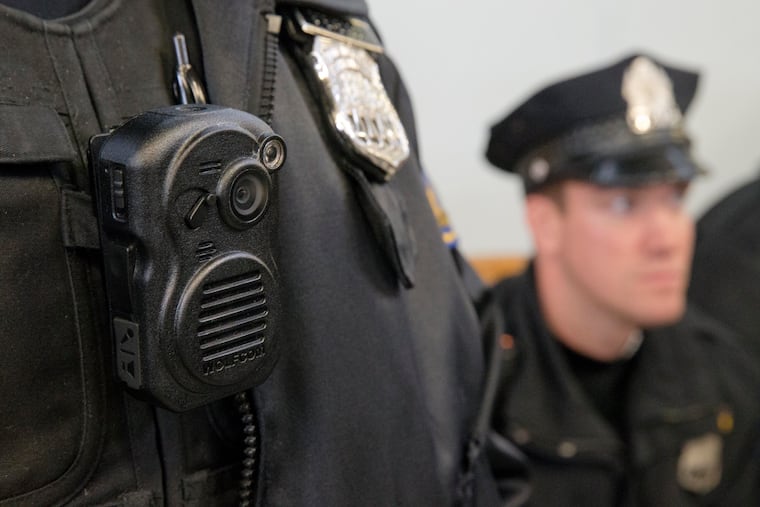
Police officers in one of Philadelphia’s largest districts frequently failed to activate their body-worn cameras during encounters that department policy required them to record, according to a new audit by the Citizens Police Oversight Commission.
The commission’s review of a random sample of 125 police incidents in North Philadelphia’s 22nd District found that officers recorded only 23 of 83 encounters that required camera footage.
The findings, released Wednesday, mark the final report in a series of audits examining body-worn camera compliance in four police districts across Philadelphia. Of the districts reviewed, the 22nd had the lowest rate of required recordings, raising concerns about whether one of the department’s primary accountability tools is being used consistently in the field, the commission said.
Janine Zajac, the commission’s director of auditing, policy, and research, said body-worn cameras are intended to provide accountability for both officers and the public. “It feels concerning when a really important tool for accountability isn’t being used,” she said.
The 22nd District, which spans neighborhoods including Yorktown, Strawberry Mansion, and Brewerytown, was selected alongside the 24th, 18th, and 15th Districts as part of an audit series designed to examine camera use across different parts of the city. The districts were chosen for their geographic diversity, activity levels, and the volume of complaints the commission receives from residents, Zajac said.
The audits looked at several measures of compliance with the department’s policy, including whether officers activated cameras when required, whether all officers on a scene recorded, and whether footage captured the full encounter.
Performance varied across the districts, said Michael Tooley Jr., a senior analyst for the commission. But the 22nd District stood out, he said: Officers recorded only 28% of incidents requiring footage, compared with 62% in the 18th District and 73% in the 15th District, and 88% of vehicle stops in the 24th District.
The commission reviewed incidents from April and June 2025 in the 22nd District, while the other audits examined a single month. Tooley said the commission expanded its review in the 22nd District because so few camera recordings were available from the first month requested.
The missed recordings occurred most often during investigations of premises — a category that includes domestic incidents, minor disturbances, and weapons-related calls — the review found, while vehicle stops and safety checks made up the second-largest share of incidents with absent videos.
The audit found that once officers turned their cameras on, they generally followed department procedures. Of the recordings reviewed, 91% captured the full duration of the encounter, 88% showed proper activation from standby mode, and 97% were correctly labeled and categorized.
Sgt. Eric Gripp said, a police spokesperson, the department takes the findings seriously. “Any instance in which an officer fails to activate a body-worn camera when required is inconsistent with department policy and our expectations,” he said.
Gripp noted that the 22nd District is one of the city’s busiest police districts, generating tens of thousands of body-worn camera recordings each year as officers respond to a high volume of calls and other interactions. While “that workload does not lessen our expectations for policy compliance,” he said, “it does highlight the scale of the body-worn camera program” and the demands placed on officers in the district.
City Councilmember Jeffrey Young, whose district includes much of the area served by the 22nd District, said the audit’s findings underscore the importance of adhering to body-worn camera policies, which “exist to protect everyone involved.”
He added: “I have confidence in [the department’s] ability to address these findings with transparency and professionalism.”
The audits of other districts revealed different weaknesses. In the 24th District, the commission found that nearly four in 10 videos failed to capture the entire traffic stop and that backup officers frequently did not record. In the 15th District, auditors found that officers often powered cameras completely off instead of leaving them in standby mode.
The 18th District in West Philadelphia posted some of the strongest results, with 98% standby-mode compliance and no video-labeling errors.
Joseph Giacalone, an adjunct professor at John Jay College of Criminal Justice and a retired sergeant with the New York City Police Department, said officers often arrive at chaotic scenes where remembering to activate a body-worn camera might not be their first instinct.
“It’s just not a natural thing,” he said.
But he also said departments must find ways to make camera activation routine because the footage can benefit both officers and the public. “Those videos provide better insight into what the police actually do — and most of the time, they’re right when they’re doing it,” he said.
Paula Sen, who coleads the Defender Association of Philadelphia’s police accountability unit and has conducted reviews of officers’ body-worn camera usage, said the footage is equally important for defendants and defense attorneys.
“Every attorney in this office watches hundreds to thousands of body-worn cameras each year,” Sen said. The recordings provide objective evidence that can contradict an officer’s account of an incident, she said, and help defense attorneys successfully challenge evidence in court.
Zajac said police department officials were receptive when the commission shared its findings and recommendations in May, with district leaders expressing interest in better understanding what might be preventing officers from properly using the cameras.
Gripp said the department continues to reinforce its body-worn camera policy through roll-call reminders, additional training, and supervisory oversight. Supervisors are expected to review footage, reinforce compliance, and address deficiencies when they are identified, he said.
Since launching its body-worn cameras more than a decade ago, Gripp said, the department has recorded millions of interactions. “Like any large-scale accountability program, our responsibility is to continually evaluate performance, identify opportunities for improvement, and strengthen compliance,” he said.
Clarification: A quote about the number of body-worn cameras viewed by the Defender Association of Philadelphia has been updated.