‘Swarthmore 9’ protesters plead no contest to noise violation for pro-Palestinian encampment
Members of the group entered the plea a day before their trial on trespassing charges was set to begin.
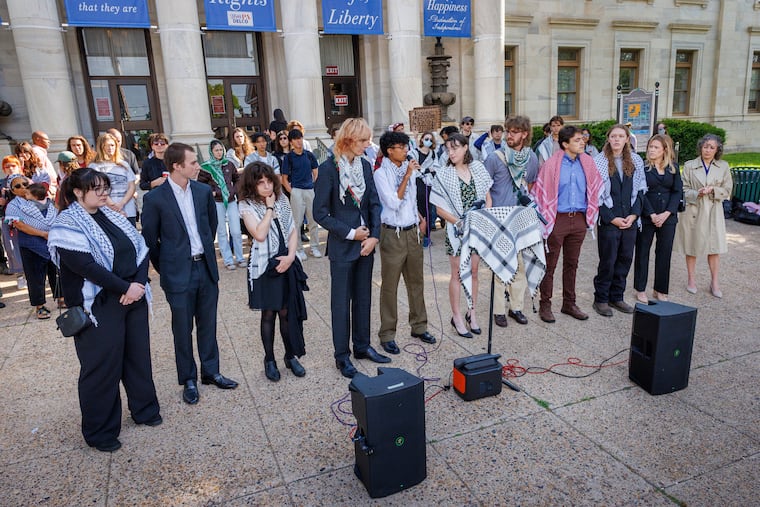
Nine protesters who were charged with trespassing for refusing to leave a pro-Palestinian encampment at Swarthmore College last year have entered no-contest pleas to summary noise violation offenses, ending a contentious legal case that had spanned more than a year.
The so-called Swarthmore 9 entered the pleas late Monday, the day before their trial was expected to begin before Delaware County Court Judge Dominic Pileggi.
As part of the plea negotiation, all nine agreed to perform eight hours of community service and pay court costs.
The group had been charged with misdemeanor trespassing, and had refused to accept an earlier, similar plea offer made by District Attorney Tanner Rouse that would have had the same outcome. Doing so, they said at the time, could chill future student protests.
In a statement Tuesday, members of the group said the decision to take the plea deal was “an incredibly difficult and far from unanimous decision.” They said they felt they had “no good options” and accepted the deal to avoid probation or jail time.
“We are deeply grateful for the outpouring of support in solidarity with our case,” the statement said. “The community’s work in pressuring the DA and condemning Swarthmore’s repression and complicity only strengthens our upcoming fight for divestment and an end to the genocide.”
Rouse, for his part, said the case came to a close in “the same way that every other defiant trespass case that we have handled during my time in the office has concluded.”
“This offer had been on the table since the morning of their arrest, and in fact the case would have been withdrawn entirely, as they requested and as other protesters have had their cases withdrawn, if they had performed the same community service before formal arraignment,” he said in a statement Tuesday.
The group was arrested and briefly detained outside the college’s Trotter Hall in May 2025 when officers from surrounding police departments dismantled their encampment protesting the war in Gaza and Swarthmore’s IT contract with Cisco, a company that does business with the Israeli government.
Of the nine people arrested, only one, Jace Boland, is a student at the college. Another, Brendan Cook, is a former student who was suspended for participating in an earlier protest in 2024.
The others — Jonathan Britt, Mara Helen Cahill, Daria C. Dressler, Thomas Falcone, Colin Buckley Malcarney, Riley J. McManus, and Andrew Thomas — are not affiliated with Swarthmore.
Last week, Pileggi denied a motion to dismiss the charges against them, ruling that prosecutors had presented sufficient evidence for the case to proceed to trial.
Swarthmore issued multiple orders to protesters last spring to leave the campus, citing concerns over vandalism and public safety. Many of the protesters wore masks, refused to identify themselves, and were not affiliated with the school, according to administrators at the college.
Prosecutors noted that other protesters at the encampment avoided arrest by following an order to leave the area and were allowed to continue chanting and holding protest signs elsewhere on the campus.