2026 NFL draft, position by position: Why offensive line help is critical for the Eagles
Three of the five players along the line have long-term injury concerns or could be nearing retirement. If healthy, the O-line is still a force, but it's time to start considering backfills.
From April 6-17, The Inquirer’s Eagles reporting team will be breaking down each position on the roster ahead of the NFL draft, looking at the depth chart and long-term personnel picture as well as some names that could emerge as Eagles targets in the April 23-25 event.
OL personnel picture
It wasn’t long ago that this position group was like the Ronco Rotisserie Oven: “Set it and forget it.” The Eagles won the Super Bowl two seasons ago in large part because they had arguably the best offensive line in football, the best offensive line coach in football, and the most unstoppable play in football.
A lot has changed. Three of the five players along the line have long-term injury concerns or could be nearing retirement. That coach, Jeff Stoutland, is no longer with the team. That play, the Tush Push, was neutered to the point that its detractors didn’t feel the need to legislate it out of the game during offseason rules discussions.
Lane Johnson missed the second half of last season after suffering a Lisfranc injury in his right foot. He turns 36 next month and his Hall of Fame career has taken its toll on his body. Landon Dickerson and Cam Jurgens each spent time in Colombia this offseason getting stem cell therapy treatment, which isn’t legal in the U.S., to help deal with the pain and injuries that slowed them down in 2025. Dickerson, 27, who has required multiple surgeries to deal with his injuries since college, even contemplated recently how much football he has left in him.
» READ MORE: 2026 NFL draft, position by position: Will the Eagles find a tight end they like?
When healthy, the Eagles still do have one of the best units in the game, but it’s time for the team to start worrying about backfills. There is no obvious replacement for Johnson on the roster. And if Dickerson soon hangs up his cleats, the Eagles have a gaping hole at left guard, too.
The Eagles re-upped with swing tackle Fred Johnson, who has provided solid relief to Johnson and Jordan Mailata over the last two seasons, but there are question marks attached to most of the reserves on the roster. The Eagles drafted a backup center last year, Drew Kendall, who has some flexibility to play guard, but he saw limited action and it’s unclear if he’s capable of being a long-term answer at either spot. Same goes for Myles Hinton and Cameron Williams, late-round tackle selections from the last draft, and Willie Lampkin, the undersized interior lineman the Eagles claimed off waivers at the end of camp last year and then stashed on injured reserve.
Will the Eagles use their first pick to draft Johnson’s heir? Will they draft the guard of the future, either to backfill for Dickerson or step in for Tyler Steen, who had an average 2025 season? Offensive line may be the most intriguing position group for the Eagles in the 2026 draft. — Jeff Neiburg
Potential names/targets in the draft
If the Eagles are looking for an heir for Johnson or to upgrade the right guard spot, this is a great draft for it. Seven offensive linemen are projected to be selected in the first round.
There is a mix of pro-ready players along with linemen who need more time to develop into high-end starters. Utah’s Spencer Fano, Miami’s Francis Mauigoa, and Georgia’s Monroe Freeling are expected to be drafted ahead of the Eagles’ pick at No. 23.
There’s a strong chance the Eagles will find a player they like along the offensive line when they make their first-round selection. They have met with plenty during the draft process and have used seven of their 17 reported predraft visits on offensive linemen.
Here are six offensive line targets, three at tackle, three at interior line, who could make sense for the Eagles in the early rounds:
Offensive tackles
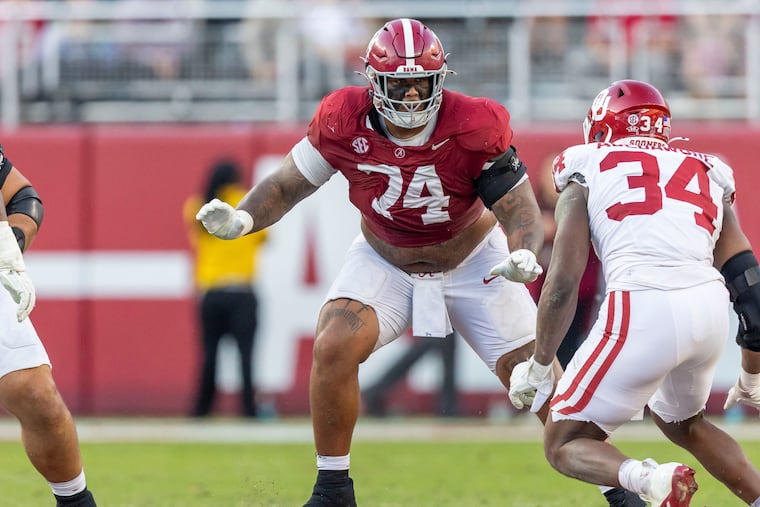
Kadyn Proctor, Alabama
Proctor, a massive 6-foot-7, 352 pounds, has been linked to the Eagles throughout the draft process. The two-year starter at left tackle for Alabama has powerful striking power upon contact and is an aggressive run blocker who can create displacement in one-on-one and double-team blocks.
Proctor has good athleticism for his size, which allows him to block in space. When he gets his hands on edge rushers and defensive tackles first, he has the power and size to overwhelm defenders.
There were inconsistencies with his blocking technique, pad level, and recovery ability in pass protection, and he admitted that he wasn’t at an ideal playing weight early in the 2025 season, but Proctor has great tools to turn into an excellent NFL player, whether it’s at guard or tackle.
Proctor has been projected as high as No. 6 overall and as low as the end of the first round, so it is possible he is off the board by the time the Eagles make their first pick.
Max Iheanachor, Arizona State
Iheanachor, who took a predraft visit to Philly recently, has promising athletic traits, size, arm length, and lateral quickness to mirror pass rushers and to cut off back- and front-side defensive linemen at 6-6, 321. He also excels at climbing to the second level on double-team blocks up to second-level defenders.
The athleticism from the two-year starter popped at the NFL Scouting Combine, when he ran a 4.91-second 40-yard dash, leaped a 9-foot, 7-inch broad jump, and jumped a 30½-inch vertical.
Iheanachor’s hand placement, strike timing, and core strength all need time to improve, and he does not consistently maintain one-on-one blocks. However, Iheanachor has tools to eventually develop into a quality NFL starter. He would be a first-round target for the Eagles, with the potential to become Johnson’s heir at right tackle.
Blake Miller, Clemson
Miller, who was the Eagles’ pick in our most recent mock draft, was a four-year starter for Clemson at right tackle. Standing at 6-7, 317, Miller has light feet in pass protection and a strong vise grip as a pass protector to stop pass rushers in their tracks.
He made his most strides as a run blocker in 2025, showing consistency climbing to the second level and kicking out edge rushers on outside runs.
Improving his core strength, which gets tested against powerful edge rushers, and filling out his lower body need to be priorities for Miller in his transition to the NFL, but he’s got starter level traits and athleticism to be the right tackle of the future for the Eagles.
» READ MORE: Zach Ertz talks grisly knee injury, rehab, 2026 plans: ‘I don’t want it to be the last play that I have’
Interior linemen
Olaivavega Ioane, Penn State
Ioane, the only projected first-round interior lineman who also took a predraft visit to Philly, is a mauling lineman who has power as a run blocker and consistently creates running lanes with his physicality at 6-4, 320. He was a two-year starter at Penn State at left guard and also made a start at right guard early in his career.
He has functional athleticism to climb to the second level, and his ability to handle power as a pass protector is a standout attribute.
Speedier rushers in the interior can give Ioane issues and his best blocks happen in a phone booth rather than on the move, but the interior offensive lineman projects as a Day 1 starter and could immediately push to be a starter on the Eagles’ offensive line.
Chase Bisontis, Texas A&M
Bisontis, a two-year starter for the Aggies at left guard who also has a predraft visit scheduled with the Eagles, is a physical interior lineman who has active hands to hand fight in pass protection and quick feet to mirror in pass protection. At 6-5, 315, he has a sturdy pass protection anchor that allows him to handle power rushes from defensive linemen.
He sometimes overextends himself by playing with a high pad level and doesn’t always move defensive linemen in one-on-one blocking situations, but his physical demeanor on double-team blocks in the run game, balance as a pass protector, and athleticism to block in space will give him a chance to start as a rookie. He is projected to be drafted in the second round.
Keylan Rutledge, Georgia Tech
Rutledge, a two-year starter at right guard for Georgia Tech, is a physically imposing player (6-4, 316) who clears space when he pulls across the line of scrimmage and tries to block defensive linemen into the ground.
His strong hands and torque to move defensive linemen against their will carries over to the passing game, where he works to get his hands on pass rushers early in his pass sets.
His lack of foot speed and redirection skills in pass protection won’t make him a fit for every team, but Rutledge will be an excellent addition to a downhill running offense. He is a projected Day 2 pick with starting level upside. — Devin Jackson