Eagles roundtable: What are the team’s biggest questions coming out of the draft?
The roster picture is now more or less complete heading into training camp. What were the biggest surprises of the Eagles' draft, and what are the remaining roster implications?
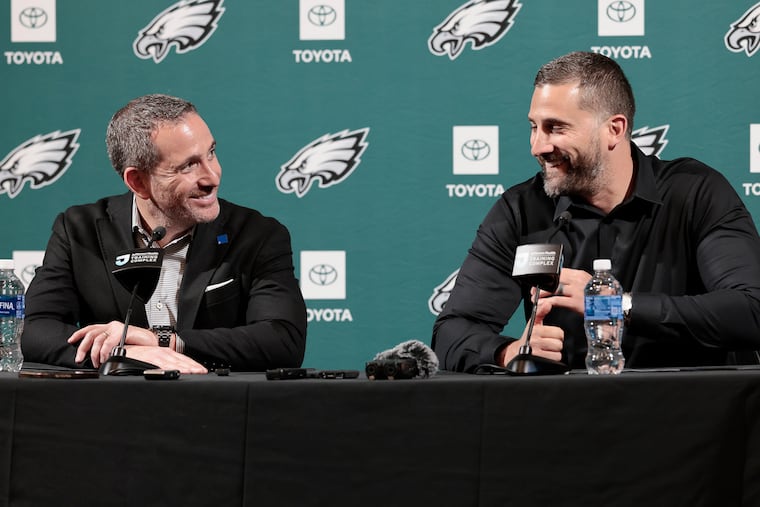
The NFL draft dust has settled, as teams look to pad the bottom of their rosters with undrafted free agents and assess what other small gaps they can fill. For the Eagles (pending whatever happens on the A.J. Brown front), the end of the draft gives us a fairly complete roster picture heading into camp.
With that in mind, The Inquirer’s Eagles reporters Olivia Reiner, Jeff Neiburg, and Ryan Novozinsky assessed the state of the team heading into the final week of April, sizing up the most impactful and surprising moves of the draft and assessing the biggest questions left to answer as training camp approaches in July.
What’s a big remaining question you have when you look at the Eagles roster?
Reiner: Who will start at safety alongside Drew Mukuba? The Eagles drafted a seventh-round safety in Cole Wisniewski, but he seems like an unlikely starter in 2026. As the roster currently stands, Michael Carter and Marcus Epps are the most logical contenders for the job come training camp. Epps, 30, served as a backup last year (four starts) but has plenty of starting experience over seven seasons. Carter, 27, has primarily played at nickel cornerback throughout his five-year career, but he spent time working with the safeties last season, too. Are the Eagles satisfied with these two players as their top candidates for the gig going into camp, or will they add a viable starter via the veteran free-agent market or a trade?
Neiburg: Have the Eagles done enough to protect themselves along the offensive line? Howie Roseman made sure to mention Saturday night after the draft ended that the roster building isn’t over yet. It’s the right perspective, of course. The Eagles have plenty of time to bring in more players ahead of camp. But for an offensive line that was as banged up as it was in 2025, I would have expected the depth chart after draft weekend to have more steady reinforcements behind the starters than it does right now. The Eagles know their players and their health better than me, but I’d be most concerned with the interior unit right now. Behind Landon Dickerson, Cam Jurgens, and Tyler Steen, there’s not a lot of reliable depth.
Novozinsky: Do they have enough offensive firepower? Howie Roseman obviously made a huge push for offense at the draft. Five of the Eagles’ eight picks play on that side of the ball. But with the looming departure of A.J. Brown, the Birds are putting a lot of pressure on DeVonta Smith, Dallas Goedert, an unproven Dontayvion Wicks and a couple of rookies in Makai Lemon and Eli Stowers to surge their offense under new coordinator Sean Mannion. Bottom line: The likely loss of Brown is going to hurt. Did Roseman do enough to cushion that blow?
How much do you expect to see Makai Lemon and Eli Stowers on the field in 2026? What are reasonable expectations for their production?
Reiner: As he typically does, Howie Roseman draft-proofed the roster at just about every position, alleviating some of the pressure from his rookies to jump in and take on heavy workloads right away. That doesn’t mean his top two picks won’t get there eventually, though. Especially Lemon, if Brown is traded after June 1, is likely to step in behind Smith at WR2 and assume a proportionate number of targets. With Goedert still projected to be TE1 in 2026, Stowers’ production in Year 1 might pale in comparison to Lemon’s. But he will still likely get on the field, primarily as a receiver, in certain packages in his rookie year.
Neiburg: Lemon, a lot. Stowers, a pretty decent amount. The expectation is that Brown will be out of town before camp begins. Lemon might not have off-the-chart speed, but he’s an NFL-ready route-runner and has really reliable hands. He should slot in at No. 2 behind Smith, and even if he’s third, the Eagles will be deploying him as a weapon in the slot pretty often. Stowers, too. They don’t need him to be an in-line blocker, especially since that’s not his strength right now. Here’s a fun question for you: Who gets more targets in 2026? Hollywood Brown or Stowers? The Eagles will look to get Stowers on the field and create mismatches, and with where Hollywood Brown is on the depth chart, even with A.J. Brown gone, it may be closer than you think. I’d give the slight edge to the wide receiver, but it’ll be a fun one to track.
Novozinsky: We’ll likely see more of Lemon than Stowers this season. With Brown all but out of town, Mannion is going to lean on Lemon heavily — and for good reason. Lemon’s impressive route-running skills and catch radius will go a long way in making up for a star receiver getting traded. With Goedert still around, Mannion will (rightly) ease Stowers into the fold.
What was your biggest Eagles-related surprise of this draft?
Reiner: If you told me that the Eagles traded up in the first round to draft a receiver, I would’ve been mildly surprised. But I probably would’ve been more surprised that Lemon was available within a reasonable trade-up for the Eagles from No. 23 to No. 20. Carnell Tate (No. 4 overall to the Tennessee Titans), Jordyn Tyson (No. 8 to the New Orleans Saints) and Lemon seemed likely to come off the board within the first 15 picks, and the next tier of receivers seemed like unlikely first-round fits for the Eagles if they stayed at No. 23.
Neiburg: That two picks went by before they drafted an offensive lineman. I’m well aware that the Eagles need pass-catchers, especially given the A.J. Brown situation and the fact that, once again, they were entering a season with no tight ends signed to contracts beyond the league year. But the offensive line was a big issue last year, and there are the obvious questions about the futures of Johnson and Dickerson. That said, both key players are back this season, and could be back for 2027, and maybe even beyond. Who knows? Plus, the Eagles like Markel Bell a lot, and the fact that he doesn’t need to play right away means they have plenty of time to both develop him and learn what they have before he’s needed to start. There’s always next draft — and there are other ways to acquire players, too.
» READ MORE: The Eagles’ early 2026 draft haul was promising. But it was the Jonathan Greenard deal that outshined the picks.
Novozinsky: I’m stunned Roseman didn’t take a safety earlier. Reed Blankenship and Sydney Brown are gone. Mukuba had an injury-riddled 2025. Epps is a year away from free agency. They need a long-term answer at the position — and Cole Wisniewski isn’t it. Taking a second-round flier on Toledo safety Emmanuel McNeil-Warren — who was still on the board when the Eagles took Stowers — seemed like the obvious move. Evidently, Roseman disagreed.
Name one Eagles veteran whose position on the team was helped by this draft, and one whose might be threatened by it.
Reiner: One player who was helped by this draft: Tyler Steen. Had the Eagles drafted a player like Kadyn Proctor, a first-round tackle with the potential to kick inside to guard for the time being, Steen might have been competing to keep his job in training camp. Instead, he is poised to return for a second season as the Eagles’ starting right guard in a contract year. With a strong performance, he could earn himself a lucrative second deal, either in Philly or elsewhere.
A player who might be threatened? Grant Calcaterra. Last year, the Eagles carried only three tight ends on the initial 53-man roster — Calcaterra, Dallas Goedert, and Kylen Granson. Sure, they could keep four at the start of the season in Goedert, Calcaterra, Stowers, and Johnny Mundt, but Calcaterra isn’t a lock like he was last year. If he does make the initial 53, his role might be threatened as the season progresses and Stowers acclimates to the next level. Stowers is still a raw tight end prospect, especially as a blocker, but that doesn’t change the likelihood that Calcaterra’s days are numbered.
Neiburg: One player who was helped: DeVonta Smith. The seemingly inevitable departure of his running mate will slot him in as the clear-cut No. 1 receiver, but the Eagles just drafted a new weapon at his position and a tight end who projects to line up plenty in the slot and even out wide. If the players the Eagles drafted pan out the way they think, combined with the other receivers they have acquired, the team has made it so that defenses may not be able to key in on stopping Smith with other capable catchers on the field.
One player who might be threatened: Nolan Smith. The Eagles just devoted a lot of capital to Jonathan Greenard. They have a lot of money tied up on the interior of the line, with Jordan Davis already signed to a big deal and Jalen Carter presumably up next. Add the fact that Quinyon Mitchell and Cooper DeJean are soon due for big raises and it’s hard to imagine Smith signing his second NFL contract with the Eagles, who probably would be wise to keep the depth chart relatively cheap behind Greenard over the next few years.
Novozinsky: One player who was helped: Jalen Hurts. Look, as much as I think Roseman could have done more to prepare for the eventual loss of A.J. Brown, taking a receiver in the first round is a step in the right direction. We all thought Philly would play it safe in Round 1 with an edge rusher or offensive tackle. Roseman zagged and took one of the best pass catchers in the draft. That’s good news for Hurts.
One player who might be threatened: Tanner McKee. The drafting of North Dakota State quarterback Cole Payton, when combined with the Andy Dalton acquisition, could signify the end of the McKee era (potentially via trade) in Philly. Roseman said he was fine keeping four quarterbacks on the roster, but there’s just no real need to keep two developmental QBs in the room. Maybe a desperate team will give you something of value for him.
Looking at the other three draft classes in the NFC East, anything in particular get your attention?
Reiner: To no one’s surprise, the Dallas Cowboys leaned heavily into the defensive side of the ball with their draft picks, selecting safety Caleb Downs and edge rusher Malachi Lawrence on Day 1. All offseason long, Christian Parker has been steadily acquiring the pieces needed to attempt to turn the unit around after a dismal 2025 season. The New York Giants also made the most of their two first-round picks by taking linebacker/edge rusher Arvell Reese and offensive tackle Francis Mauigoa in the top 10.
Neiburg: We knew Dallas needed to load up on defense, and the Cowboys got Parker some notable pieces that should help the first-year coordinator turn what was one of the league’s worst defenses into a better one. Washington acted similarly, adding a middle-of-the-field impact player in Sonny Styles, but the Commanders didn’t have a second-round pick and then went for a receiver in the third round. I’m not sure if Washington has gotten much better this offseason. The Giants, on the other hand, got a second top-10 pick before the draft when they sent Dexter Lawrence to Cincinnati. Adding Reese to an already awesome group of edge rushers should give the Eagles some fits twice a year for the foreseeable future. And Mauigoa should help stabilize an offensive line that allowed the seventh-highest total of pressures in the NFL in 2025.
Novozinsky: The Cowboys’ draft didn’t shock me. They found top-end talent in Downs and aggressively traded up for him (you just know he’s going to make the Giants regret that for years). What got my attention is just how calculated the Giants seemed under John Harbaugh. They could have gone the flashy route and taken Jordyn Tyson or another skill-position player, but they opted to build through the trenches and further lean into their relentless pass rush. They’re going to be a problem.