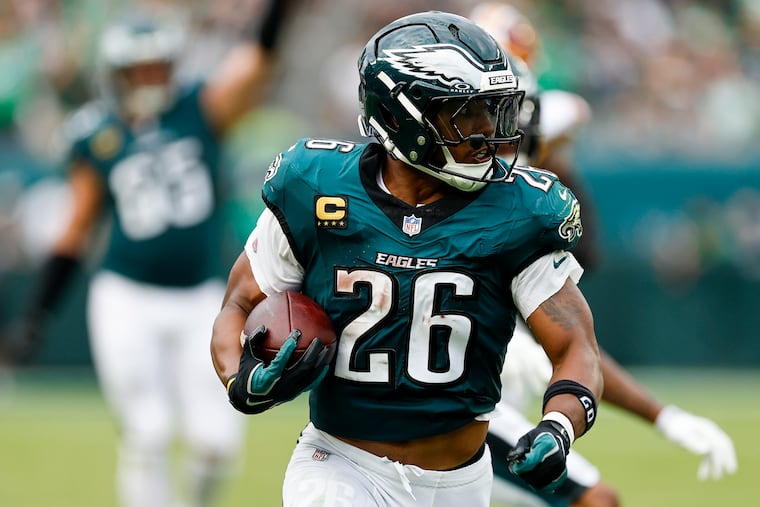
A.J. Brown’s pool of trade suitors is smaller after the Bills’ D.J. Moore move. The Eagles must demand a first-round pick for Brown.
There is a bare minimum return the Eagles need in order to justify the competitive hit they’d take without Brown in 2026. It is a return where only a team’s best available draft pick is good enough.
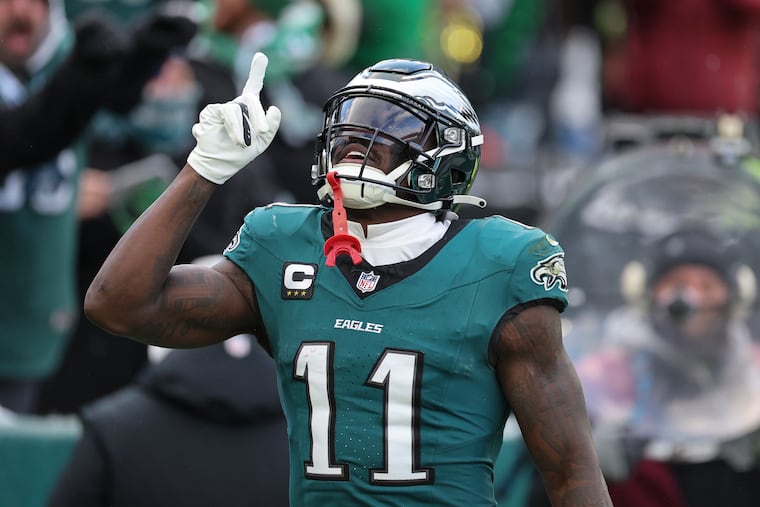
The biggest Eagles-related takeaway from the D.J. Moore trade?
A lot of NFL general managers are a lot less capable than Howie Roseman.
As for A.J. Brown, the impact of the Bills’ acquisition of Moore is being overstated.
Roseman may get the first-round pick he reportedly is seeking in exchange for Brown, but it’s no more likely now that the Bears have somehow managed to finagle a second-round pick out of the Bills for Moore. If anything, Roseman might deserve credit for driving up the price for Moore, who was the Bears’ fourth receiving option by the end of a season in which he caught just 50 passes for 682 yards. Buffalo had a clear need for a primary receiver. Dealing a second-round pick for Moore might sound more reasonable when your other option is trading a first- and second-round pick for Brown. What we know for sure is that the small pool of teams that made obvious sense as a trade partner for the Eagles just shrunk by one.
» READ MORE: Eagles free agency roundtable: Who are some realistic targets — and bigger targets — for the Birds?
Here’s what else we know:
The Trent McDuffie trade could be just as much of a harbinger in the opposite direction.
A two-time All-Pro at a premium position (cornerback) entering his age-26 season, McDuffie is headed to the Rams for the No. 29 pick in this year’s draft, a future third, and change. I don’t think it’s accurate to say that the McDuffie deal is an indication of the elite cornerback market, at least not relative to Brown. Keep in mind, the Colts traded away two first-round picks and Adonai Mitchell for Sauce Gardner at the deadline. One of those picks ended up at No. 16 this year. Who knows what next year’s will be. That’s the elite cornerback market.

David Murphy alerts
The McDuffie trade does give us a neat and tidy for-instance. Given the sacrifice the Chiefs just made at a more premium position, would they then be willing to turn around and trade the No. 29 pick they received for McDuffie to the Eagles for Brown? Maybe they would. Hey, maybe they will. They sure do need a wide receiver. That said, it seems far more likely that they are looking at that No. 29 pick the same way the Eagles would in justifying a trade of Brown: as a chance to add another five years of well-below-market-rate production in the form of a rookie.
The overall point is that you can talk yourself silly trying to project the market based on one deal. The Moore deal can just as easily be construed as the price a team is willing to pay to not pay the price the Eagles are asking for Brown.
The Eagles are justified in asking for a first- and second-rounder for Brown, assuming what they really expect is a first-rounder and an assortment of mid-to-late-round picks.
There are plenty of comps.
The Raiders acquired 29-year-old Davante Adams from the Packers for No. 22 overall and No. 53 overall in 2022.
The Bills acquired 26-year-old Stefon Diggs for No. 22 overall and change from the Vikings in 2020.
The Chiefs acquired No. 29 overall, No. 50 overall and change from the Dolphins for 28-year-old Tyreek Hill in 2022.
It’s easy to see the genesis of Roseman’s current reported asking price. It’s also easy to see why that asking price has drawn snickers.
Consider:
The first-round pick the Bills traded to the Vikings turned out to be Justin Jefferson.
The second-rounder that the Raiders traded to the Packers turned out to be Alec Pierce (after Green Bay traded the pick to draft Christian Watson). The first-rounder was Quay Walker, a four-year starter at linebacker.
The Chiefs used the No. 29 pick they landed for Hill to trade up to draft McDuffie at No. 21.
» READ MORE: Why Eagles should target Kenyon Sadiq, KC Concepcion, and Germie Bernard — even if it means trading A.J. Brown
On the other side of these deals were two of the worst organizations in the NFL (Dolphins, Raiders), and the team that just traded a second-round pick for Moore and has the second-most expensive wide receiver room in the NFL without a true WR1 to show for it.
There aren’t many other for-instances. The Texans traded away DeAndre Hopkins for No. 40 overall in 2020, but that deal included running back David Johnson in the return and was universally panned regardless. Last offseason, the Steelers traded away No. 52 overall for 27-year-old DK Metcalf, whose four-year averages were worse than Brown’s 2025.
There aren’t many teams that can give the Eagles what they need.
I use the word “need” for a reason. The Eagles need a first-round pick to justify trading Brown. The only way they might otherwise justify it is by landing a future first plus a 2026 second, i.e. the “Ravens Scenario.” We’ll get to that in a second. First, let’s explain what we mean when we say the Eagles “need” a first-rounder.
This is not abstract. Concretely, the Eagles need to be able to replace Brown. The best way to do it is via the draft, where there happens to be a number of players who could help them and who are projected to be within striking distance of No. 23. But the Eagles need plenty else besides a replacement for Brown. We saw that this year, when they had Brown. To justify trading Brown, they need to at least end up with a pick that maximizes their odds of replacing him (even if they end up “replacing” him with a star at another position). Bare minimum is a top-50ish pick. But only if they feel like they need to trade him for the best offer. Right now, their best leverage is their willingness to bring him back. Which is why they are making that willingness known.
Not many teams are in a position to give them what they need. Cross off the Bills. Presumably the Chiefs, unless Andy Reid and Brett Veach have radically changed the philosophy under which they traded away Hill to pave the way for McDuffie. Nobody is giving up a top-10 pick for Brown, so cross them off too.
The Dolphins (No. 11) are more likely to trade Jaylen Waddle for a Brown-type package than to trade for Brown. The Cowboys (No. 12) don’t need a wide receiver, nor do the Rams (No. 13), who just traded their expendable first-rounder to the Chiefs for McDuffie. The Bucs (No. 15) are brimming with wide receivers, including last year’s first-rounder Emeka Egbuka. The Lions (No. 17) have a lot of needs more pressing than the skill positions. Same goes for the Vikings (No. 18). The Panthers (No. 19) spent significant draft capital on Tetairoa McMillan last year. Brown doesn’t fit their timeline.
Next up is Dallas again at No. 20, then the Steelers, who just traded for Metcalf and like to build from within. The Chargers don’t have the luxury of trading No. 22 for Brown. Forget the Browns (No. 24). We’ve already covered the Bears (No. 25). Cross off the Texans (No. 28), who have Nico Collins and youth around him.
That leaves us with the Ravens at No. 14, the 49ers at No. 27, the Broncos at No. 30, the Patriots at No. 31, and the Seahawks at No. 32.
If the Eagles are reluctant to trade Brown to a fellow NFC contender, that would leave three teams: Ravens, Broncos, Patriots. Denver and New England would need to offer their first-rounder, because the next best 2026 picks are No. 62 and No. 63, which isn’t nearly good enough. The Ravens are in the opposite boat. Their No. 14 overall pick is too high. Their second-rounder (No. 45) is borderline, and would only make sense if coupled with a high future pick.
» READ MORE: Your Eagles guide to free agency, Part I: What changes and new faces are coming on offense?
The Eagles’ ability to land a first-rounder is contingent on the Ravens’ willingness to give up a future first or the Patriots/Broncos (or Seahawks/49ers) belief in the players who will be on the board at the end of this year’s first round.
None of that is impacted by the cost of trading for Moore. The Ravens and the Patriots are the two obvious teams, assuming we remove the Chiefs and the NFC contenders. The Ravens aren’t going to give up No. 14 for Brown, and No. 45 is only worth it for the Eagles if they have 45 players they love on their draft board. A future first from Baltimore would give them an opportunity to move up. The Pats’ first-rounder would work if coupled with a pick that also gives the Eagles ammo to move up from No. 23 or No. 31 to draft a guy they covet.
This is a pass-fail sort of thing. There is a bare minimum return the Eagles need in order to justify the competitive hit they’d take without Brown in 2026. It is a return where only a team’s best available draft pick is good enough. There are only a few teams that might consider it. That was the case before the Bills traded for Moore. It remains the case now.

The Eagles seem reluctant to address the handling of the Jalen Hurts blood clots saga, but the key questions involved in the story aren’t going anywhere. Throughout the week, in the absence of remarks from general manager Howie Roseman or team medical personnel, head coach Nick Sirianni was peppered by reporters. He’s offered few details in return. After speaking with high-ranking medical officials currently or previously employed by NFL teams, The Inquirer’s Jeff McLane frames four central issues that remain unanswered, while also looking at what this situation means for Hurts’ future in Philadelphia. Listen here.
Listen to all episodes here or wherever you get your podcasts.