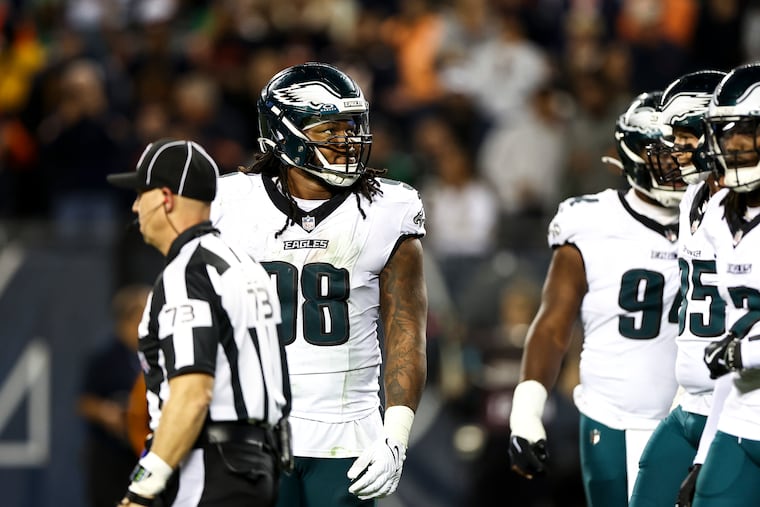
A.J. Brown left the Eagles because he wanted what was best for himself. You’d do the same thing.
The star receiver explicitly told the world that winning at the highest level wasn't enough for him. No one should be surprised that his personal quest has taken him out of Philly.
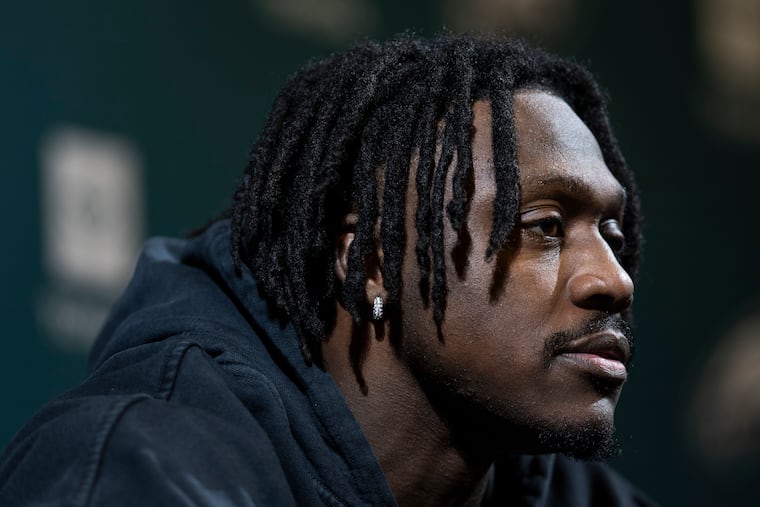
It was all right there for anyone who cared to see and read and understand. You can accuse A.J. Brown of a lot of things. You can accuse him of taking a few plays off last season out of longtime frustration and moments of immaturity. Of being passive-aggressive in public. Of failing to keep his true feelings about Jalen Hurts, the Eagles’ offense, and his role in it to himself. But you can’t accuse him of blindsiding anyone about his dissatisfaction here. About his desire to leave the Eagles and play for another NFL team, specifically the New England Patriots. About the complicated and contradictory feelings that sometimes exist within those who are striving for greatness and confident that it’s within their grasp.
There it all was, on Feb. 12, 2025, three days after Super Bowl LIX. Brown took to Instagram and laid bare everything that had been swirling in his heart and mind in the 72 hours following Eagles 40, Chiefs 22. This is what he wrote:
After a few days, I’ve had time to reflect on being a champion.
I’ve tried to feel how everyone made it seem to be a champion, and unfortunately it was short-lived … two days to be exact lol.
I’ve never been a champion at the highest level before, but I thought my hard work would be justified by winning it all. It wasn’t. My thrill for this game comes when I dominate. It’s the Hunt that does it for me. It’s when the DB drops his head and surrenders because he can’t F with me. The intense battles. Early mornings. Late nights. Sacrifices. I love putting smiles on people’s faces, don’t get me wrong, but it just wasn’t what I thought it would be. It’s the journey that I love the most. BACK 2 Work!
The low-hanging-fruit reaction to some of Brown’s actions over his last two seasons — and even to his post — has been to grab every handy cliche about his being just another typically selfish wide receiver who put his own desires and goals above the team’s. Those criticisms would have more merit if there was more than just scant evidence that Brown was a destructive force.

Mike Sielski alerts
Over Brown’s four seasons with them, the Eagles won one Super Bowl, played in another, won 73% of their regular-season and postseason games, and qualified for the playoffs every year. His per-17-games statistical averages were outstanding — 93 receptions, 1,380 yards, and nine touchdowns — and he caught three touchdowns in four Super Bowl or conference championship games. His behavior bothered his teammates so much that they voted him a captain three straight years.
If you’re comparing Brown’s tenure with the Eagles to that of Terrell Owens, you’ve conveniently forgotten what it looks like when a wide receiver publicly implies that the starting quarterback is an Uncle Tom, cleaves the locker room in two, and causes a Super Bowl contender to disintegrate into a 6-10 disaster.
Does that mean that Brown was right to lollygag on a couple of routes last season? No. It means, as the economist Thomas Sowell said, that there are no solutions, only tradeoffs. Brown was worth his. The notion that his social media posts and cryptic postgame answers to media members’ questions were so harmful to the Eagles’ culture and performance that they had to trade him is ridiculous. What’s more, that notion simply is false.
The Eagles traded Brown not because they didn’t want him to play here anymore, but because he didn’t want to play here anymore. It’s important, then, to understand why he was so discontented, and that Instagram post betrays a depth to Brown’s angst that suggests that, as long as he was with the Eagles, his feelings were never going to change.
The easiest and most reflexive complaints to levy against Brown are that he should have remembered there’s no I in team, that the Eagles’ success should have been enough to satiate him, and that he should have been content blocking on the outside and being grateful for whatever targets he got in an offense that, when it was at its best, ran the ball three out of every five plays.
These are the primary complaints, of course, among the most strident pro-Eagles partisans. All they want is the Eagles to win, and they don’t care how the Eagles win, and they presume that every Eagles player feels or should feel exactly the same way that they as fans do.
But Brown climbed that mountain, reveled in the glory of reaching the summit, and then found himself asking a timeless question: Is that all there is? As a receiver, he plays a more individually oriented position than, say, a left tackle or even a quarterback does, and because he does, he wanted something more. He wanted the same thing that Ted Williams wanted: When he walked down the street, he wanted people to whisper, There goes the best there ever was.
He wants to dust every cornerback and catch every pass thrown to him, and he wants to be in a place and in a system and under conditions where he has more freedom and opportunity for those experiences. The psychologist Mihaly Csikszentmihalyi called them “flow,” a state of total creativity, concentration, control, and pleasure, and Brown determined — not without good reason — that he wasn’t entering that state often enough with Hurts and wouldn’t in the future, no matter how good a play-caller Sean Mannion turned out to be.
It remains to be seen if he will with Drake Maye; based on Maye’s performance in the 2025 postseason, Brown’s search might be harder than he first thought. But at least he knows what he’s looking for. He appears to be seeking a kind of transcendent, subjective excellence that runs counter to the culture of football and to the general perception of professional athletes … but that aligns perfectly with the way many people measure their own happiness.
Someone asked me Tuesday if I thought Brown cared more about being a great receiver than about winning a Super Bowl. I would say yes, he does, insofar as I think that people can derive more satisfaction from their own labor and achievements than from a collective victory or accomplishment. That reality doesn’t mean that you’re not working toward your team’s success or that you’re not happy when it arrives. But we’re fooling ourselves if we believe that such success will be equally gratifying for everyone.
A.J. Brown is far from the only person who loves his or her work for its own sake, for the fulfillment and sense of identity that it provides. He just dared to tell everyone how he really felt.

It was a blowout, and it left a lot of questions. The Eagles’ 27-7 loss to the Bears Monday night at Soldier Field featured an offense that fizzled, a defense that folded, and a coaching staff that looked outmatched. The Philadelphia Inquirer’s Jeff McLane and Jeff Neiburg provide a postmortem of the defense’s disappointing start to the season, critique of offensive coordinator Sean Mannion’s approach, and assessment of how some of general manager Howie Roseman’s moves have panned out so far. Listen here.
Listen to all episodes here or wherever you get your podcasts.